Capone Valentina P, Morello William, Taroni Francesca, Montini Giovanni
Pediatric Nephrology, Dialysis and Transplant Unit, Department of Clinical Sciences and Community Health, University of Milan, Fondazione IRCCS Ca' Granda-Ospedale Maggiore Policlinico, 20122 Milano, Italy.
Int J Mol Sci. 2017 Apr 11;18(4):796. doi: 10.3390/ijms18040796.
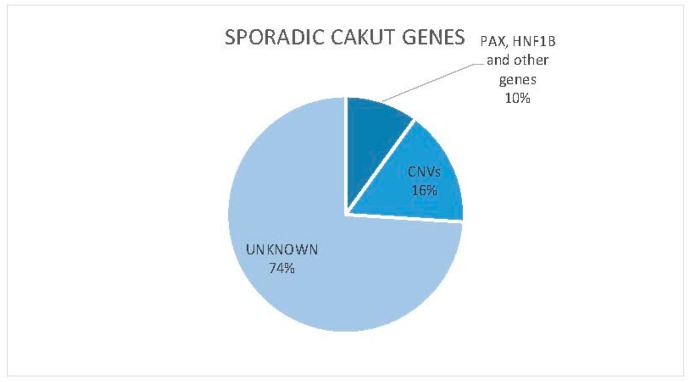
Congenital anomalies of the kidney and urinary tract (CAKUT) are the most frequent form of malformation at birth and represent the cause of 40-50% of pediatric and 7% of adult end-stage renal disease worldwide. The pathogenesis of CAKUT is based on the disturbance of normal nephrogenesis, secondary to environmental and genetic causes. Often CAKUT is the first clinical manifestation of a complex systemic disease, so an early molecular diagnosis can help the physician identify other subtle clinical manifestations, significantly affecting the management and prognosis of patients. The number of sporadic CAKUT cases explained by highly penetrant mutations in a single gene may have been overestimated over the years and a genetic diagnosis is missed in most cases, hence the importance of identifying new genetic approaches which can help unraveling the vast majority of unexplained CAKUT cases. The aim of our review is to clarify the current state of play and the future perspectives of the genetic bases of CAKUT.
先天性肾脏和尿路畸形(CAKUT)是出生时最常见的畸形形式,是全球40%-50%的儿童终末期肾病和7%的成人终末期肾病的病因。CAKUT的发病机制基于正常肾发生的紊乱,继发于环境和遗传因素。CAKUT通常是一种复杂全身性疾病的首发临床表现,因此早期分子诊断有助于医生识别其他细微的临床表现,显著影响患者的治疗和预后。多年来,由单个基因的高外显率突变解释的散发性CAKUT病例数量可能被高估了,大多数情况下会错过基因诊断,因此识别新的基因方法很重要,这有助于揭示绝大多数无法解释的CAKUT病例。我们综述的目的是阐明CAKUT遗传基础的现状和未来前景。