Lee En-Pei, Hsia Shao-Hsuan, Lin Jainn-Jim, Chan Oi-Wa, Lee Jung, Lin Chia-Ying, Wu Han-Ping
Division of Pediatric Critical Care Medicine, Department of Pediatrics, Chang Gung Memorial Hospital, Linko, Kweishan, Taoyuan, Taiwan; College of Medicine, Chang Gung University, Taoyuan, Taiwan.
College of Medicine, Chang Gung University, Taoyuan, Taiwan; Division of Pediatric General Medicine, Department of Pediatrics, Chang Gung Memorial Hospital, Linko, Kweishan, Taoyuan, Taiwan.
Biomed Res Int. 2017;2017:3613475. doi: 10.1155/2017/3613475. Epub 2017 Mar 16.
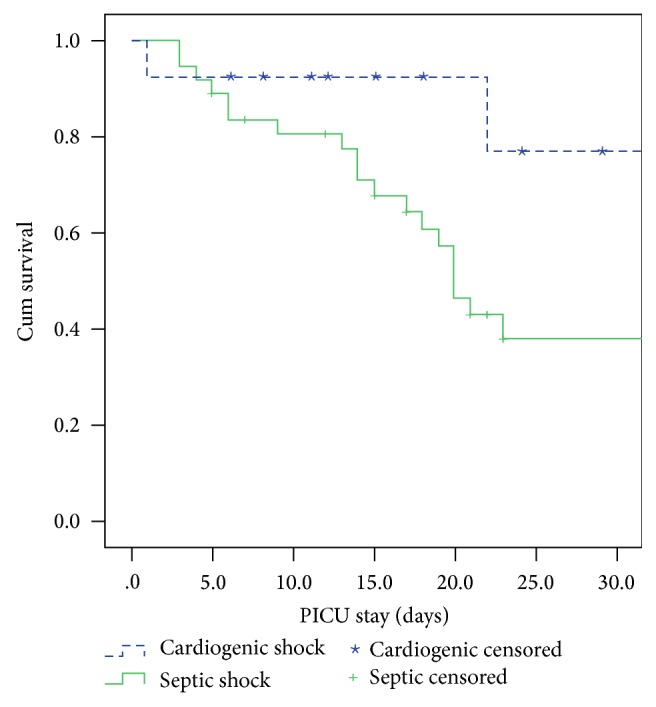
Septic shock and cardiogenic shock are the two most common types of shock in children admitted to pediatric intensive care units (PICUs). The aim of the study was to investigate which hemodynamic variables were associated with mortality in children with shock. We retrospectively analyzed 50 children with shock (37 septic shock cases and 13 cardiogenic shock cases) in the PICU and monitored their hemodynamics using transpulmonary thermodilution from 2003 to 2016. Clinical factors were analyzed between the patients with septic and cardiogenic shock. In addition, hemodynamic parameters associated with mortality were analyzed. The 28-day mortality was significantly higher in the septic group than in the cardiogenic group ( = 0.016). Initially, the parameters of cardiac output and cardiac contractility were higher in the septic group ( < 0.05) while the parameters of preload and afterload were all higher in the cardiogenic group ( < 0.05). Cardiac index was significantly lower in the nonsurvivors of cardiogenic shock at the time of initial admission and after the first 24 hours (both < 0.05), while systemic vascular resistance index (SVRI) was significantly lower in the nonsurvivors of septic shock ( < 0.001). Therefore, during the first 24 hours after intensive care, SVRI and cardiac index are the most important hemodynamic parameters associated with mortality.
脓毒性休克和心源性休克是入住儿科重症监护病房(PICUs)儿童中最常见的两种休克类型。本研究的目的是调查哪些血流动力学变量与休克儿童的死亡率相关。我们回顾性分析了2003年至2016年期间PICU中50例休克儿童(37例脓毒性休克病例和13例心源性休克病例),并使用经肺热稀释法监测其血流动力学。分析了脓毒性休克和心源性休克患者之间的临床因素。此外,还分析了与死亡率相关的血流动力学参数。脓毒症组的28天死亡率显著高于心源性休克组( = 0.016)。最初,脓毒症组的心输出量和心脏收缩性参数较高( < 0.05),而心源性休克组的前负荷和后负荷参数均较高( < 0.05)。心源性休克非存活者在初次入院时和最初24小时后的心脏指数均显著降低(均 < 0.05),而脓毒性休克非存活者的全身血管阻力指数(SVRI)显著降低( < 0.001)。因此,在重症监护后的最初24小时内,SVRI和心脏指数是与死亡率相关的最重要的血流动力学参数。