Kim Jee Yeon, Park In Ja, Kim Hyeong Ryul, Kim Dong Kwan, Lee Jong Lyul, Yoon Yong Sik, Kim Chan Wook, Lim Seok-Byung, Lee Jung Bok, Yu Chang Sik, Kim Jin Cheon
Department of Colon and Rectal Surgery, University of Ulsan College of Medicine and Asan Medical Center, Seoul, Korea.
Department of Thoracic and Cardiovascular Surgery, University of Ulsan College of Medicine and Asan Medical Center, Seoul, Korea.
Oncotarget. 2017 May 30;8(22):36566-36577. doi: 10.18632/oncotarget.16616.
We aimed to compare disease-free survival after pulmonary metastasectomy to that after hepatic metastasectomy, and to identify prognostic factors after pulmonary metastasectomy.
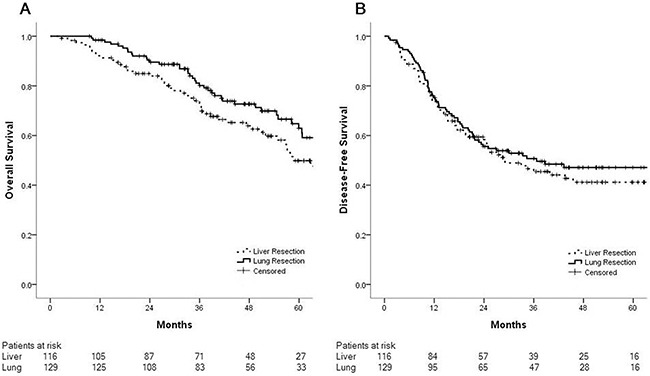
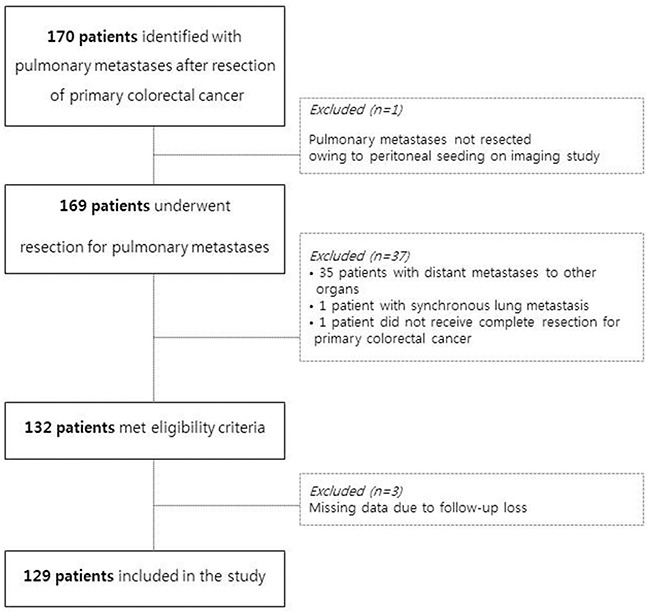
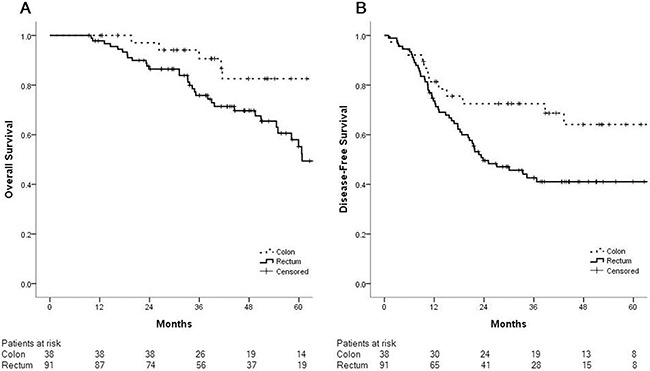
Between 2005 and 2015, 129 patients underwent resection of isolated metachronous lung metastases from colorectal cancer. Three-year DFS after pulmonary metastasectomy was similar to that after hepatic metastasectomy (50.7% vs. 45.5%, respectively; p=0.58). Rectal cancer (hazard ratio [HR]: 2.04, 95% confidence interval [CI]: 1.09-3.79; p=0.03) and ≥2 metastases (HR: 2.17, 95% CI: 1.28-3.68; p=0.004) were independent adverse risk factors associated with disease-free survival after pulmonary metastasectomy on multivariate analysis. Three-year DFS for colon vs. rectal cancer patients was 72.5% vs. 42.6%, respectively (p=0.04). The number of lung metastases was an independent risk factor for DFS after pulmonary metastasectomy in rectal cancer patients.
Patients who underwent lung metastasectomy after curative resection of colorectal cancers were investigated. Disease-free survival (DFS) after pulmonary metastasectomy was compared to that after hepatic metastasectomy, which has a relatively well-known prognosis. Multivariate Cox proportional hazards analysis was performed to identify clinical variables predictive of survival after pulmonary metastasectomy.
Disease-free survival rates after resection of lung vs. liver metastases arising from colorectal cancers are similar. However, lung metastases specifically from rectal cancers produce poorer DFS rates. Primary tumor location must be considered for pulmonary metastasis treatment and follow-up in colorectal cancer patients.
我们旨在比较肺转移瘤切除术后与肝转移瘤切除术后的无病生存期,并确定肺转移瘤切除术后的预后因素。
2005年至2015年间,129例患者接受了结直肠癌孤立性异时性肺转移瘤切除术。肺转移瘤切除术后的三年无病生存率与肝转移瘤切除术后相似(分别为50.7%和45.5%;p = 0.58)。直肠癌(风险比[HR]:2.04,95%置信区间[CI]:1.09 - 3.79;p = 0.03)和≥2处转移(HR:2.17,95% CI:1.28 - 3.68;p = 0.004)是多因素分析中与肺转移瘤切除术后无病生存期相关的独立不良风险因素。结肠癌与直肠癌患者的三年无病生存率分别为72.5%和42.6%(p = 0.04)。肺转移瘤数量是直肠癌患者肺转移瘤切除术后无病生存期的独立危险因素。
对结直肠癌根治性切除术后接受肺转移瘤切除术的患者进行研究。将肺转移瘤切除术后的无病生存期(DFS)与预后相对明确的肝转移瘤切除术后的无病生存期进行比较。进行多因素Cox比例风险分析以确定预测肺转移瘤切除术后生存的临床变量。
结直肠癌肺转移瘤与肝转移瘤切除术后的无病生存率相似。然而,特别是来自直肠癌的肺转移瘤产生的无病生存率较低。在结直肠癌患者的肺转移瘤治疗和随访中必须考虑原发肿瘤位置。