McDermott Molly E, DeGroote Lucas W
Powdermill Nature Reserve, Carnegie Museum of Natural History, Rector, Pennsylvania, United States of America.
PLoS One. 2017 Apr 12;12(4):e0174247. doi: 10.1371/journal.pone.0174247. eCollection 2017.
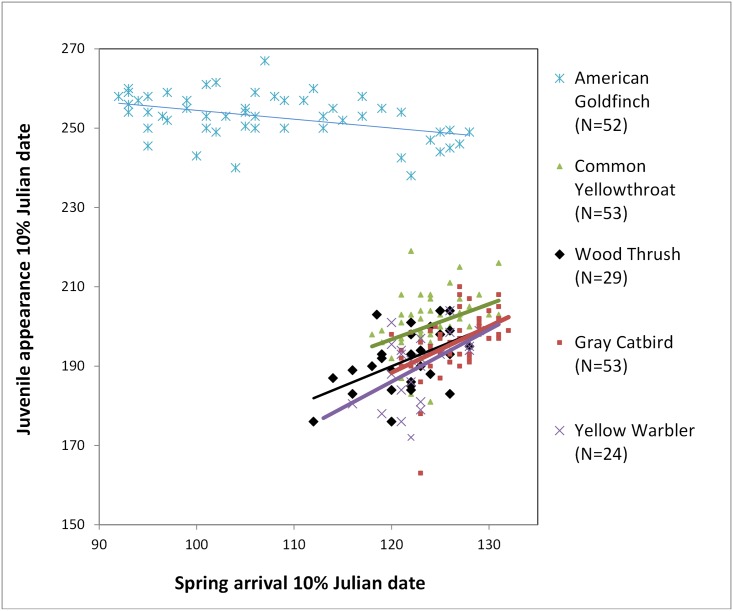
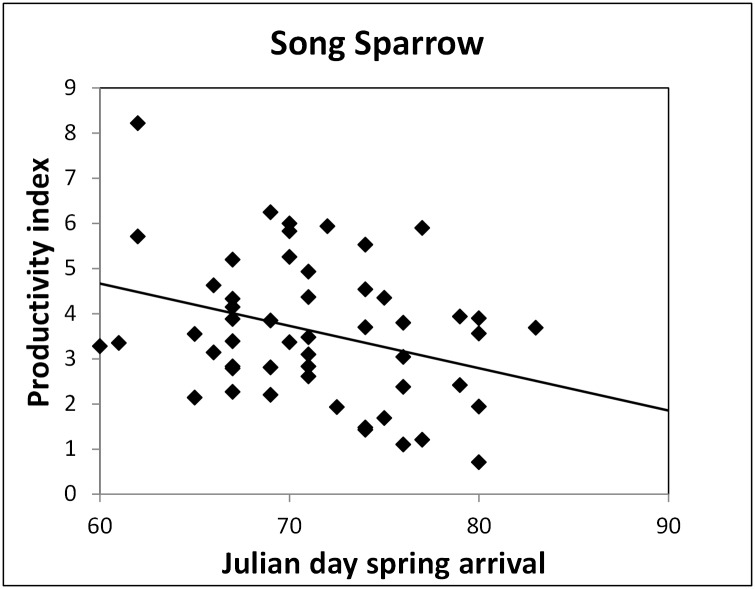
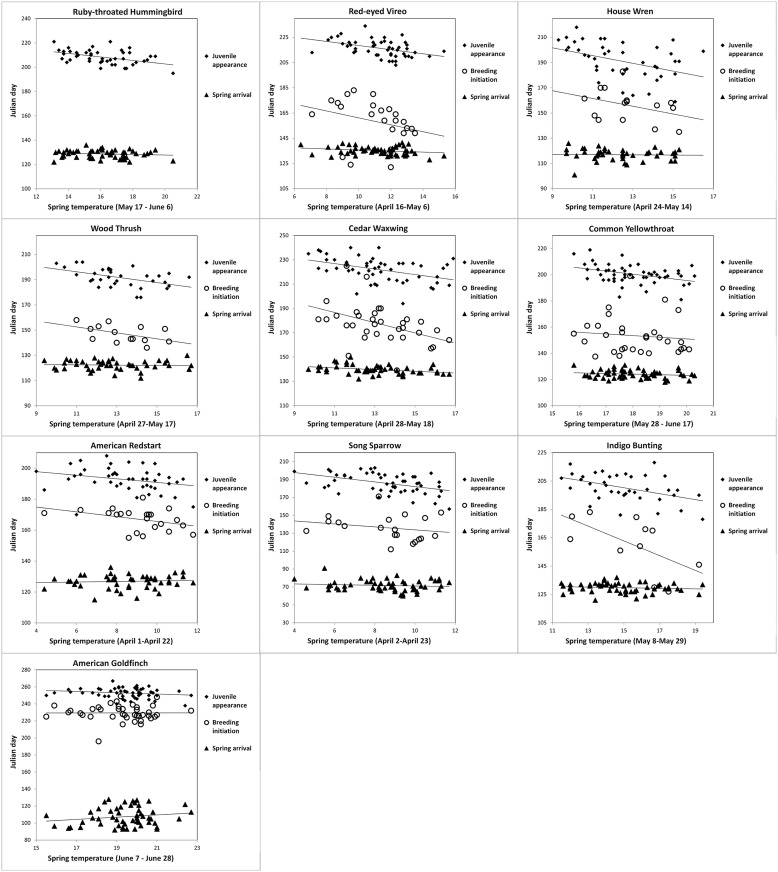
Advanced timing of both seasonal migration and reproduction in birds has been strongly associated with a warming climate for many bird species. Phenological responses to climate linking these stages may ultimately impact fitness. We analyzed five decades of banding data from 17 migratory bird species to investigate 1) how spring arrival related to timing of breeding, 2) if the interval between arrival and breeding has changed with increasing spring temperatures, and 3) whether arrival timing or breeding timing best predicted local productivity. Four of 17 species, all mid- to long-distance migrants, hatched young earlier in years when migrants arrived earlier to the breeding grounds (~1:1 day advancement). The interval between arrival on breeding grounds and appearance of juveniles shortened with warmer spring temperatures for 12 species (1-6 days for every 1°C increase) and over time for seven species (1-8 days per decade), suggesting that some migratory passerines adapt to climate change by laying more quickly after arrival or reducing the time from laying to fledging. We found more support for the former, that the rate of reproductive advancement was higher than that for arrival in warm years. Timing of spring arrival and breeding were both poor predictors of avian productivity for most migrants analyzed. Nevertheless, we found evidence that fitness benefits may occur from shifts to earlier spring arrival for the multi-brooded Song Sparrow. Our results uniquely demonstrate that co-occurring avian species are phenologically plastic in their response to climate change on their breeding grounds. If migrants continue to show a weaker response to temperatures during migration than breeding, and the window between arrival and optimal breeding shortens further, biological constraints to plasticity may limit the ability of species to adapt successfully to future warming.
对于许多鸟类物种而言,季节性迁徙和繁殖时间的提前与气候变暖密切相关。将这些阶段联系起来的对气候的物候响应可能最终影响适应性。我们分析了17种候鸟50年的环志数据,以研究:1)春季到达时间与繁殖时间的关系;2)随着春季气温升高,到达与繁殖之间的间隔是否发生了变化;3)到达时间或繁殖时间是否能最好地预测当地的繁殖率。17种鸟类中的4种,均为中长途迁徙鸟类,在候鸟更早到达繁殖地的年份中更早孵出幼鸟(提前约1:1天)。对于12种鸟类,随着春季气温升高,到达繁殖地与幼鸟出现之间的间隔缩短(每升高1°C缩短1 - 6天),并且在7种鸟类中随着时间推移缩短(每十年缩短1 - 8天),这表明一些迁徙雀形目鸟类通过到达后更快产卵或缩短从产卵到 fledging的时间来适应气候变化。我们发现更多证据支持前者,即在温暖年份繁殖提前的速度高于到达提前的速度。对于大多数分析的候鸟而言,春季到达时间和繁殖时间都不能很好地预测鸟类的繁殖率。然而,我们发现有证据表明,多窝产的歌雀提前春季到达可能会带来适应性益处。我们的结果独特地表明,同时出现的鸟类物种在其繁殖地对气候变化的物候响应具有可塑性。如果候鸟在迁徙期间对温度的响应继续比繁殖期间弱,并且到达与最佳繁殖之间的窗口进一步缩短,可塑性的生物学限制可能会限制物种成功适应未来变暖的能力。