Visser Bertanne, Willett Denis S, Harvey Jeffrey A, Alborn Hans T
Evolutionary Ecology and Genetics Group, Biodiversity Research Centre, Earth and Life Institute, Université Catholique de Louvain, Croix du Sud 4-5, 1348 Louvain-la-Neuve, Belgium; Institut de Recherche sur la Biologie de l'Insecte (IRBI), UMR 7261 CNRS/Université François-Rabelais de Tours, Avenue Monge, 37200 Tours, France.
Chemistry Research Unit, Center of Medical, Agricultural, and Veterinary Entomology, Agricultural Research Service , United States Department of Agriculture , 1600 SW 23rd Drive, Gainesville, FL 32608, USA.
R Soc Open Sci. 2017 Mar 22;4(3):160815. doi: 10.1098/rsos.160815. eCollection 2017 Mar.
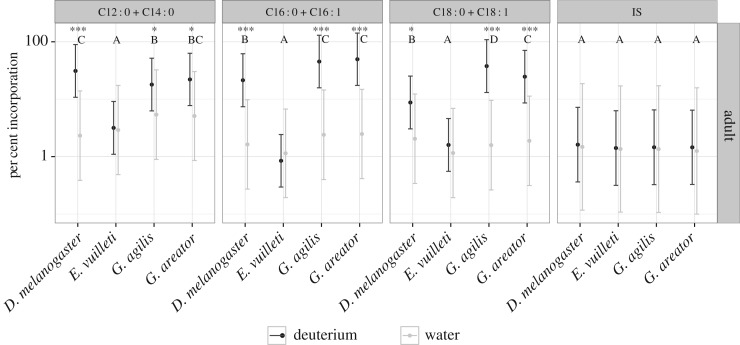
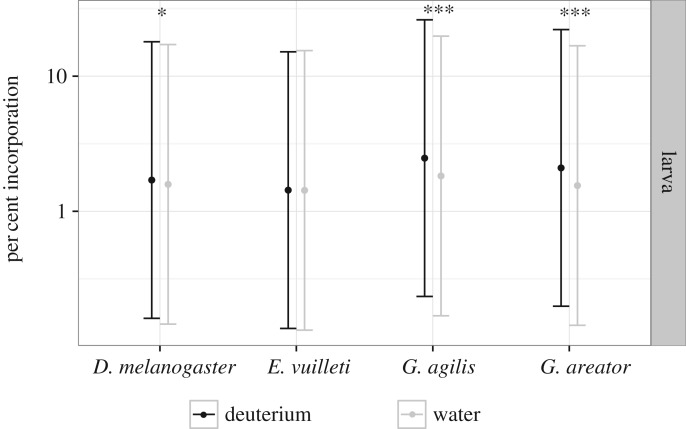
The ability to synthesize lipids is critical for an organism's fitness; hence, metabolic pathways, underlying lipid synthesis, tend to be highly conserved. Surprisingly, the majority of parasitoids deviate from this general metabolic model by lacking the ability to convert sugars and other carbohydrates into lipids. These insects spend the first part of their life feeding and developing in or on an arthropod host, during which they can carry over a substantial amount of lipid reserves. While many parasitoid species have been tested for lipogenic ability at the adult life stage, it has remained unclear whether parasitoid larvae can synthesize lipids. Here we investigate whether or not several insects can synthesize lipids during the larval stage using three ectoparasitic wasps (developing on the outside of the host) and the vinegar fly that differ in lipogenic ability in the adult life stage. Using feeding experiments and stable isotope tracing with gas chromatography/mass spectrometry, we first confirm lipogenic abilities in the adult life stage. Using topical application of stable isotopes in developing larvae, we then provide clear evidence of concurrence in lipogenic ability between larval and adult life stages in all species tested.
合成脂质的能力对生物体的健康至关重要;因此,脂质合成所涉及的代谢途径往往高度保守。令人惊讶的是,大多数寄生蜂偏离了这种一般的代谢模式,因为它们缺乏将糖类和其他碳水化合物转化为脂质的能力。这些昆虫在其生命的第一阶段在节肢动物宿主内或体表取食和发育,在此期间它们可以积累大量的脂质储备。虽然许多寄生蜂物种已在成虫阶段测试了其脂肪生成能力,但寄生蜂幼虫是否能合成脂质仍不清楚。在这里,我们使用三种体外寄生蜂(在宿主外部发育)和成年阶段脂肪生成能力不同的果蝇,研究几种昆虫在幼虫阶段是否能合成脂质。通过喂养实验和气相色谱/质谱联用的稳定同位素示踪法,我们首先证实了成虫阶段的脂肪生成能力。然后,通过在发育中的幼虫体表局部应用稳定同位素,我们为所有测试物种的幼虫阶段和成虫阶段脂肪生成能力的一致性提供了明确证据。