Capuano Cristina, Pighi Chiara, Molfetta Rosa, Paolini Rossella, Battella Simone, Palmieri Gabriella, Giannini Giuseppe, Belardinilli Francesca, Santoni Angela, Galandrini Ricciarda
Department of Experimental Medicine, Laboratorio Pasteur Italia Fondazione Cenci Bolognetti, Sapienza University , Rome, Italy.
Department of Molecular Medicine, Laboratorio Pasteur Italia Fondazione Cenci Bolognetti, Sapienza University , Rome, Italy.
Oncoimmunology. 2017 Feb 10;6(3):e1290037. doi: 10.1080/2162402X.2017.1290037. eCollection 2017.
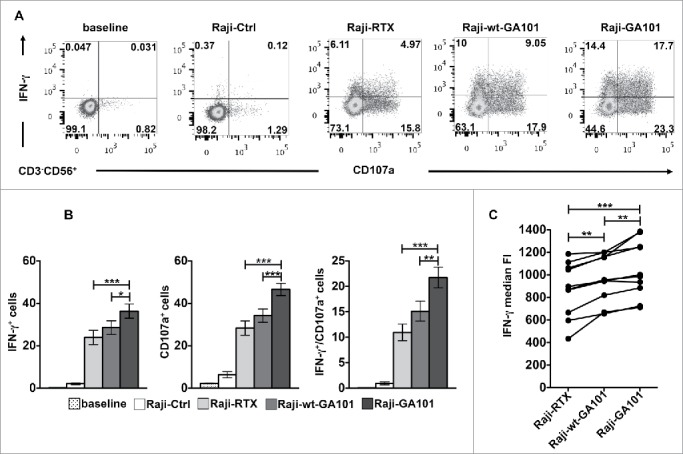
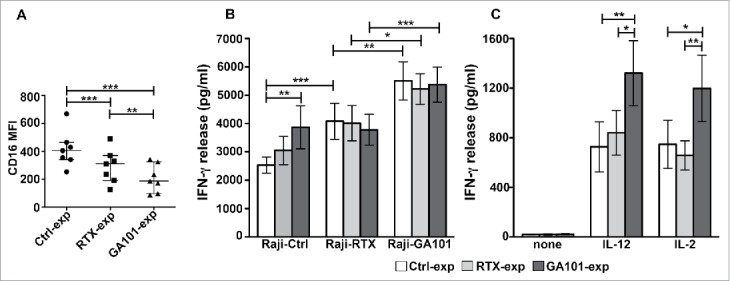
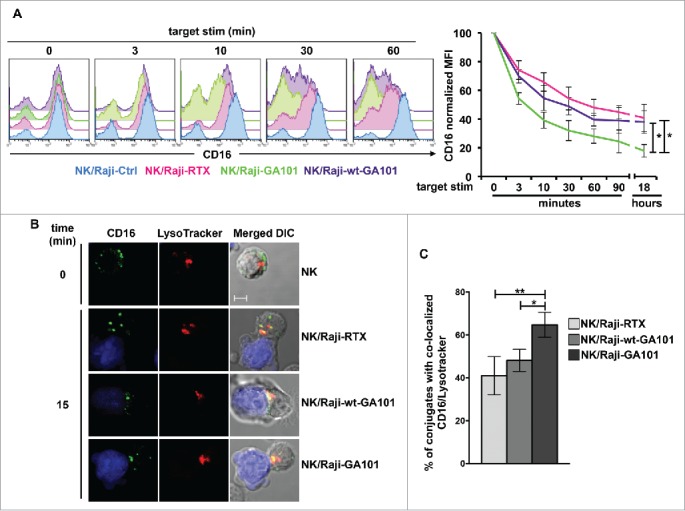
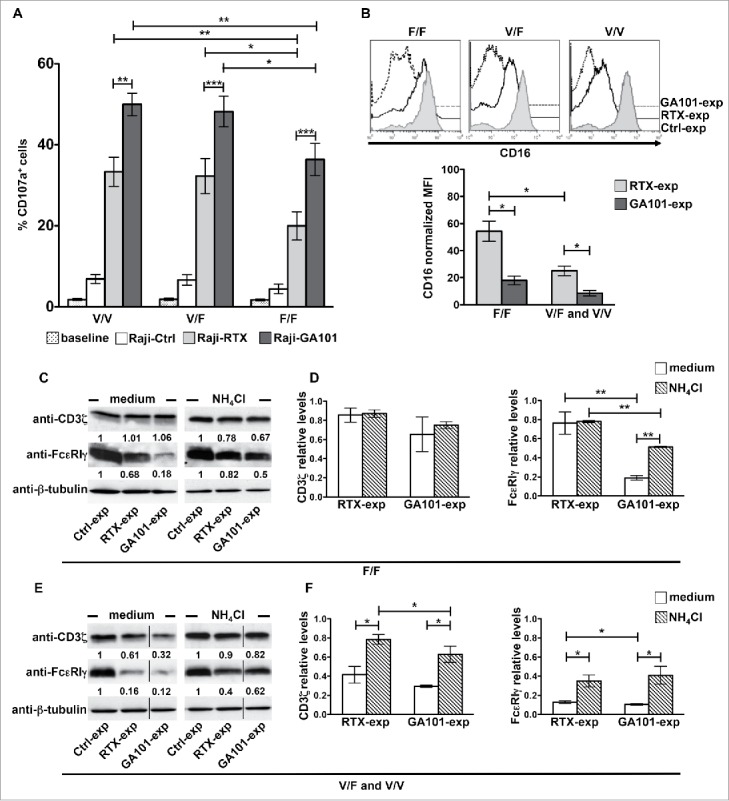
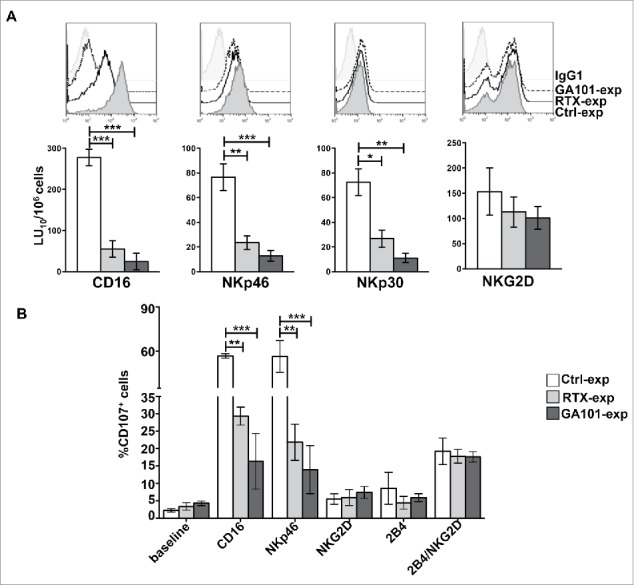
Natural killer (NK) cell-mediated antibody-dependent cellular cytotoxicity (ADCC), based on the recognition of IgG-opsonized targets by the low-affinity receptor for IgG FcγRIIIA/CD16, represents one of the main mechanisms by which therapeutic antibodies (mAbs) mediate their antitumor effects. Besides ADCC, CD16 ligation also results in cytokine production, in particular, NK-derived IFNγ is endowed with a well-recognized role in the shaping of adaptive immune responses. Obinutuzumab is a glycoengineered anti-CD20 mAb with a modified crystallizable fragment (Fc) domain designed to increase the affinity for CD16 and consequently the killing of mAb-opsonized targets. However, the impact of CD16 ligation in optimized affinity conditions on NK functional program is not completely understood. Herein, we demonstrate that the interaction of NK cells with obinutuzumab-opsonized cells results in enhanced IFNγ production as compared with parental non-glycoengineered mAb or the reference molecule rituximab. We observed that affinity ligation conditions strictly correlate with the ability to induce CD16 down-modulation and lysosomal targeting of receptor-associated signaling elements. Indeed, a preferential degradation of FcεRIγ chain and Syk kinase was observed upon obinutuzumab stimulation independently from CD16-V158F polymorphism. Although the downregulation of FcεRIγ/Syk module leads to the impairment of cytotoxic function induced by NKp46 and NKp30 receptors, obinutuzumab-experienced cells exhibit an increased ability to produce IFNγ in response to different stimuli. These data highlight a relationship between CD16 aggregation conditions and the ability to promote a degradative pathway of CD16-coupled signaling elements associated to the shift of NK functional program.
自然杀伤(NK)细胞介导的抗体依赖性细胞毒性(ADCC)基于低亲和力IgG FcγRIIIA/CD16对IgG调理的靶标的识别,是治疗性抗体(mAb)介导其抗肿瘤作用的主要机制之一。除ADCC外,CD16的结合还会导致细胞因子产生,特别是NK细胞衍生的IFNγ在适应性免疫反应的形成中具有公认的作用。奥滨尤妥珠单抗是一种糖基工程化抗CD20 mAb,其可结晶片段(Fc)结构域经过修饰,旨在增加对CD16的亲和力,从而增强对mAb调理靶标的杀伤作用。然而,在优化亲和力条件下CD16结合对NK功能程序的影响尚未完全明确。在此,我们证明,与亲本非糖基工程化mAb或参考分子利妥昔单抗相比,NK细胞与奥滨尤妥珠单抗调理的细胞相互作用会导致IFNγ产生增加。我们观察到亲和力结合条件与诱导CD16下调以及受体相关信号元件的溶酶体靶向能力密切相关。事实上,在奥滨尤妥珠单抗刺激下,观察到FcεRIγ链和Syk激酶优先降解,这与CD16-V158F多态性无关。尽管FcεRIγ/Syk模块的下调会导致NKp46和NKp30受体诱导的细胞毒性功能受损,但经历过奥滨尤妥珠单抗作用的细胞在对不同刺激的反应中表现出增强的IFNγ产生能力。这些数据突出了CD16聚集条件与促进与NK功能程序转变相关的CD16偶联信号元件降解途径能力之间的关系。