Social and Behavioral Sciences, Harvard T.H. Chan School of Public Health, Boston, MA, USA.
Department Behavioral and Social Sciences, Brown School of Public Health, Providence, RI, USA.
J Int AIDS Soc. 2017 Apr 6;20(1):21442. doi: 10.7448/IAS.20.01/21442.
Black men who have sex with men (MSM) continue to suffer a disproportionate burden of new HIV diagnoses and mortality. To better understand some of the reasons for these profound disparities, we examined whether the association between social trust and late HIV diagnosis and mortality differed by race/ethnicity, and investigated potential indirect effects of any observed differences.
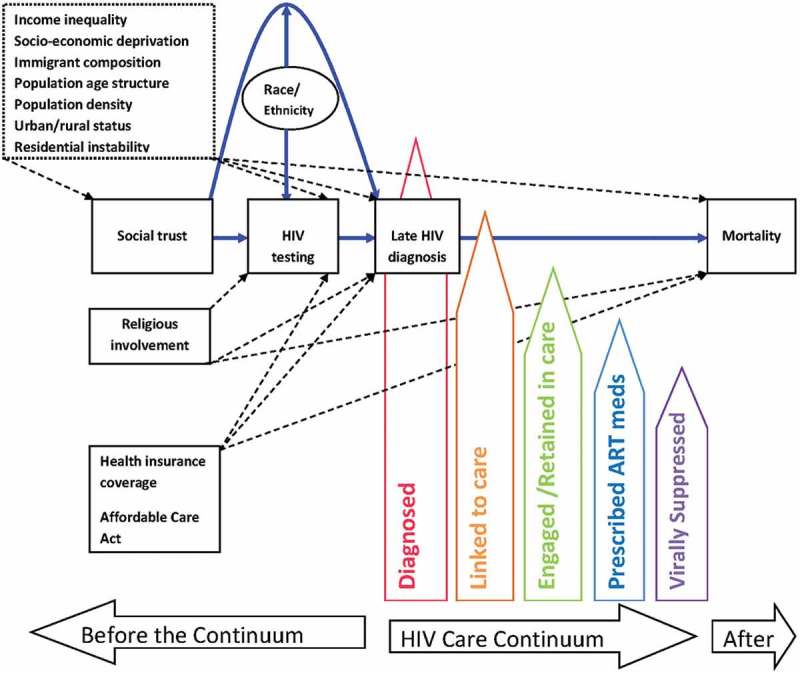
We performed generalized structural equation modelling to assess main and interaction associations between trust among one's neighbours in 2009 (i.e. social trust) and race/ethnicity (Black, White, and Hispanic) predicting late HIV diagnosis (a CD4 count ≤200 cell/µL within three months of a new HIV diagnosis) rates and all-cause mortality rates of persons ever diagnosed late with HIV, across 47 American states for the years 2009-2013. We examined potential indirect effects of state-level HIV testing between social trust and late HIV diagnosis. Social trust data were from the Gallup Healthways Survey, HIV data from the Centers for Disease Control and Prevention, and HIV testing from the Behavioral Risk Factor Surveillance System. Covariates included state-level structural, healthcare, and socio-demographic factors including income inequality, healthcare access, and population density. We stratified analysis by transmission group (male-to-male, heterosexual, and injection drug use (IDU)).
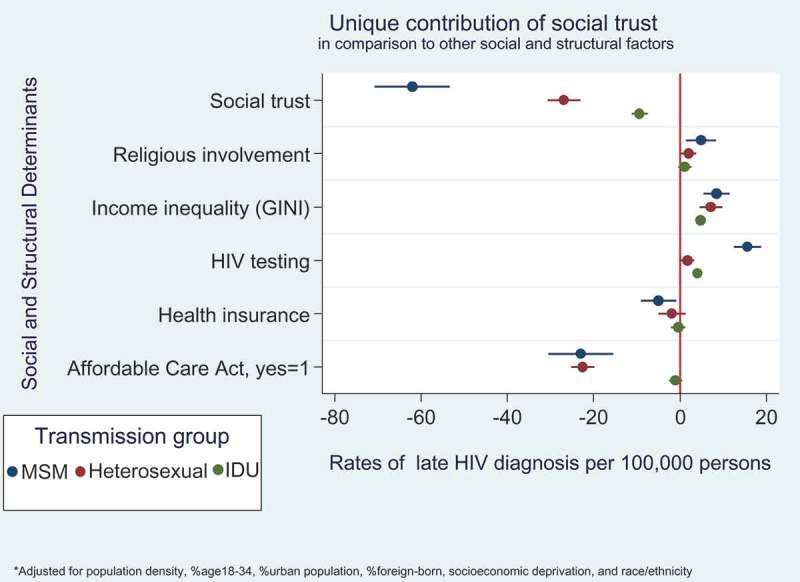
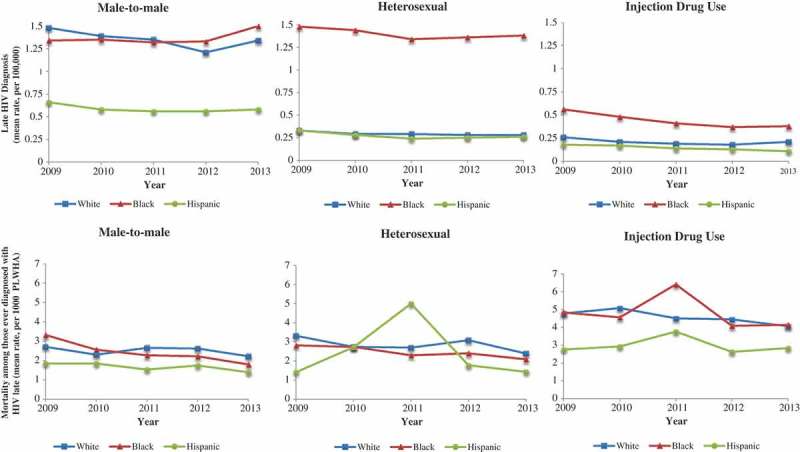
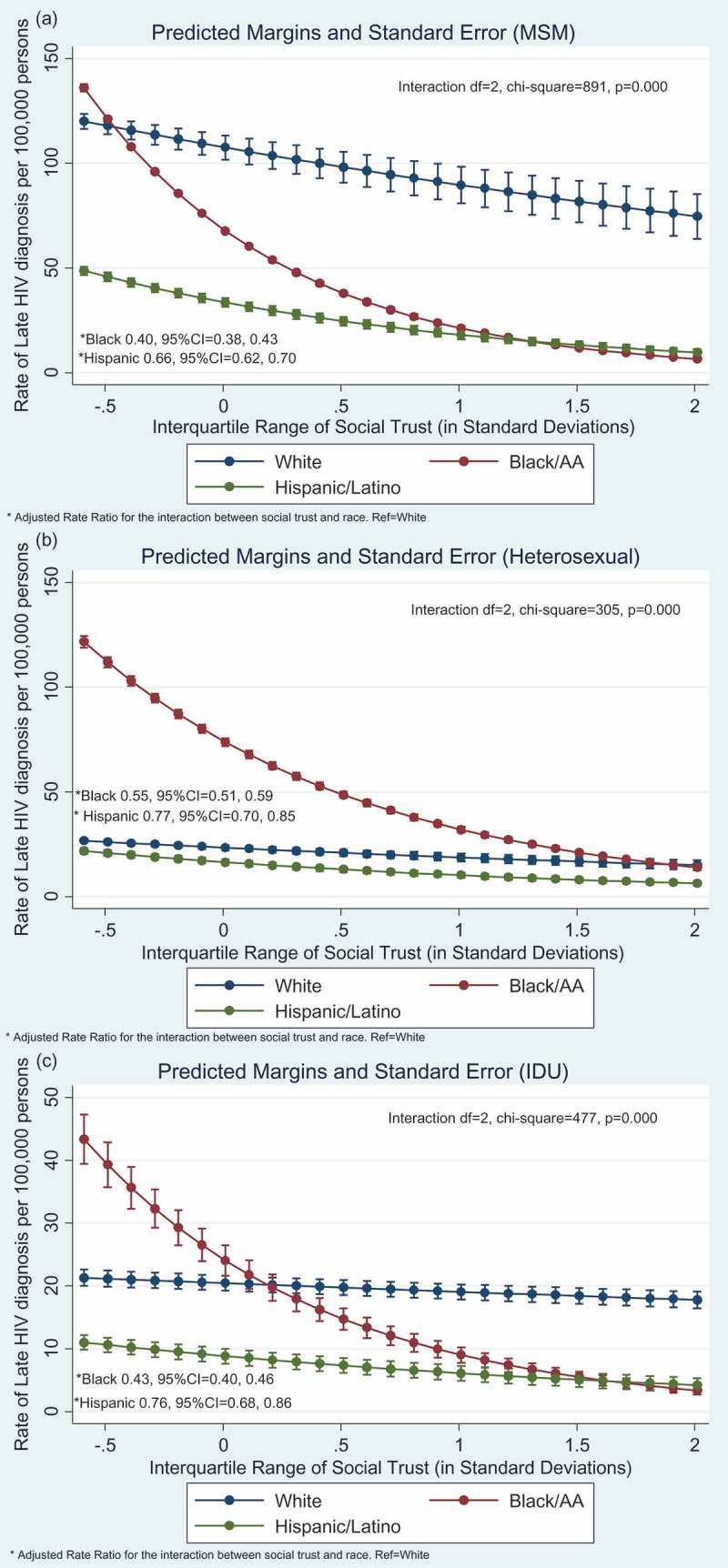
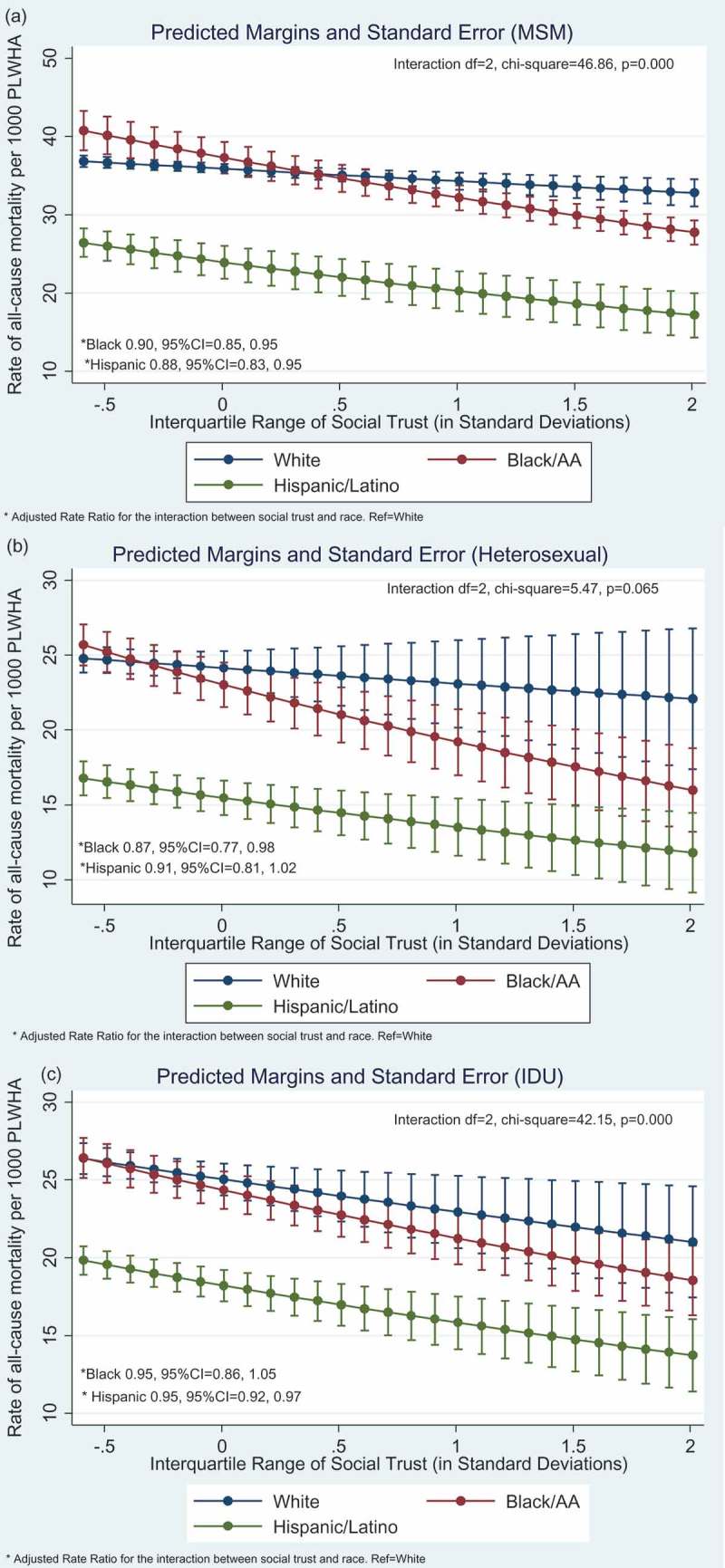
States with higher levels of social trust had lower late HIV diagnosis rates: Adjusted Rate Ratio [aRR] were consistent across risk groups (0.57; 95%CI 0.53-0.62, male-to-male), (aRR 0.58; 95%CI 0.54-0.62, heterosexual) and (aRR 0.64; 95%CI 0.60-0.69, IDU). Those associations differed by race/ethnicity (all p < 0.001). The associations were most protective for Blacks followed by Hispanics, and least protective for Whites. HIV testing mediated between 18 and 32% of the association between social trust and late HIV diagnosis across transmission group but for Blacks relative to Whites only. Social trust was associated with lower all-cause mortality rates and that association varied by race/ethnicity within the male-to-male and IDU transmission groups only.
Social trust may promote timely HIV testing, which can facilitate earlier HIV diagnosis, thus it can be a useful determinant to monitor the relationship with HIV care continuum outcomes especially for racial/ethnic minority groups disproportionately infected by HIV.
男男性行为者(MSM)中的黑人继续承受着不成比例的新 HIV 诊断和死亡率。为了更好地了解造成这些巨大差异的部分原因,我们研究了社会信任与 HIV 诊断和死亡率之间的关联是否因种族/民族而有所不同,并调查了观察到的差异可能存在的间接影响。
我们使用广义结构方程模型评估了 2009 年邻里之间信任(即社会信任)与种族/民族(黑人、白人和西班牙裔)之间的主要和交互关联,预测了 47 个美国州在 2009-2013 年间具有晚期 HIV 诊断(新 HIV 诊断后三个月内 CD4 计数≤200 个/μL)的 HIV 诊断率和所有原因死亡率。我们研究了州级 HIV 检测在社会信任与晚期 HIV 诊断之间的潜在间接影响。社会信任数据来自盖洛普健康之路调查,HIV 数据来自疾病控制和预防中心,HIV 检测数据来自行为风险因素监测系统。协变量包括州级结构、医疗保健和社会人口统计学因素,包括收入不平等、医疗保健获取和人口密度。我们按传播组(男男性行为、异性恋和注射吸毒)进行分层分析。
社会信任水平较高的州具有较低的晚期 HIV 诊断率:调整后的比率(aRR)在所有风险组中均一致(0.57;95%CI 0.53-0.62,男男性行为),(aRR 0.58;95%CI 0.54-0.62,异性恋)和(aRR 0.64;95%CI 0.60-0.69,注射吸毒)。这些关联因种族/民族而异(均 p<0.001)。关联对黑人最具保护作用,其次是西班牙裔,对白人的保护作用最小。HIV 检测在社会信任与晚期 HIV 诊断之间的关联中起中介作用,占传播组的 18-32%,但仅在黑人和白人之间存在关联。社会信任与较低的全因死亡率相关,这种关联仅在男男性行为和 IDU 传播组内因种族/民族而异。
社会信任可能会促进及时的 HIV 检测,这有助于更早地进行 HIV 诊断,因此,它可以作为监测与 HIV 护理连续体结果关系的有用指标,尤其是对感染 HIV 的比例不成比例的少数族裔群体。