Department of Behavioral Health Science and Health Education, College for Public Health and Social Justice, Saint Louis University, St. Louis, Missouri, USA; email:
Governance Studies, The Brookings Institution, Washington, DC.
Annu Rev Public Health. 2022 Apr 5;43:173-191. doi: 10.1146/annurev-publhealth-052020-112623. Epub 2022 Jan 6.
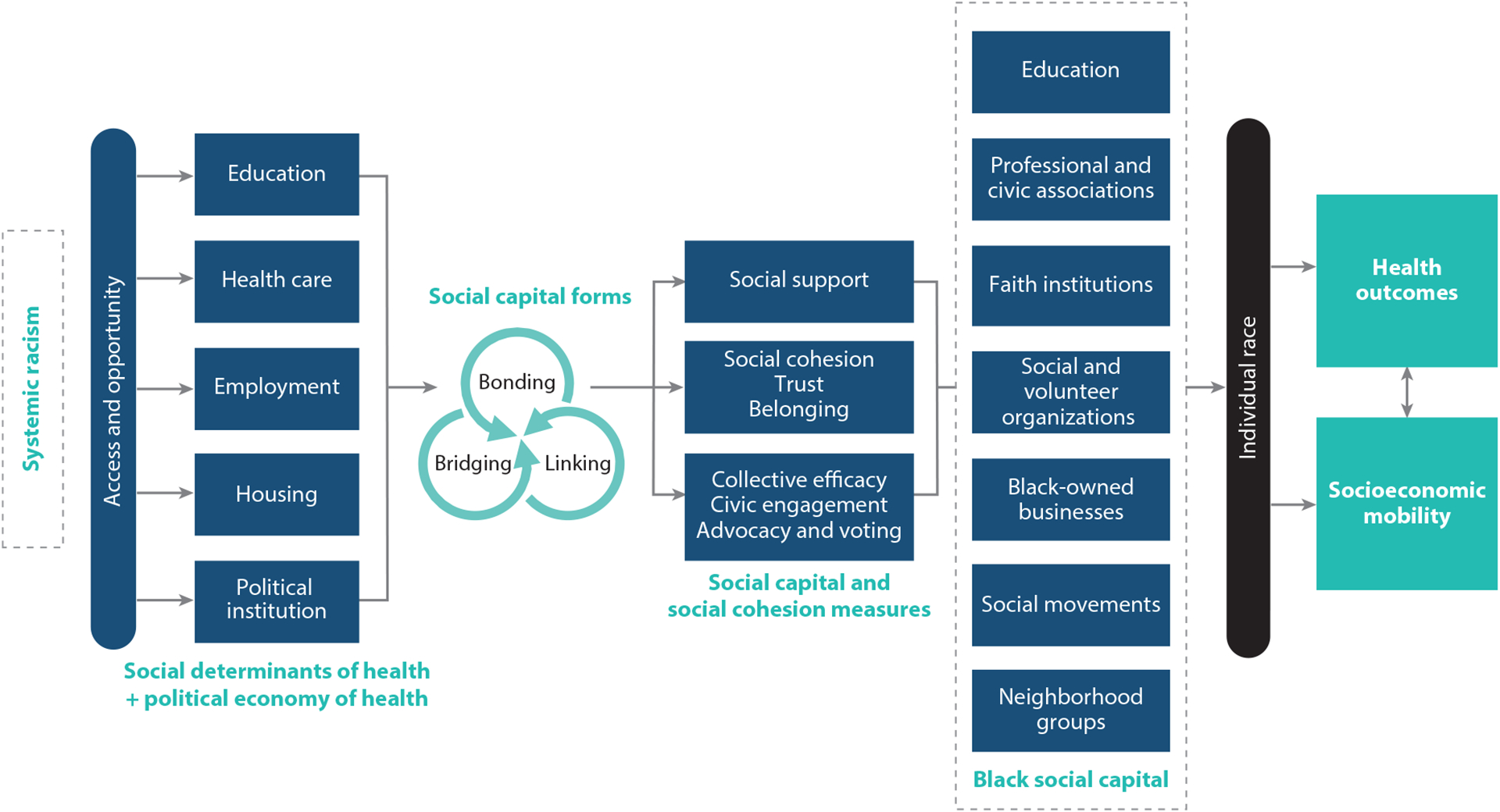
This review aims to delineate the role of structural racism in the formation and accumulation of social capital and to describe how social capital is leveraged and used differently between Black and White people as a response to the conditions created by structural racism. We draw on critical race theory in public health praxis and restorative justice concepts to reimagine a race-conscious social capital agenda. We document how American capitalism has injured Black people and Black communities' unique construction of forms of social capital to combat systemic oppression. The article proposes an agenda that includes communal restoration that recognizes forms of social capital appreciated and deployed by Black people in the United States that can advance health equity and eliminate health disparities. Developing a race-conscious social capital framing that is inclusive of and guided by Black community members and academics is critical to the implementation of solutions that achieve racial and health equity and socioeconomic mobility.
这篇综述旨在阐明结构性种族主义在社会资本的形成和积累中的作用,并描述在结构性种族主义所造成的条件下,黑人和白人如何利用和使用社会资本的方式存在差异。我们借鉴了公共卫生实践中的批判种族理论和恢复性司法概念,重新构想了一个具有种族意识的社会资本议程。我们记录了美国资本主义是如何伤害黑人和黑人社区独特构建的社会资本形式,以对抗系统性压迫的。本文提出了一个议程,包括社区恢复,承认和利用美国黑人所赞赏和运用的社会资本形式,以促进健康公平,消除健康差距。制定一个具有种族意识的社会资本框架,包容并由黑人社区成员和学者指导,对于实施实现种族和健康公平以及社会经济流动的解决方案至关重要。