Saraç Sema, Afşar Gülgün Çetintaş, Oruç Özlem, Topçuoğlu Özgür Bilgin, Saltürk Cüneyt, Peker Yüksel
Department of Pulmonary Medicine, Istanbul Sureyyapasa Chest Diseases and Chest Surgery Hospital, Istanbul, Turkey.
Department of Neurology, Istanbul Sureyyapasa Chest Diseases and Chest Surgery Hospital, Istanbul, Turkey.
Med Sci Monit. 2017 Apr 13;23:1792-1799. doi: 10.12659/msm.902075.
BACKGROUND We addressed the impact of patient education followed by frequent visits on compliance with positive airway pressure (PAP) treatment in patients with obstructive sleep apnea (OSA) in a Turkish sleep clinic cohort. MATERIAL AND METHODS This single-center, randomized, controlled study was conducted in Istanbul, Turkey between June 2014 and April 2015. Among 115 eligible OSA patients (mean age 51.0±9.3 years; 75.5% men), 63 were randomized to standard support (SS) group (general information about OSA and PAP treatment at baseline), and 52 to educational support (ES) group (additional polysomnography chart viewing from both diagnostic and titration nights). All patients were scheduled to five PAP control visits between two weeks and six months after the PAP prescription. Primary outcome was the PAP compliance (4 hours/night for 70% of all the nights) at the last visit. RESULTS Average PAP usage was 4.2±2.5 hours/night in the SS group, and 5.2±2.1 hours/night in the ES group (p=0.027). PAP compliance was achieved among 68.3% in the SS group, and 86.5% in the ES group (p=0.021). In a multivariate analysis, ES strategy followed by frequent visits predicted PAP compliance (odds ratio [OR] 3.6, 95% confidence interval [CI] 1.2-10.6; p=0.020). Other predictors were obesity (OR 3.4, 95% CI 1.2-9.7; p=0.019) and severe OSA (apnea-hypopnea index ≥30/hour) at baseline (OR 4.7, 95% CI 1.2-17.6; p=0.023). Primary school education level was inversely related with PAP compliance (OR 0.3, 95% CI 0.1-0.9; p=0.036). CONCLUSIONS Patient education with polysomnography chart view followed by frequent visits increased long-term compliance with PAP treatment.
我们探讨了在土耳其一家睡眠诊所队列中,患者教育及随后的频繁复诊对阻塞性睡眠呼吸暂停(OSA)患者持续气道正压通气(PAP)治疗依从性的影响。
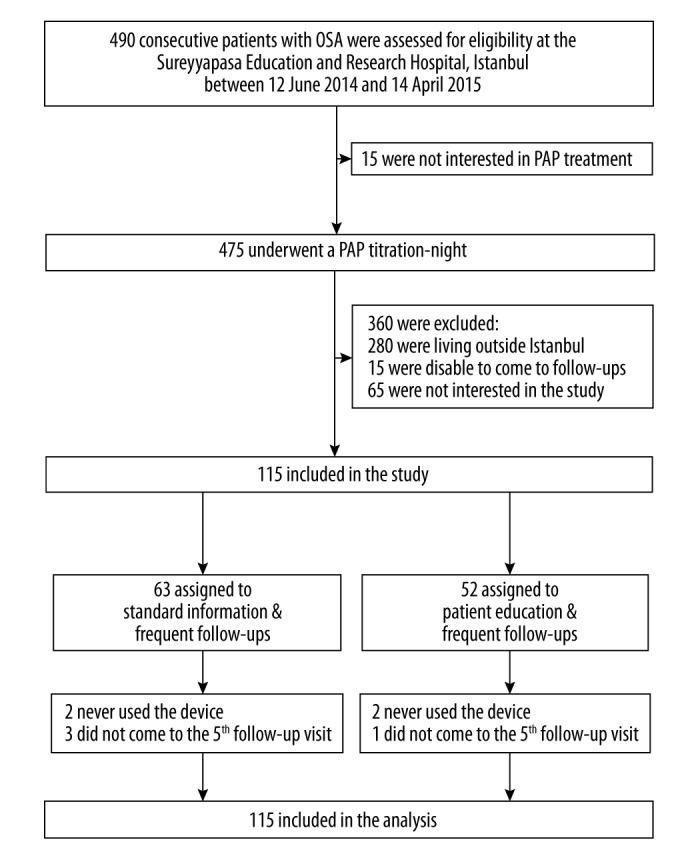
这项单中心、随机、对照研究于2014年6月至2015年4月在土耳其伊斯坦布尔进行。在115名符合条件的OSA患者(平均年龄51.0±9.3岁;75.5%为男性)中,63名被随机分配至标准支持(SS)组(在基线时提供有关OSA和PAP治疗的一般信息),52名被分配至教育支持(ES)组(额外提供诊断和滴定夜间的多导睡眠图图表查看)。所有患者在PAP处方开具后的两周至六个月内安排了五次PAP控制复诊。主要结局是最后一次复诊时的PAP依从性(所有夜晚的70%达到每晚4小时)。
SS组的平均PAP使用时间为4.2±2.5小时/晚,ES组为5.2±2.1小时/晚(p=0.027)。SS组的PAP依从率为68.3%,ES组为86.5%(p=0.021)。在多变量分析中,ES策略及随后的频繁复诊可预测PAP依从性(优势比[OR]3.6,95%置信区间[CI]1.2-10.6;p=0.020)。其他预测因素包括肥胖(OR 3.4,95%CI 1.2-9.7;p=0.019)和基线时的重度OSA(呼吸暂停低通气指数≥30/小时)(OR 4.7,95%CI 1.2-17.6;p=0.023)。小学教育水平与PAP依从性呈负相关(OR 0.3,95%CI 0.1-0.9;p=0.036)。
通过查看多导睡眠图图表进行患者教育并随后频繁复诊可提高PAP治疗的长期依从性。