Bhavsar Amit P, Gunaretnam Erandika P, Li Yuling, Hasbullah Jafar S, Carleton Bruce C, Ross Colin J D
Faculty of Pharmaceutical Sciences, The University of British Columbia, Vancouver, British Columbia, Canada.
BC Children's Hospital Research Institute, Vancouver, British Columbia, Canada.
PLoS One. 2017 Apr 13;12(4):e0175711. doi: 10.1371/journal.pone.0175711. eCollection 2017.
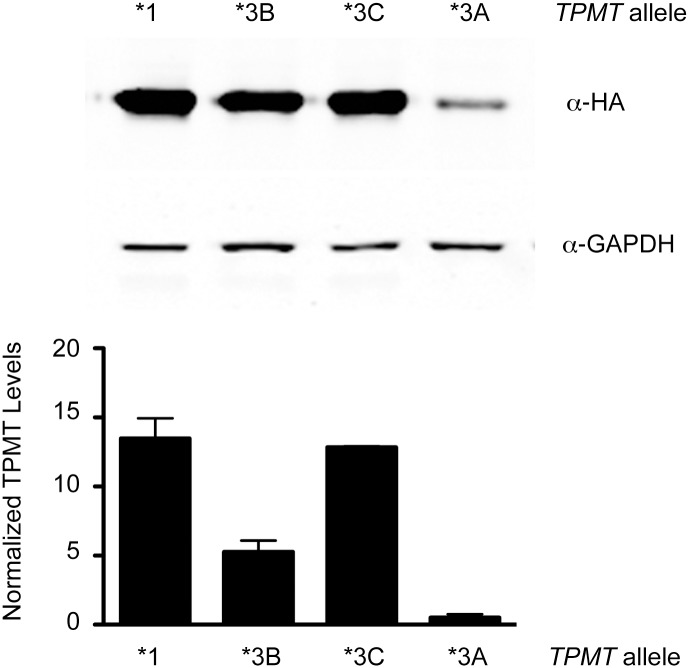
Cisplatin is a highly-effective and widely-used chemotherapeutic agent that causes ototoxicity in many patients. Pharmacogenomic studies of key genes controlling drug biotransformation identified variants in thiopurine methyltransferase (TPMT) as predictors of cisplatin-induced ototoxicity, although the mechanistic basis of this interaction has not been reported. Expression constructs of TPMT3A, 3B and 3C variants were generated and monitored in cultured cells. Cellular TPMT3A levels were detected at >20-fold lower amounts than the wild type confirming the unstable nature of this variant. The expression of wild type TPMT (TPMT1) in two murine ear cell lines, HEI-OC1 and UB/OC-1, significantly mitigated their susceptibility to cisplatin toxicity. Cisplatin treatment induced Tlr4 gene expression in HEI-OC1 cells and this response was blunted by the expression of wild type TPMT but not TPMT3A. In line with the significant mitigation of TPMT*1-expressing cells to cisplatin cytotoxicity, these findings demonstrate a drug-gene interaction between increased TPMT activity and decreased susceptibility to cisplatin-induced toxicity of inner ear cells.
顺铂是一种高效且广泛使用的化疗药物,会导致许多患者出现耳毒性。对控制药物生物转化的关键基因进行的药物基因组学研究确定,硫嘌呤甲基转移酶(TPMT)的变体可作为顺铂诱导耳毒性的预测指标,尽管这种相互作用的机制基础尚未见报道。构建了TPMT3A、3B和3C变体的表达载体,并在培养细胞中进行监测。检测到细胞中TPMT3A的水平比野生型低20倍以上,证实了该变体的不稳定性质。野生型TPMT(TPMT1)在两种小鼠耳细胞系HEI-OC1和UB/OC-1中的表达,显著降低了它们对顺铂毒性的敏感性。顺铂处理可诱导HEI-OC1细胞中Tlr4基因表达,而野生型TPMT的表达可减弱这种反应,但TPMT3A则不能。与表达TPMT*1的细胞对顺铂细胞毒性的显著减轻一致,这些发现表明TPMT活性增加与内耳细胞对顺铂诱导毒性的敏感性降低之间存在药物-基因相互作用。