Channanath Arshad M, Elkum Naser, Al-Abdulrazzaq Dalia, Tuomilehto Jaakko, Shaltout Azza, Thanaraj Thangavel Alphonse
Dasman Diabetes Institute, Dasman, Kuwait.
Department of Pediatrics, Faculty of Medicine, Kuwait University, Safat, Kuwait.
PLoS One. 2017 Apr 13;12(4):e0175728. doi: 10.1371/journal.pone.0175728. eCollection 2017.
The "accelerator hypothesis" predicts early onset of Type 1 diabetes (T1D) in heavier children. Studies testing direction of correlation between body mass index (BMI) and age at onset of T1D in different continental populations have reported differing results-inverse, direct, and neutral. Evaluating the correlation in diverse ethnic populations is required to generalize the accelerator hypothesis.
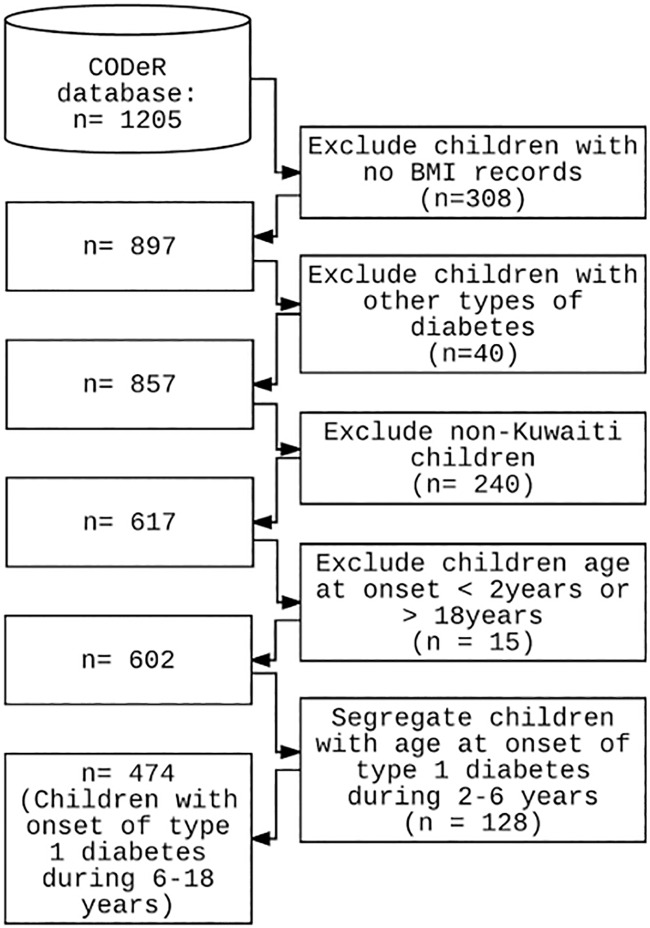
The study cohort comprised 474 Kuwaiti children of Arab ethnicity diagnosed with T1D at age 6 to 18 years during 2011-2013. Age- and sex-adjusted BMI z-scores were calculated by comparing the BMI measured at diagnosis with Kuwaiti pediatric population reference data recorded during comparable time-period. Multiple linear regression and Pearson correlation analyses were performed.
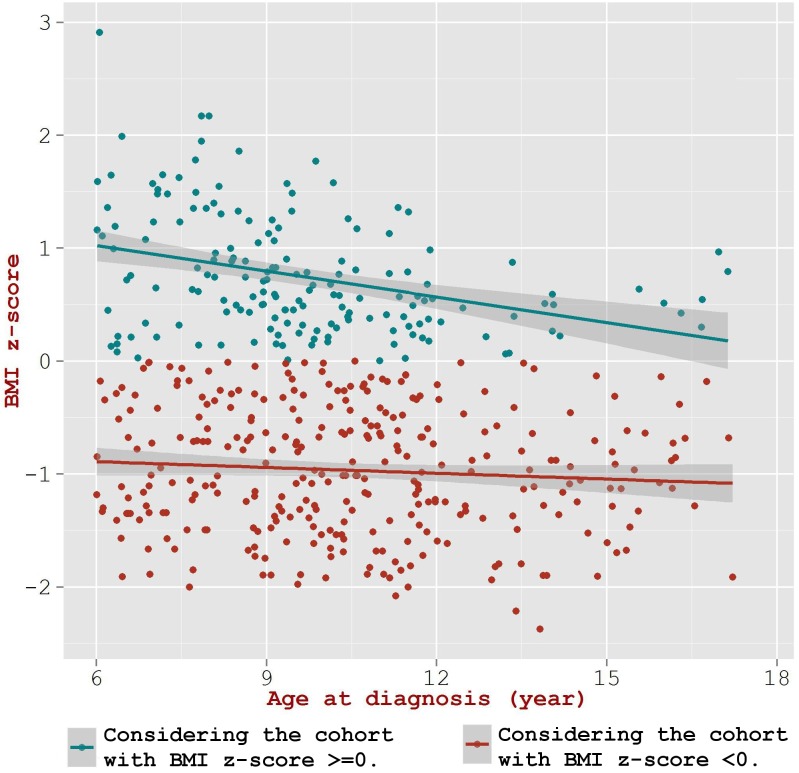
BMI z-score was seen inversely associated with onset age (r,-0.28; p-value<0.001). Children with BMI z-score>0 (i.e. BMI >national average) showed a stronger correlation (r,-0.38; p-value<0.001) than those with BMI z-score<0 (r,-0.19; p-value<0.001); the former group showed significantly lower mean onset age than the latter group (9.6±2.4 versus 10.5±2.7; p-value<0.001). Observed inverse correlation was consistent with that seen in Anglo-saxon, central european, caucasian, and white children while inconsistent with that seen in Indian, New Zealander, and Australian children.
The accelerator hypothesis generalizes in Arab pediatric population from Kuwait.
“加速假说”预测较重儿童1型糖尿病(T1D)发病较早。在不同大陆人群中测试体重指数(BMI)与T1D发病年龄之间相关性方向的研究报告了不同结果——负相关、正相关和无相关性。需要评估不同种族人群中的相关性,以推广加速假说。
研究队列包括2011年至2013年期间6至18岁被诊断为T1D的474名阿拉伯族科威特儿童。通过将诊断时测量的BMI与同期记录的科威特儿科人群参考数据进行比较,计算年龄和性别调整后的BMI z评分。进行了多元线性回归和Pearson相关性分析。
BMI z评分与发病年龄呈负相关(r = -0.28;p值<0.001)。BMI z评分>0(即BMI>全国平均水平)的儿童比BMI z评分<0的儿童显示出更强的相关性(r = -0.38;p值<0.001);前一组的平均发病年龄明显低于后一组(9.6±2.4对10.5±2.7;p值<0.001)。观察到的负相关与在盎格鲁-撒克逊、中欧、白种人和白人儿童中观察到的一致,而与在印度、新西兰和澳大利亚儿童中观察到的不一致。
加速假说在科威特的阿拉伯儿科人群中具有普遍性。