Hospital in Brzesko, Clinic of Pediatrics, Brzesko, Poland
Department of Pediatric and Adolescent Endocrinology, Chair of Pediatrics, Pediatric Institute, Jagiellonian University, Medical College, Kraków, Poland
J Clin Res Pediatr Endocrinol. 2020 Sep 2;12(3):281-286. doi: 10.4274/jcrpe.galenos.2020.2019.0133. Epub 2020 Jan 28.
One of the hypothesized reasons for the observed increase in type 1 diabetes incidence in children is weight gain, causing accelerated disease development in predisposed individuals. This so-called accelerator hypothesis is, however, controversial. The aim was to analyze whether, in the ethnically homogeneous population of Lesser Poland, an increase in the number of cases of diabetes among children was associated with younger age and higher body mass index-standard deviation score (BMI-SDS) at the time of diagnosis.
Retrospective data analysis from medical records of all patients <14 years (n=559; 50.6% male), with newly diagnosed type 1 diabetes, in Lesser Poland between 1 January 2006 and 31 December 2017 (11 years).
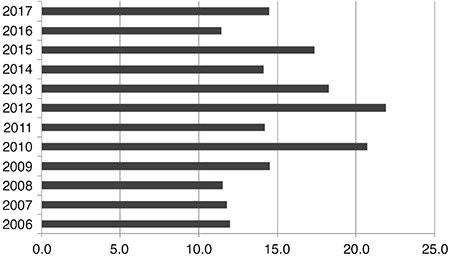
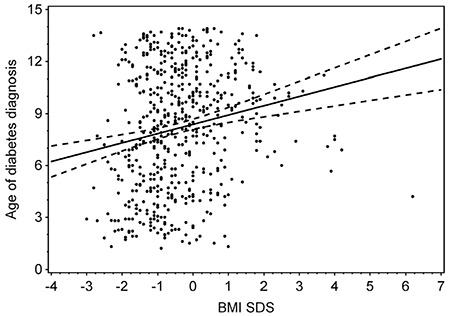
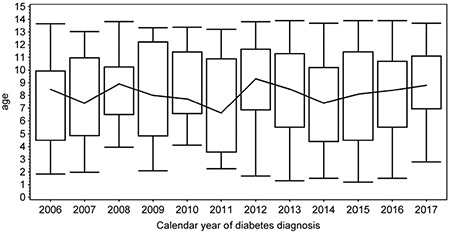
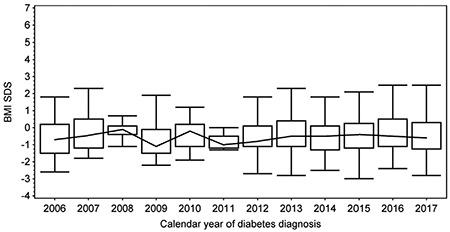
The incidence ratio ranged significantly (p<0.001) from the lowest in 2006 (11.2/100,000/year) to the highest in 2012 (21.9/100,000/year). The mean age of diagnosis was 8.2±3.5 years. There was no trend in decreasing diagnosis age (p=0.43). The mean BMI-SDS was -0.4±1.2. Almost all children (91.6%) presented with BMI-SDS within the normal range at the time of diagnosis, with only 2.7% of cases being obese and 5.7% underweight at the moment of diagnosis. There was no clear trend at all in BMI-SDS over the study period.
These results do not corroborate an increase of type 1 incidence in paediatric population being associated with younger age of diagnosis and higher BMI-SDS. This implies that the accelerator hypothesis does not hold true in the study population.
儿童 1 型糖尿病发病率上升的一个假设原因是体重增加,导致易感个体的疾病加速发展。然而,这种所谓的加速假说存在争议。本研究旨在分析在种族单一的小波兰地区,儿童糖尿病病例数的增加是否与诊断时年龄较小和体重指数标准差评分(BMI-SDS)较高有关。
回顾性分析了 2006 年 1 月 1 日至 2017 年 12 月 31 日(11 年)期间在小波兰地区新诊断为 1 型糖尿病的所有年龄<14 岁(n=559;男性占 50.6%)患者的病历中的数据。
发病率比值差异具有统计学意义(p<0.001),最低值为 2006 年(11.2/100,000/年),最高值为 2012 年(21.9/100,000/年)。诊断时的平均年龄为 8.2±3.5 岁。诊断年龄无下降趋势(p=0.43)。平均 BMI-SDS 为-0.4±1.2。几乎所有儿童(91.6%)在诊断时 BMI-SDS 均在正常范围内,只有 2.7%的病例肥胖,5.7%的病例消瘦。整个研究期间,BMI-SDS 没有明显的趋势。
这些结果不支持儿童 1 型糖尿病发病率上升与诊断时年龄较小和 BMI-SDS 较高有关。这表明加速假说在研究人群中并不成立。