Division of Endocrinology and Metabolism, Department of Internal Medicine, College of Medicine, Korea University, Seoul.
Department of Biostatistics, College of Medicine, Korea University, Seoul.
J Gerontol A Biol Sci Med Sci. 2018 Mar 2;73(3):386-392. doi: 10.1093/gerona/glx055.
Previous studies have shown that chronic kidney disease (CKD) is associated with accelerated loss of skeletal muscle in patients on dialysis. However, the relationships of sarcopenia with albuminuria and early-stage CKD in patients with type 2 diabetes have not been examined.
We analyzed diabetic subgroup data from 409 patients with type 2 diabetes from the Korean Sarcopenic Obesity Study (KSOS). Sarcopenia was defined as a skeletal muscle mass index (SMI; SMI [%] = total skeletal muscle mass [kg]/weight [kg] × 100) less than 2 SD below the sex-specific mean for a younger reference group. The estimated glomerular filtration rates and urinary albumin-to-creatinine ratios were used to assess renal function and albuminuria.
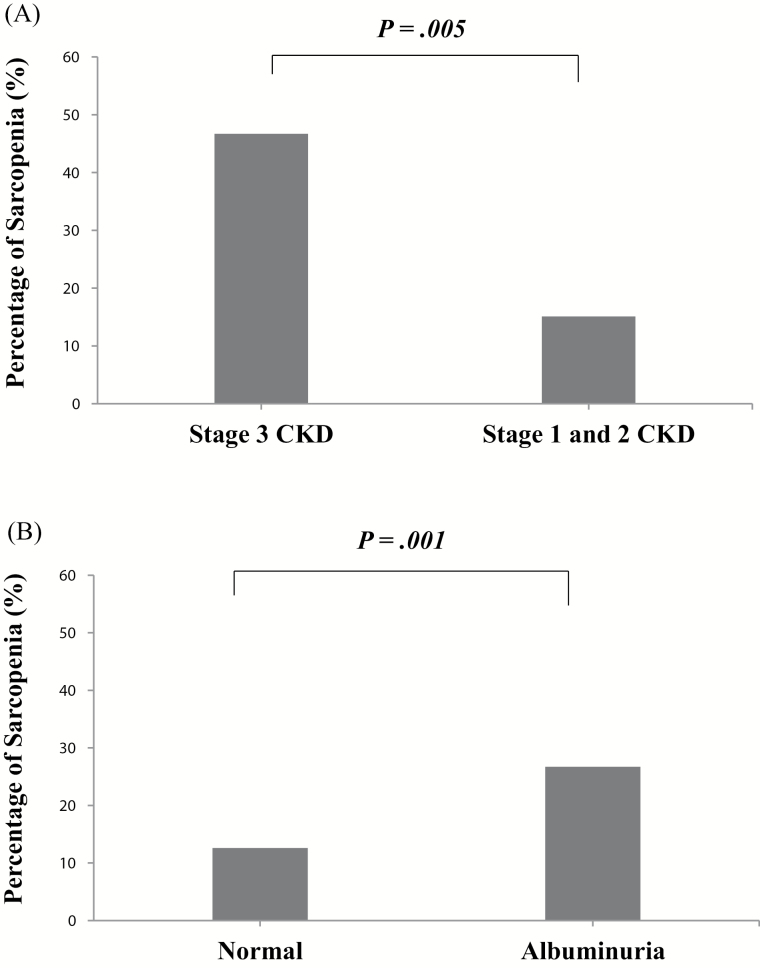
The prevalence of sarcopenia was significantly increased in the albuminuria group compared with the normo-albuminuria group (26.7% vs 12.6%, p = .001), as well as in CKD 3 group compared with the CKD 1-2 group (46.7% vs 15.1%, p = .005). After adjusting for age, SMI was negatively correlated with urinary albumin-to-creatinine ratios and positively correlated with aspartate aminotransferase, alanine aminotransferase, total cholesterol, high-density lipoprotein cholesterol, and low-density lipoprotein cholesterol levels. Multiple logistic regression analysis revealed that the odds ratio for albuminuria association was 3.02 (95% CI 1.37-6.67) in the lowest tertile of SMI compared with the highest tertile after adjusting for various confounding factors.
Sarcopenia is more prevalent in individuals with albuminuria than in those without albuminuria. Furthermore, increased albuminuria is independently associated with low muscle mass in patients with type 2 diabetes.
先前的研究表明,慢性肾脏病(CKD)与透析患者骨骼肌加速丢失有关。然而,尚未研究 2 型糖尿病患者的肌肉减少症与蛋白尿和早期 CKD 的关系。
我们分析了来自韩国肌肉减少性肥胖研究(KSOS)的 409 名 2 型糖尿病患者的糖尿病亚组数据。肌肉减少症定义为骨骼肌质量指数(SMI;SMI [%] = 总骨骼肌质量 [kg]/体重 [kg] × 100)低于年轻参考组性别特异性平均值的 2 个标准差以下。估计的肾小球滤过率和尿白蛋白与肌酐比值用于评估肾功能和蛋白尿。
与正常白蛋白尿组相比,蛋白尿组的肌肉减少症患病率显著增加(26.7%比 12.6%,p =.001),与 CKD 3 组相比,CKD 1-2 组的肌肉减少症患病率也显著增加(46.7%比 15.1%,p =.005)。在校正年龄后,SMI 与尿白蛋白与肌酐比值呈负相关,与天冬氨酸转氨酶、丙氨酸转氨酶、总胆固醇、高密度脂蛋白胆固醇和低密度脂蛋白胆固醇水平呈正相关。多因素逻辑回归分析显示,在校正各种混杂因素后,SMI 最低三分位与最高三分位相比,白蛋白尿的比值比为 3.02(95%CI 1.37-6.67)。
与无蛋白尿者相比,有蛋白尿者的肌肉减少症更为普遍。此外,在 2 型糖尿病患者中,白蛋白尿与肌肉质量减少独立相关。