D'Onofrio Stasia, Hyde James, Garcia-Rill Edgar
Center for Translational Neuroscience, Department of Neurobiology and Developmental Sciences, University of Arkansas for Medical Sciences, Little Rock, Arkansas.
Department of Psychiatry and Center for Neural Basis of Cognition, University of Pittsburgh, Pittsburgh, Pennsylvania.
Physiol Rep. 2017 Apr;5(7). doi: 10.14814/phy2.13246.
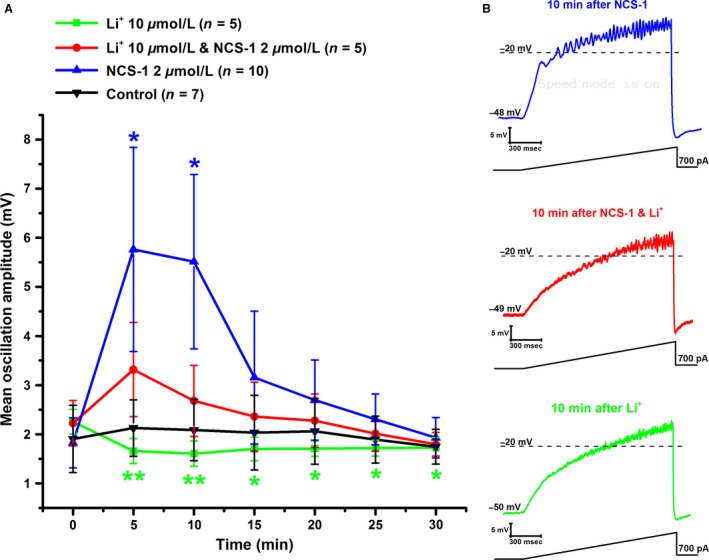
Bipolar disorder is characterized by sleep dysregulation, suggesting a role for the reticular activating system (RAS). Postmortem studies showed increased expression of neuronal calcium sensor protein 1 (NCS-1) in the brains of some bipolar disorder patients, and reduced or aberrant gamma band activity is present in the same disorder. Lithium (Li) has been shown to effectively treat the mood disturbances in bipolar disorder patients. We previously showed that NCS-1 at low levels increased, and at high levels decreased, gamma oscillations in RAS pedunculopontine neurons (PPN), and that Li decreased these oscillations. We previously described the effects of each agent on oscillations, G-protein mechanisms, and Ca currents. However, we designed the present experiments to determine the nature of the interaction of NCS-1 and Li at physiological concentrations that would have an effect within minutes of application. As expected, Li decreased gamma oscillation amplitude, while NCS-1 increased the amplitude of gamma oscillations. We identified NCS-1 at 2 μmol/L as a concentration that increased gamma oscillations within 5-10 min, and Li at 10 μmol/L as a concentration that decreased gamma oscillations within 5 min. The combined application of NCS-1 and Li at these concentrations showed that Li reduced the effects of NCS-1 on oscillation amplitude within 5-10 min. These results demonstrate that at physiological levels, Li acts to reduce the effects of NCS-1 so that, given over expression of NCS-1, Li would have salutary effects.
双相情感障碍的特征是睡眠失调,提示网状激活系统(RAS)发挥了作用。尸检研究显示,一些双相情感障碍患者大脑中神经元钙传感器蛋白1(NCS-1)的表达增加,且该疾病存在γ波段活动减少或异常的情况。锂(Li)已被证明能有效治疗双相情感障碍患者的情绪紊乱。我们之前发现,低水平的NCS-1会增加RAS脑桥脚被盖核神经元(PPN)的γ振荡,而高水平的NCS-1则会使其降低,并且锂会减少这些振荡。我们之前描述了每种药物对振荡、G蛋白机制和钙电流的影响。然而,我们设计了本实验,以确定在生理浓度下NCS-1和锂相互作用的性质,这种相互作用在应用后几分钟内就会产生效果。正如预期的那样,锂降低了γ振荡幅度,而NCS-1增加了γ振荡幅度。我们确定2 μmol/L的NCS-1是在5 - 10分钟内增加γ振荡的浓度,10 μmol/L的锂是在5分钟内降低γ振荡的浓度。在这些浓度下联合应用NCS-1和锂表明,锂在5 - 10分钟内降低了NCS-1对振荡幅度的影响。这些结果表明,在生理水平上,锂的作用是降低NCS-1的影响,因此,鉴于NCS-1的过度表达,锂会产生有益的效果。