Ferrazzoli Davide, Ortelli Paola, Maestri Roberto, Bera Rossana, Gargantini Roberto, Palamara Grazia, Zarucchi Marianna, Giladi Nir, Frazzitta Giuseppe
Department of Parkinson's disease, Movement Disorders and Brain Injury Rehabilitation, Moriggia Pelascini HospitalComo, Italy.
Department of Biomedical Engineering, Istituti Clinici Scientifici Maugeri Spa Società Benefit, IRCCS MontescanoPavia, Italy.
Front Behav Neurosci. 2017 Mar 31;11:56. doi: 10.3389/fnbeh.2017.00056. eCollection 2017.
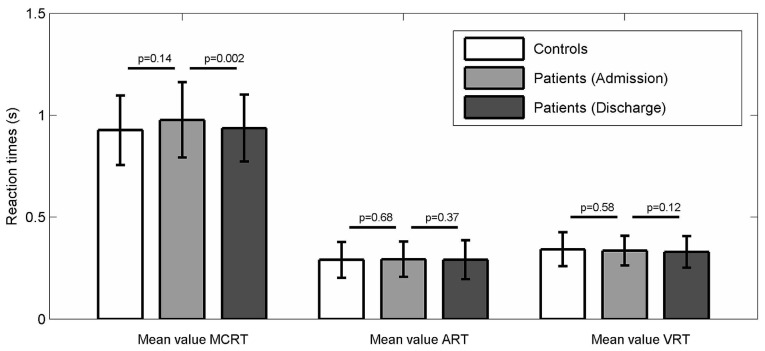
Rehabilitation for patients with Parkinson's disease (PD) is based on cognitive strategies that exploit attention. Parkinsonians exhibit impairments in divided attention and interference control. Nevertheless, the effectiveness of specific rehabilitation treatments based on attention suggests that other attentional functions are preserved. Data about attention are conflicting in PD, and it is not clear whether rehabilitative treatments that entail attentional strategies affect attention itself. Reaction times (RTs) represent an instrument to explore attention and investigate whether changes in attentional performances parallel rehabilitation induced-gains. RTs of 103 parkinsonian patients in "on" state, without cognitive deficits, were compared with those of a population of 34 healthy controls. We studied those attentional networks that subtend the use of cognitive strategies in motor rehabilitation: alertness and focused and sustained attention, which is a component of the executive system. We used visual and auditory RTs to evaluate alertness and multiple choices RTs (MC RTs) to explore focused and sustained attention. Parkinsonian patients underwent these tasks before and after a 4-week multidisciplinary, intensive and goal-based rehabilitation treatment (MIRT). Unified Parkinson's Disease Rating Scale (UPDRS) III and Timed Up and Go test (TUG) were assessed at the enrollment and at the end of MIRT to evaluate the motor-functional effectiveness of treatment. We did not find differences in RTs between parkinsonian patients and controls. Further, we found that improvements in motor-functional outcome measures after MIRT ( < 0.0001) paralleled a reduction in MC RTs ( = 0.014). No changes were found for visual and auditory RTs. Correlation analysis revealed no association between changes in MC RTs and improvements in UPDRS-III and TUG. These findings indicate that alertness, as well as focused and sustained attention, are preserved in "on" state. This explains why Parkinsonians benefit from a goal-based rehabilitation that entails the use of attention. The reduction in MC RTs suggests a positive effect of MIRT on the executive component of attention and indicates that this type of rehabilitation provides benefits by exploiting executive functions. This ensues from different training approaches aimed at bypassing the dysfunctional basal ganglia circuit, allowing the voluntary execution of the defective movements. These data suggest that the effectiveness of a motor rehabilitation tailored for PD lies on cognitive engagement.
帕金森病(PD)患者的康复基于利用注意力的认知策略。帕金森病患者在注意力分散和干扰控制方面存在缺陷。然而,基于注意力的特定康复治疗的有效性表明其他注意力功能得以保留。帕金森病中关于注意力的数据相互矛盾,尚不清楚需要注意力策略的康复治疗是否会影响注意力本身。反应时间(RTs)是探索注意力以及研究注意力表现的变化是否与康复诱导的改善并行的一种手段。将103名处于“开”状态且无认知缺陷的帕金森病患者的反应时间与34名健康对照者的反应时间进行了比较。我们研究了那些在运动康复中支持认知策略使用的注意力网络:警觉性以及集中和持续注意力,这是执行系统的一个组成部分。我们使用视觉和听觉反应时间来评估警觉性,并使用多项选择反应时间(MC RTs)来探索集中和持续注意力。帕金森病患者在为期4周的多学科、强化且基于目标的康复治疗(MIRT)前后接受了这些任务。在入组时和MIRT结束时评估统一帕金森病评定量表(UPDRS)III和计时起立行走测试(TUG),以评估治疗的运动功能有效性。我们未发现帕金森病患者和对照者在反应时间上存在差异。此外,我们发现MIRT后运动功能结果测量指标的改善(<0.0001)与MC RTs的减少(=0.014)并行。视觉和听觉反应时间未发现变化。相关性分析显示MC RTs的变化与UPDRS - III和TUG的改善之间无关联。这些发现表明,在“开”状态下,警觉性以及集中和持续注意力得以保留。这解释了为什么帕金森病患者能从需要使用注意力的基于目标的康复中获益。MC RTs的减少表明MIRT对注意力的执行成分有积极影响,并表明这种类型的康复通过利用执行功能带来益处。这源于旨在绕过功能失调的基底神经节回路的不同训练方法,从而允许对有缺陷的运动进行自主执行。这些数据表明,为帕金森病量身定制的运动康复的有效性在于认知参与。