Strehl Ute, Aggensteiner Pascal, Wachtlin Daniel, Brandeis Daniel, Albrecht Björn, Arana Maria, Bach Christiane, Banaschewski Tobias, Bogen Thorsten, Flaig-Röhr Andrea, Freitag Christine M, Fuchsenberger Yvonne, Gest Stephanie, Gevensleben Holger, Herde Laura, Hohmann Sarah, Legenbauer Tanja, Marx Anna-Maria, Millenet Sabina, Pniewski Benjamin, Rothenberger Aribert, Ruckes Christian, Wörz Sonja, Holtmann Martin
Institute for Medical Psychology and Behavioral Neurobiology, University of TübingenTübingen, Germany.
Department of Child and Adolescent Psychiatry and Psychotherapy, Central Institute of Mental Health, Medical Faculty Mannheim, University of HeidelbergMannheim, Germany.
Front Hum Neurosci. 2017 Mar 31;11:135. doi: 10.3389/fnhum.2017.00135. eCollection 2017.
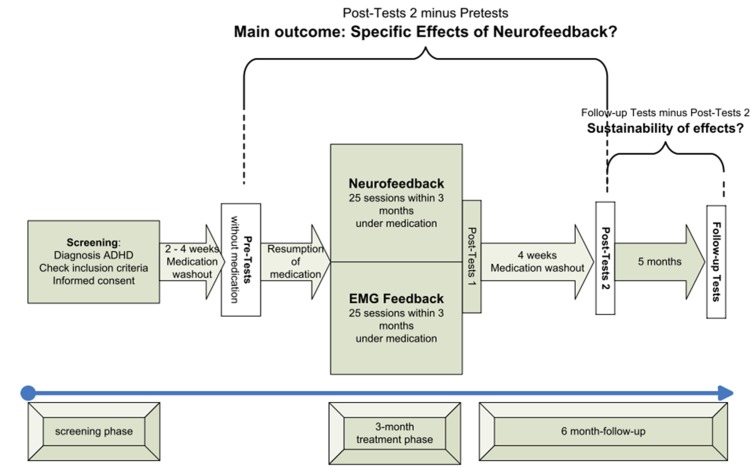
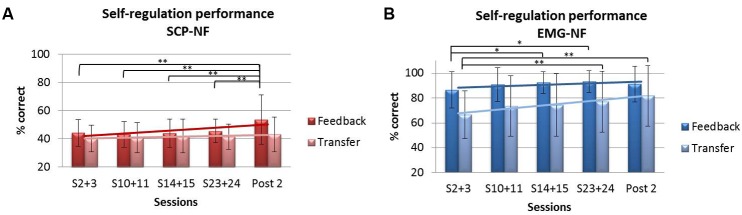
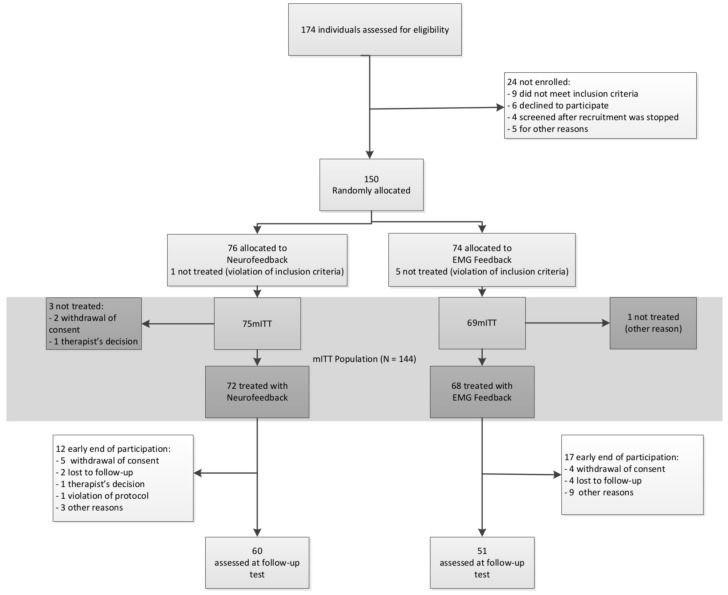
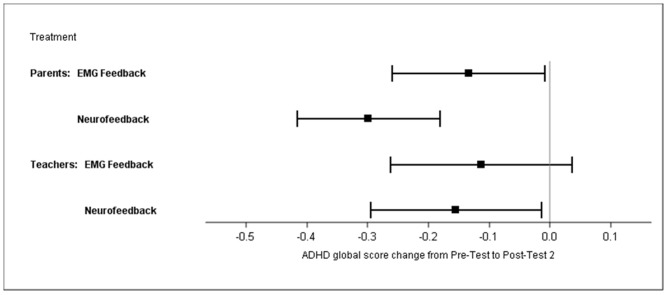
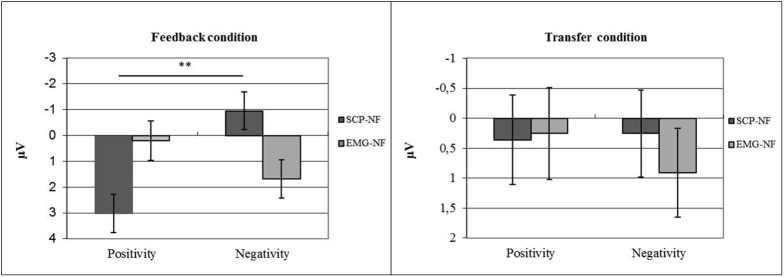
Neurofeedback (NF) in children with attention-deficit/hyperactivity disorder (ADHD) has been investigated in a series of studies over the last years. Previous studies did not unanimously support NF as a treatment in ADHD. Most studies did not control for unspecific treatment effects and did not demonstrate that self-regulation took place. The present study examined the efficacy of NF in comparison to electromyographic (EMG) feedback to control for unspecific effects of the treatment, and assessed self-regulation of slow cortical potentials (SCPs). A total of 150 children aged 7-9 years diagnosed with ADHD (82% male; 43% medicated) were randomized to 25 sessions of feedback of SCPs (NF) or feedback of coordination of the supraspinatus muscles (EMG). The primary endpoint was the change in parents' ratings of ADHD core symptoms 4 weeks after the end of treatment compared to pre-tests. Children in both groups showed reduced ADHD-core symptoms (NF 0.3, 95% CI -0.42 to -0.18; EMG 0.13, 95% CI -0.26 to -0.01). NF showed a significant superiority over EMG (treatment difference 0.17, 95% CI 0.02-0.3, = 0.02). This yielded an effect size (ES) of = 0.57 without and 0.40 with baseline observation carried forward (BOCF). The sensitivity analysis confirmed the primary result. Successful self-regulation of brain activity was observed only in NF. As a secondary result teachers reported no superior improvement from NF compared to EMG, but within-group analysis revealed effects of NF on the global ADHD score, inattention, and impulsivity. In contrast, EMG feedback did not result in changes despite more pronounced self-regulation learning. Based on the primary parent-rated outcome NF proved to be superior to a semi-active EMG feedback treatment. The study supports the feasibility and efficacy of NF in a large sample of children with ADHD, based on both specific and unspecific effects. Current controlled trials ISRCTN76187185, registered 5 February 2009.
在过去几年的一系列研究中,对患有注意力缺陷多动障碍(ADHD)的儿童进行了神经反馈(NF)研究。先前的研究并未一致支持将NF作为ADHD的一种治疗方法。大多数研究没有控制非特异性治疗效果,也没有证明发生了自我调节。本研究比较了NF与肌电图(EMG)反馈控制治疗非特异性效果的疗效,并评估了慢皮层电位(SCP)的自我调节。共有150名7至9岁被诊断为ADHD的儿童(82%为男性;43%正在服药)被随机分为接受25次SCP反馈(NF)或冈上肌协调反馈(EMG)。主要终点是治疗结束后4周与治疗前相比,父母对ADHD核心症状评分的变化。两组儿童的ADHD核心症状均有所减轻(NF为0.3,95%CI为-0.42至-0.18;EMG为0.13,95%CI为-0.26至-0.01)。NF显示出比EMG有显著优势(治疗差异为0.17,95%CI为0.02 - 0.3,P = 0.02)。这产生了一个效应大小(ES),不采用基线观察结转(BOCF)时为0.57,采用BOCF时为0.40。敏感性分析证实了主要结果。仅在NF组观察到成功的大脑活动自我调节。作为次要结果,教师报告与EMG相比,NF没有更显著的改善,但组内分析显示NF对总体ADHD评分、注意力不集中和冲动有影响。相比之下,尽管EMG反馈有更明显的自我调节学习,但并未导致变化。基于主要的父母评分结果,NF被证明优于半主动EMG反馈治疗。该研究支持了NF在大量ADHD儿童样本中的可行性和疗效,基于特异性和非特异性效果。当前对照试验ISRCTN76187185,于2009年2月5日注册。