Key Laboratory of Animal Models and Human Disease Mechanisms of the Chinese Academy of Sciences & Yunnan Province, Kunming Institute of Zoology, Chinese Academy of Sciences, Kunming Yunnan 650223, China; Nerve System Coding Discipline Group, Kunming College of Life Science, University of the Chinese Academy of Sciences, Kunming Yunnan 650000, China.
Key Laboratory of Animal Models and Human Disease Mechanisms of the Chinese Academy of Sciences & Yunnan Province, Kunming Institute of Zoology, Chinese Academy of Sciences, Kunming Yunnan 650223, China.
Zool Res. 2017 Mar 18;38(2):88-95. doi: 10.24272/j.issn.2095-8137.2017.015.
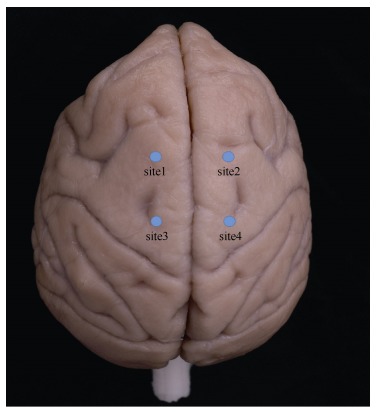
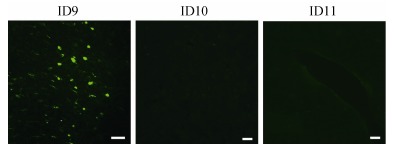
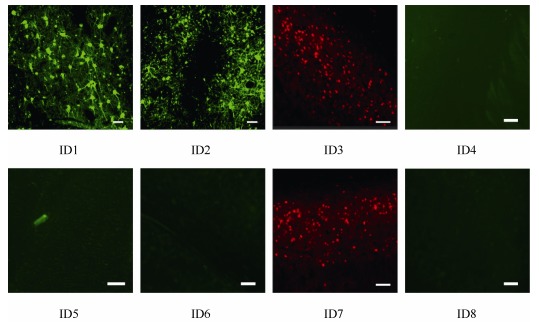
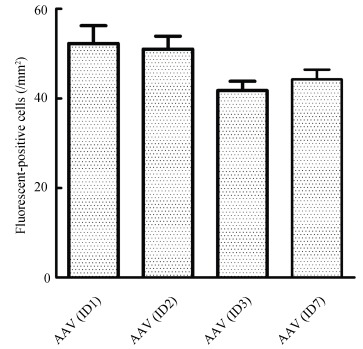
Viral vector transfection systems are among the simplest of biological agents with the ability to transfer genes into the central nervous system. In brain research, a series of powerful and novel gene editing technologies are based on these systems. Although many viral vectors are used in rodents, their full application has been limited in non-human primates. To identify viral vectors that can stably and effectively express exogenous genes within non-human primates, eleven commonly used recombinant adeno-associated viral and lentiviral vectors, each carrying a gene to express green or red fluorescence, were injected into the parietal cortex of four rhesus monkeys. The expression of fluorescent cells was used to quantify transfection efficiency. Histological results revealed that recombinant adeno-associated viral vectors, especially the serotype 2/9 coupled with the cytomegalovirus, human synapsin I, or Ca/calmodulin-dependent protein kinase II promoters, and lentiviral vector coupled with the human ubiquitin C promoter, induced higher expression of fluorescent cells, representing high transfection efficiency. This is the first comparison of transfection efficiencies of different viral vectors carrying different promoters and serotypes in non-human primates (NHPs). These results can be used as an aid to select optimal vectors to transfer exogenous genes into the central nervous system of non-human primates.
病毒载体转染系统是最简单的生物制剂之一,具有将基因转入中枢神经系统的能力。在脑研究中,一系列强大的新型基因编辑技术都是基于这些系统。虽然许多病毒载体在啮齿动物中得到了应用,但它们在非人类灵长类动物中的全面应用受到了限制。为了鉴定能够在非人类灵长类动物中稳定、有效地表达外源基因的病毒载体,我们将 11 种常用的重组腺相关病毒和慢病毒载体,每种载体都携带一个表达绿色或红色荧光的基因,注射到 4 只恒河猴的顶叶皮层中。用荧光细胞的表达来定量转染效率。组织学结果表明,重组腺相关病毒载体,特别是血清型 2/9 与巨细胞病毒、人突触素 I 或 Ca/钙调蛋白依赖性蛋白激酶 II 启动子,以及与人类泛素 C 启动子偶联的慢病毒载体,诱导更高表达的荧光细胞,代表着更高的转染效率。这是首次在非人类灵长类动物(NHPs)中比较不同携带不同启动子和血清型的病毒载体的转染效率。这些结果可以作为选择将外源基因转入非人类灵长类动物中枢神经系统的最佳载体的辅助手段。