Brown Colin W, Sridhara Viswanadham, Boutz Daniel R, Person Maria D, Marcotte Edward M, Barrick Jeffrey E, Wilke Claus O
Institute for Cellular and Molecular Biology, The University of Texas at Austin, Austin, Texas, USA.
Center for Computational Biology and Bioinformatics, The University of Texas at Austin, Austin, Texas, USA.
BMC Genomics. 2017 Apr 17;18(1):301. doi: 10.1186/s12864-017-3676-8.
Post-translational modification (PTM) of proteins is central to many cellular processes across all domains of life, but despite decades of study and a wealth of genomic and proteomic data the biological function of many PTMs remains unknown. This is especially true for prokaryotic PTM systems, many of which have only recently been recognized and studied in depth. It is increasingly apparent that a deep sampling of abundance across a wide range of environmental stresses, growth conditions, and PTM types, rather than simply cataloging targets for a handful of modifications, is critical to understanding the complex pathways that govern PTM deposition and downstream effects.
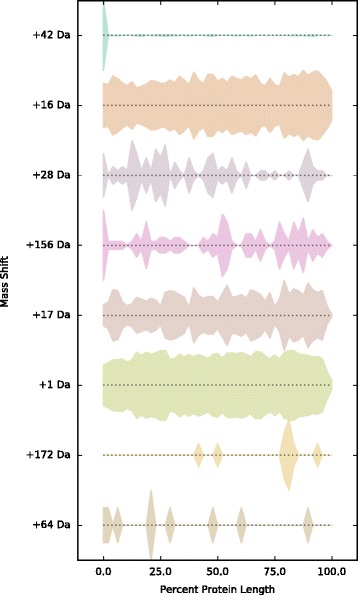
We utilized a deeply-sampled dataset of MS/MS proteomic analysis covering 9 timepoints spanning the Escherichia coli growth cycle and an unbiased PTM search strategy to construct a temporal map of abundance for all PTMs within a 400 Da window of mass shifts. Using this map, we are able to identify novel targets and temporal patterns for N-terminal N α acetylation, C-terminal glutamylation, and asparagine deamidation. Furthermore, we identify a possible relationship between N-terminal N α acetylation and regulation of protein degradation in stationary phase, pointing to a previously unrecognized biological function for this poorly-understood PTM.
Unbiased detection of PTM in MS/MS proteomics data facilitates the discovery of novel modification types and previously unobserved dynamic changes in modification across growth timepoints.
蛋白质的翻译后修饰(PTM)对于生命所有领域中的许多细胞过程都至关重要,但尽管经过数十年的研究以及大量的基因组和蛋白质组数据,许多PTM的生物学功能仍然未知。原核生物的PTM系统尤其如此,其中许多直到最近才被认识并深入研究。越来越明显的是,对广泛的环境压力、生长条件和PTM类型进行深度丰度采样,而不是简单地编目少数几种修饰的靶点,对于理解控制PTM沉积和下游效应的复杂途径至关重要。
我们利用了一个深度采样的MS/MS蛋白质组学分析数据集,该数据集涵盖了大肠杆菌生长周期的9个时间点,并采用了无偏倚的PTM搜索策略,构建了质量偏移400 Da窗口内所有PTM的丰度时间图谱。利用这一图谱,我们能够识别N端Nα乙酰化、C端谷氨酰化和天冬酰胺脱酰胺的新靶点和时间模式。此外,我们确定了N端Nα乙酰化与稳定期蛋白质降解调控之间的可能关系,这表明这种理解不足的PTM具有以前未被认识的生物学功能。
在MS/MS蛋白质组学数据中对PTM进行无偏倚检测有助于发现新的修饰类型以及生长时间点之间以前未观察到的修饰动态变化。