Dimitrova Yoana, Gruber Andreas J, Mittal Nitish, Ghosh Souvik, Dimitriades Beatrice, Mathow Daniel, Grandy William Aaron, Christofori Gerhard, Zavolan Mihaela
Biozentrum, University of Basel, Klingelbergstrasse 50-70, CH-4056, Basel, Switzerland.
Department of Cellular and Molecular Pathology, German Cancer Research Center (DKFZ), Heidelberg, Germany.
Biol Direct. 2017 Apr 17;12(1):8. doi: 10.1186/s13062-017-0180-7.
The transition between epithelial and mesenchymal phenotypes (EMT) occurs in a variety of contexts. It is critical for mammalian development and it is also involved in tumor initiation and progression. Master transcription factor (TF) regulators of this process are conserved between mouse and human.
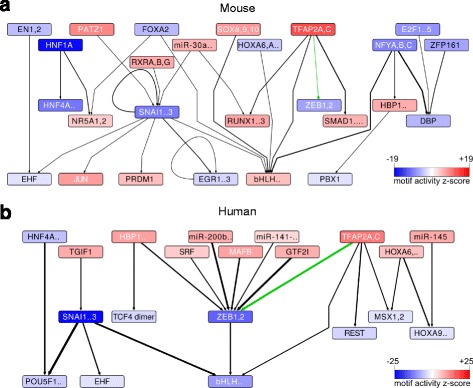
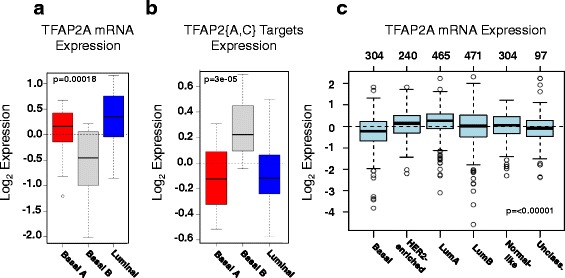
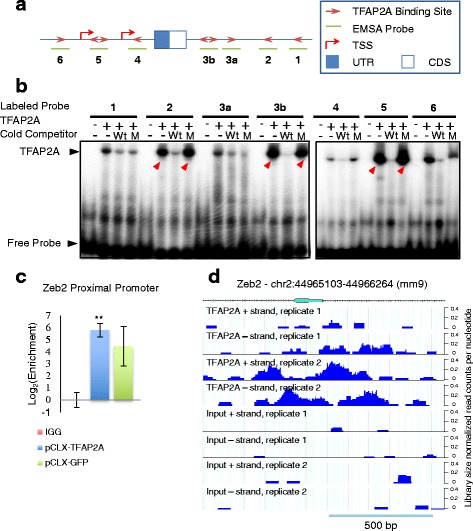
From a computational analysis of a variety of high-throughput sequencing data sets we initially inferred that TFAP2A is connected to the core EMT network in both species. We then analysed publicly available human breast cancer data for TFAP2A expression and also studied the expression (by mRNA sequencing), activity (by monitoring the expression of its predicted targets), and binding (by electrophoretic mobility shift assay and chromatin immunoprecipitation) of this factor in a mouse mammary gland EMT model system (NMuMG) cell line.
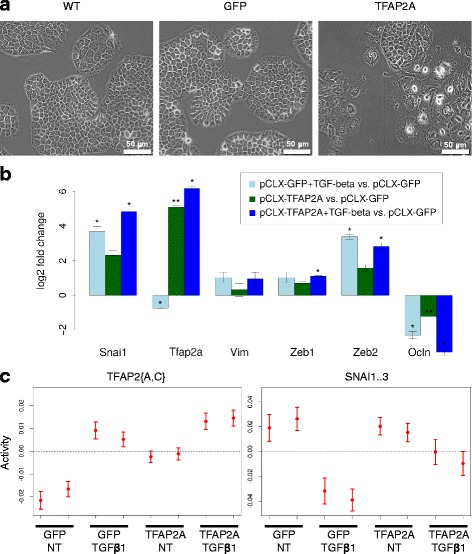
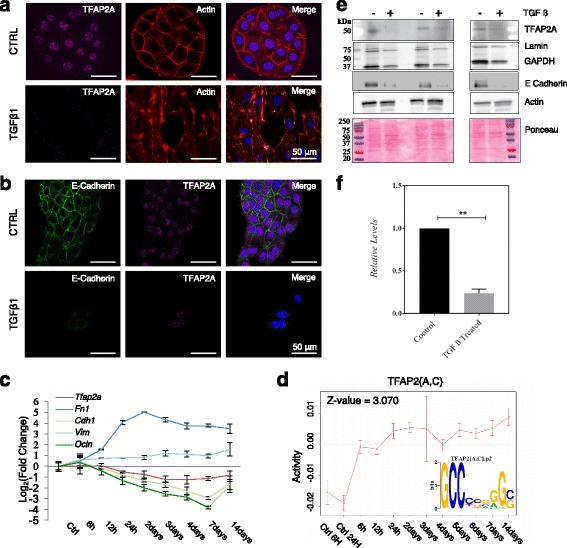
We found that upon induction of EMT, the activity of TFAP2A, reflected in the expression level of its predicted targets, is up-regulated in a variety of systems, both murine and human, while TFAP2A's expression is increased in more "stem-like" cancers. We provide strong evidence for the direct interaction between the TFAP2A TF and the ZEB2 promoter and we demonstrate that this interaction affects ZEB2 expression. Overexpression of TFAP2A from an exogenous construct perturbs EMT, however, in a manner similar to the downregulation of endogenous TFAP2A that takes place during EMT.
Our study reveals that TFAP2A is a conserved component of the core network that regulates EMT, acting as a repressor of many genes, including ZEB2.
This article has been reviewed by Dr. Martijn Huynen and Dr. Nicola Aceto.
上皮细胞与间充质细胞表型之间的转变(EMT)发生在多种情况下。它对哺乳动物发育至关重要,并且也参与肿瘤的起始和进展。该过程的主要转录因子(TF)调节因子在小鼠和人类之间是保守的。
通过对各种高通量测序数据集的计算分析,我们最初推断TFAP2A在两个物种中均与核心EMT网络相关联。然后,我们分析了公开可用的人类乳腺癌数据中TFAP2A的表达情况,并在小鼠乳腺EMT模型系统(NMuMG)细胞系中研究了该因子的表达(通过mRNA测序)、活性(通过监测其预测靶标的表达)和结合情况(通过电泳迁移率变动分析和染色质免疫沉淀)。
我们发现,在诱导EMT后,TFAP2A的活性(反映在其预测靶标的表达水平上)在多种系统中均上调,包括小鼠和人类系统,而TFAP2A的表达在更具“干细胞样”的癌症中增加。我们提供了TFAP2A转录因子与ZEB2启动子之间直接相互作用的有力证据,并证明这种相互作用会影响ZEB2的表达。然而,从外源构建体过表达TFAP2A会以类似于EMT期间内源性TFAP2A下调的方式扰乱EMT。
我们的研究表明,TFAP2A是调节EMT的核心网络的保守组成部分,作为包括ZEB2在内的许多基因的阻遏物。
本文已由Martijn Huynen博士和Nicola Aceto博士审阅。