Zhang Tian-Xiao, Saccone Nancy L, Bierut Laura J, Rice John P
Department of Psychiatry Washington University School of Medicine St. Louis MO USA.
Department of Genetics Washington University School of Medicine St. Louis MO USA.
Brain Behav. 2017 Mar 15;7(4):e00651. doi: 10.1002/brb3.651. eCollection 2017 Apr.
Smoking is a leading cause of preventable death. Early studies based on samples of twins have linked the lifetime smoking practices to genetic predisposition. The flavin-containing monooxygenase (FMO) protein family consists of a group of enzymes that metabolize drugs and xenobiotics. Both and were potentially susceptible genes for nicotine metabolism process.
In this study, we investigated the potential of FMO genes to confer risk of nicotine dependence via deep targeted sequencing in 2,820 study subjects comprising 1,583 nicotine dependents and 1,237 controls from European American and African American. Specifically, we focused on the two genomic segments including ,, and pseudo gene , and aimed to investigate the potential association between FMO genes and nicotine dependence. Both common and low-frequency/rare variants were analyzed using different algorithms. The potential functional significance of SNPs with association signal was investigated with relevant bioinformatics tools.
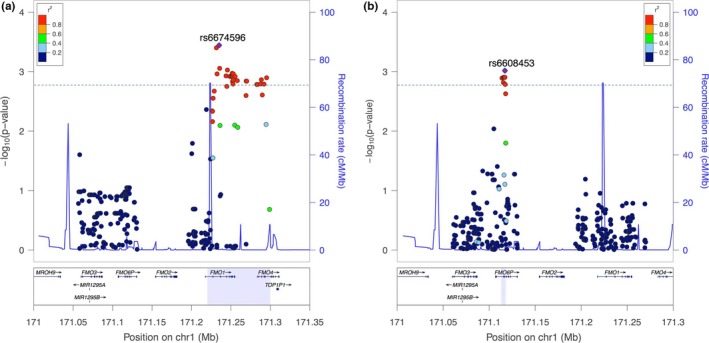
We identified different clusters of significant common variants in European (with most significant SNP rs6674596, =.0004, OR = 0.67, MAF_EA = 0.14, ) and African Americans (with the most significant SNP rs6608453, =.001, OR = 0.64, MAF_AA = 0.1, ). No significant signals were identified through haplotype-based analyses. Gene network investigation indicated that both and have a strong relation with a variety of genes belonging to gene families (with combined score greater than 0.9). Most of the significant variants identified were SNPs located within intron regions or with unknown functional significance, indicating a need for future work to understand the underlying functional significance of these signals.
Our findings indicated significant association between FMO genes and nicotine dependence. Replications of our findings in other ethnic groups were needed in the future. Most of the significant variants identified were SNPs located within intronic regions or with unknown functional significance, indicating a need for future work to understand the underlying functional significance of these signals.
吸烟是可预防死亡的主要原因。早期基于双胞胎样本的研究已将终生吸烟习惯与遗传易感性联系起来。含黄素单加氧酶(FMO)蛋白家族由一组代谢药物和外源性物质的酶组成。FMO3和FMO5都是尼古丁代谢过程的潜在易感基因。
在本研究中,我们通过对2820名研究对象进行深度靶向测序,调查了FMO基因赋予尼古丁依赖风险的可能性,这些研究对象包括1583名尼古丁依赖者和1237名来自欧裔美国人和非裔美国人的对照。具体而言,我们聚焦于包括FMO3、FMO5和假基因FMO2P的两个基因组片段,旨在研究FMO基因与尼古丁依赖之间的潜在关联。使用不同算法分析常见和低频/罕见变异。利用相关生物信息学工具研究具有关联信号的单核苷酸多态性(SNP)的潜在功能意义。
我们在欧洲人(最显著的SNP为rs6674596,P = 0.0004,OR = 0.67,欧洲裔美国人的最小等位基因频率[MAF_EA] = 0.14)和非裔美国人(最显著的SNP为rs6608453,P = 0.001,OR = 0.64,非裔美国人的最小等位基因频率[MAF_AA] = 0.1)中鉴定出不同的显著常见变异簇。通过基于单倍型的分析未鉴定出显著信号。基因网络研究表明,FMO3和FMO5都与属于细胞色素P450基因家族的多种基因有很强的关系(综合得分大于0.9)。鉴定出的大多数显著变异是位于内含子区域或功能意义未知的SNP,这表明未来需要开展工作以了解这些信号的潜在功能意义。
我们的研究结果表明FMO基因与尼古丁依赖之间存在显著关联。未来需要在其他种族群体中重复我们的研究结果。鉴定出的大多数显著变异是位于内含子区域或功能意义未知的SNP,这表明未来需要开展工作以了解这些信号的潜在功能意义。