Navas-Madroñal Miquel, Valero-Mut Ana, Martínez-Zapata María José, Simón-Talero Manuel Javier, Figueroa Sebastián, Vidal-Fernández Nuria, López-Góngora Mariana, Escartín Antonio, Querol Luis
Multiple Sclerosis Unit, Department of Neurology, Hospital de la Santa Creu i Sant Pau, Universitat Autònoma de Barcelona, Barcelona, Spain.
Iberoamerican Cochrane Centre, Biomedical Research Institute Sant Pau (IIB Sant Pau), CIBER Epidemiologia y Salud pública (CIBERESP), Barcelona, Spain.
PLoS One. 2017 Apr 17;12(4):e0175538. doi: 10.1371/journal.pone.0175538. eCollection 2017.
Antibodies targeting the inward-rectifying potassium channel KIR4.1 have been associated with multiple sclerosis (MS) but studies using diverse techniques have failed to replicate this association. The detection of these antibodies is challenging; KIR4.1 glycosylation patterns and the use of diverse technical approaches may account for the disparity of results. We aimed to replicate the association using three different approaches to overcome the technical limitations of a single technique. We also performed a systematic review to examine the association of anti-KIR4.1 antibodies with MS.
Serum samples from patients with MS (n = 108) and controls (n = 77) were tested for the presence of anti-KIR4.1 antibodies using three methods: 1) by ELISA with the low-glycosylated fraction of recombinant KIR4.1 purified from transfected HEK293 cells according to original protocols; 2) by immunocytochemistry using KIR4.1-transfected HEK293 cells; and 3) by immunocytochemistry using the KIR4.1.-transfected MO3.13 oligodendrocyte cell line. We developed a systematic review and meta-analysis of the association of anti-KIR4.1 antibodies with MS according to the Preferred Reporting Items for Systematic Reviews and Meta-Analyses (PRISMA) guidelines.
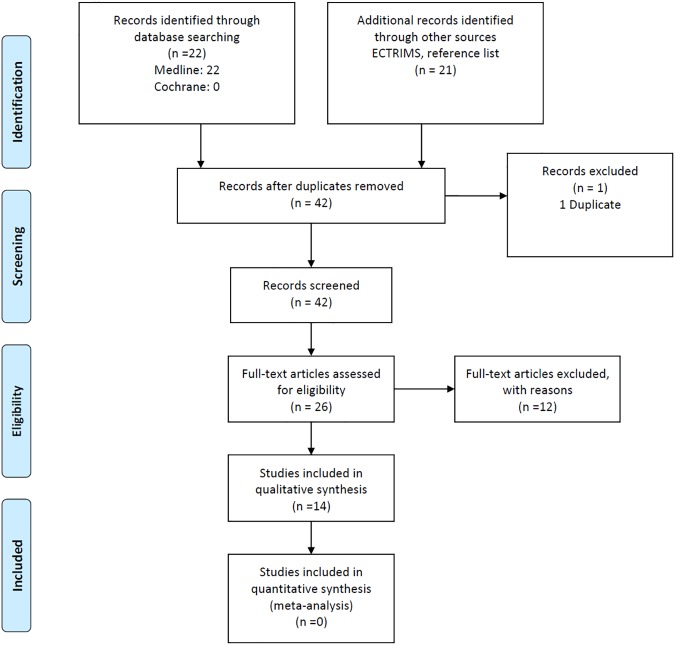
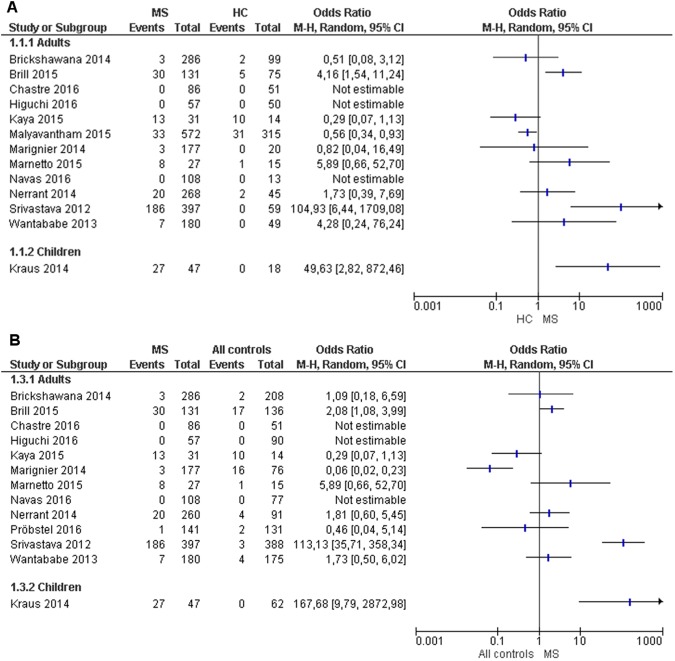
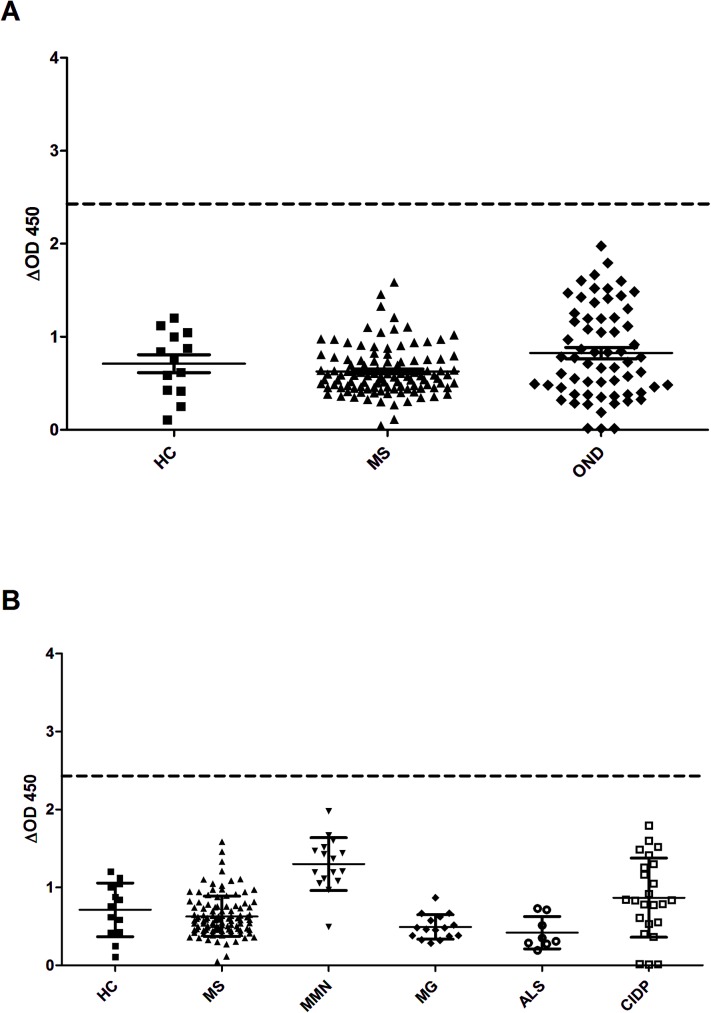
We did not detect anti-KIR4.1 antibodies in the MS patients or in controls using ELISA. Neither did we detect any significant reactivity against the antigen on the cell surface using the KIR4.1-transfected HEK293 cells or the KIR4.1-transfected MO3.13 cells. We included 13 prospective controlled studies in the systematic review. Only three studies showed a positive association between anti-KIR4.1 and MS. Clinical and statistical heterogeneity between studies precluded meta-analysis of their results.
We found no association between anti-KIR4.1 antibody positivity and MS. Although this lack of replication may be due to technical limitations, evidence from our study and others is mounting against the role of KIR4.1 as a relevant MS autoantigen.
靶向内向整流钾通道KIR4.1的抗体已被认为与多发性硬化症(MS)有关,但使用不同技术的研究未能重复这一关联。这些抗体的检测具有挑战性;KIR4.1的糖基化模式以及不同技术方法的使用可能是结果存在差异的原因。我们旨在通过三种不同方法来重复这一关联,以克服单一技术的技术局限性。我们还进行了一项系统评价,以研究抗KIR4.1抗体与MS的关联。
使用三种方法检测来自MS患者(n = 108)和对照(n = 77)的血清样本中抗KIR4.1抗体的存在:1)按照原始方案,通过酶联免疫吸附测定(ELISA)检测从转染的人胚肾293(HEK293)细胞中纯化的低聚糖化重组KIR4.1;2)使用转染KIR4.1的HEK293细胞进行免疫细胞化学检测;3)使用转染KIR4.1的MO3.13少突胶质细胞系进行免疫细胞化学检测。我们根据系统评价和Meta分析的首选报告项目(PRISMA)指南,对抗KIR4.1抗体与MS的关联进行了系统评价和Meta分析。
我们使用ELISA在MS患者或对照中未检测到抗KIR4.1抗体。使用转染KIR4.1的HEK293细胞或转染KIR4.1的MO3.13细胞,我们也未检测到对细胞表面抗原的任何显著反应性。我们在系统评价中纳入了13项前瞻性对照研究。只有三项研究显示抗KIR4.1与MS之间存在正相关。研究之间的临床和统计异质性排除了对其结果进行Meta分析的可能性。
我们发现抗KIR4.1抗体阳性与MS之间无关联。尽管这种未能重复的情况可能是由于技术局限性,但来自我们研究及其他研究的证据越来越多地反对KIR4.1作为相关MS自身抗原的作用。