Fang Min, Song Tao, Liang Xiaodong, Lv Shiliang, Li Jianbo, Xu Hong'en, Luo Limin, Jia Yongshi
Department of Radiation Oncology, Zhejiang Provincial People's Hospital, Hangzhou 310000, Zhejiang, P. R. China.
Department of Radiation Oncology, Ningbo Mingzhou Hospital, Ningbo 315000, Zhejiang, P. R. China.
Oncotarget. 2017 Jun 6;8(23):37080-37090. doi: 10.18632/oncotarget.16180.
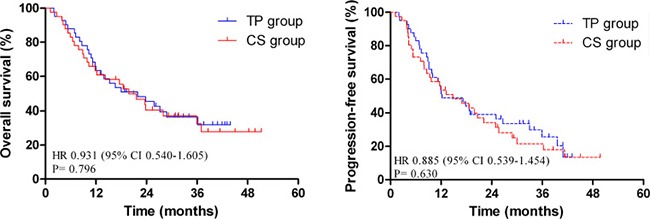
This study compared the efficiency and safety of definitive concurrent chemoradiotherapy (CCRT) using Paclitaxel plus Cisplatin (TP) versus S-1 plus Cisplatin (CS) in unresectable locally advanced esophageal squamous cell carcinoma (LAESCC). Between January 2009 and December 2013, 203 LAESCC patients were retrospectively reviewed. We performed a propensity score matching analysis; 41 patients treated with the CS regimen were matched 1:1 to patients who received the TP regimen. Patient- and disease-related characteristics were well-balanced between the two groups. The CS group showed significantly better treatment compliance (90.2% vs. 70.7%, P = 0.026) and less hospital stay (48 days vs 49 days, P = 0.025) over the TP group during the CCRT course. The complete response rate was comparable between the two groups (51.2% vs. 48.8%, P = 0.825). The 1- and 3-year overall survival (OS) rates in the TP group were 63.4% and 32.4% compared to 62.8% and 32.1% in the CS group, respectively (P = 0.796). The 1- and 3-year progression-free survival (PFS) rates in the TP group were 51.2% and 24.9%, compared to 53.6% and 18.9% in the CS group, respectively (P = 0.630). The incidence of severe and total neutropenia in the TP group was significantly higher compared to the CS group (P = 0.011 and 0.046, respectively). Multivariate analysis revealed that T stage and the complete response rate were strong prognostic factors associated with OS and PFS. In conclusion, both treatment regimens yielded satisfactory survival outcomes, but the CS regimen could significantly improve treatment compliance, reduce hematological toxicities and lengths of hospital stay. Future prospective studies in large cohorts are highly warranted to confirm the findings in our report.
本研究比较了在不可切除的局部晚期食管鳞状细胞癌(LAESCC)中,使用紫杉醇联合顺铂(TP)与S-1联合顺铂(CS)进行根治性同步放化疗(CCRT)的疗效和安全性。回顾性分析了2009年1月至2013年12月期间的203例LAESCC患者。我们进行了倾向评分匹配分析;41例接受CS方案治疗的患者与接受TP方案治疗的患者进行1:1匹配。两组患者及疾病相关特征均衡。在CCRT疗程中,CS组的治疗依从性显著优于TP组(90.2%对70.7%,P = 0.026),住院时间也更短(48天对49天,P = 0.025)。两组的完全缓解率相当(51.2%对48.8%,P = 0.825)。TP组的1年和3年总生存率(OS)分别为63.4%和32.4%,而CS组分别为62.8%和32.1%(P = 0.796)。TP组的1年和3年无进展生存率(PFS)分别为51.2%和24.9%,CS组分别为53.6%和18.9%(P = 0.630)。TP组严重中性粒细胞减少和全中性粒细胞减少的发生率显著高于CS组(分别为P = 0.011和0.046)。多因素分析显示,T分期和完全缓解率是与OS和PFS相关的强预后因素。总之,两种治疗方案均产生了令人满意的生存结果,但CS方案可显著提高治疗依从性,降低血液学毒性和住院时间。未来有必要开展大规模队列的前瞻性研究以证实本报告中的结果。