Wang Guanlin, Li Baoguo, Zhang Xueying, Niu Chaoqun, Li Jianbo, Li Li, Speakman John R
State Key Laboratory of Molecular Developmental Biology, Institute of Genetics and Developmental Biology, Chinese Academy of Sciences, Beijing, China.
University of Chinese Academy of Sciences, Beijing, China.
Int J Behav Nutr Phys Act. 2017 Apr 17;14(1):48. doi: 10.1186/s12966-017-0503-1.
Physical activity (PA) is widely acknowledged to be beneficial to health and wellbeing, and is potentially influenced by a variety of environmental factors such as ambient temperature, weather conditions and air pollution levels. Since these factors vary seasonally, physical activity participation may also respond seasonally. Current population studies to profile physical activity often sample individuals only once, and this may result in biased estimates if there is strong seasonal variation.
We conducted a study of 40 Han Chinese adults living in Beijing using GT3X accelerometers. We measured PA levels every two months across a complete year, while simultaneously monitoring ambient temperatures and air pollution levels. Average hourly vector magnitude (VM) and percentage time spent at each PA intensity (sedentary to light, moderate, vigorous and very vigorous) were measured. General Linear models (GLMs) were used to explore the effects of time of day, temperature and PM 2.5 levels on PA. One way ANOVA was used to test whether there were seasonal differences in body weight and body fatness.
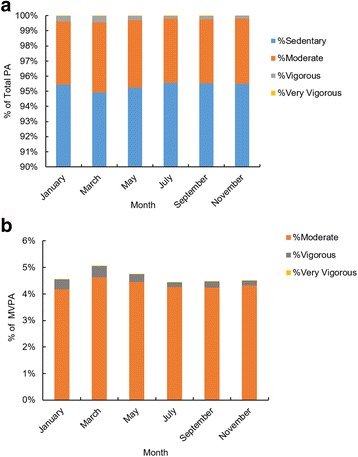
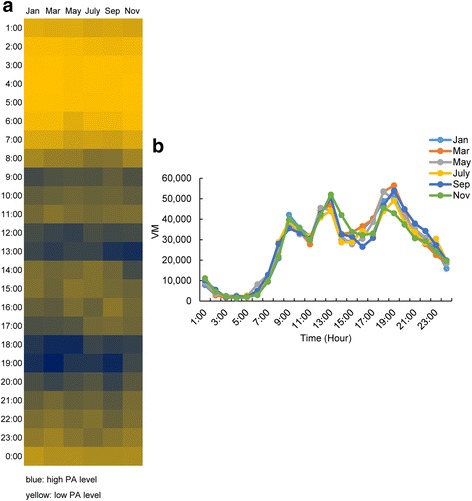
The main factors influencing activity levels were the time of day and individual characteristics including age and body fatness, but there was no significant difference between the months. In addition, there was no significant impact of either ambient temperature or air pollution levels (PM2.5). There were also no significant differences over the year in the time spent at sedentary-light, moderate and very vigorous PA levels, but for vigorous PA level which occupied less than 0.5% daily physical activity, both month and individual were significant factors.
The relatively constant pattern of urban daily life, independent of time of year, may override the potential impacts of environmental factors that would be anticipated to impact PA levels. These subjects did not specifically avoid activity coincident with elevated air pollution levels (PM2.5). Single week long measurements of physical activity could provide a representative measurement of the physical active levels in this population.
体育活动(PA)被广泛认为对健康有益,并且可能受到多种环境因素的影响,如环境温度、天气状况和空气污染水平。由于这些因素随季节变化,体育活动的参与情况也可能随季节变化。当前用于描述体育活动情况的人群研究通常只对个体进行一次抽样,如果存在强烈的季节变化,这可能导致估计偏差。
我们使用GT3X加速度计对40名居住在北京的汉族成年人进行了一项研究。我们在一整年中每两个月测量一次体育活动水平,同时监测环境温度和空气污染水平。测量了平均每小时向量大小(VM)以及在每种体育活动强度(久坐至轻度、中度、剧烈和非常剧烈)下花费的时间百分比。使用一般线性模型(GLMs)来探讨一天中的时间、温度和PM 2.5水平对体育活动的影响。使用单因素方差分析来测试体重和体脂是否存在季节性差异。
影响活动水平的主要因素是一天中的时间以及包括年龄和体脂在内的个体特征,但各月份之间没有显著差异。此外,环境温度和空气污染水平(PM2.5)均没有显著影响。在久坐至轻度、中度和非常剧烈的体育活动水平下花费的时间在一年中也没有显著差异,但对于占每日体育活动不到0.5%的剧烈体育活动水平,月份和个体都是显著因素。
与一年中的时间无关的相对恒定的城市日常生活模式,可能会抵消预期会影响体育活动水平的环境因素的潜在影响。这些受试者没有特意避免在空气污染水平(PM2.5)升高时进行活动。对体育活动进行为期一周的单次测量可以提供该人群体育活动水平的代表性测量。