Center for Substance Abuse Research, Lewis Katz School of Medicine, Temple University, Philadelphia, PA, USA.
National Institute on Drug Abuse, Neuronal Networks Sections, National Institutes of Health, Baltimore, MD,, USA.
Addict Biol. 2018 Jan;23(1):247-255. doi: 10.1111/adb.12507. Epub 2017 Apr 17.
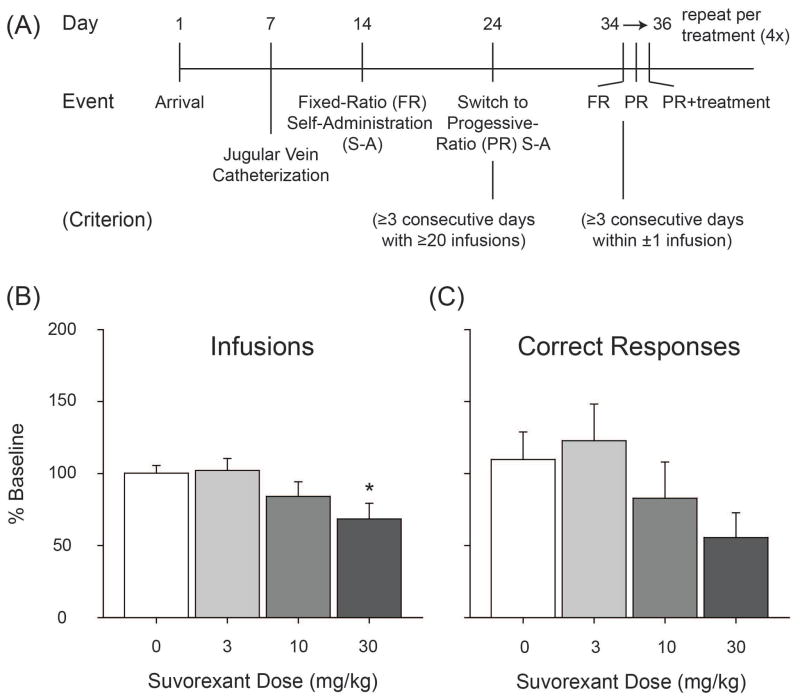
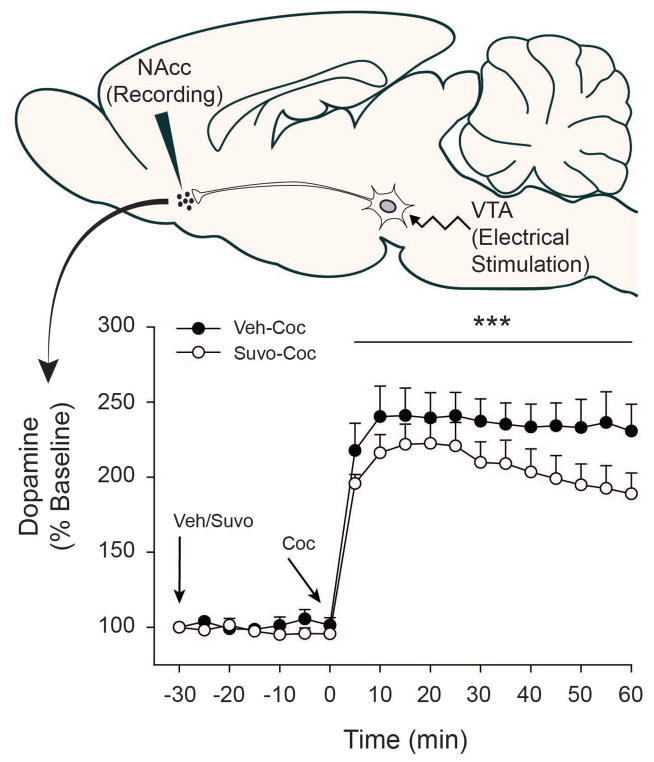
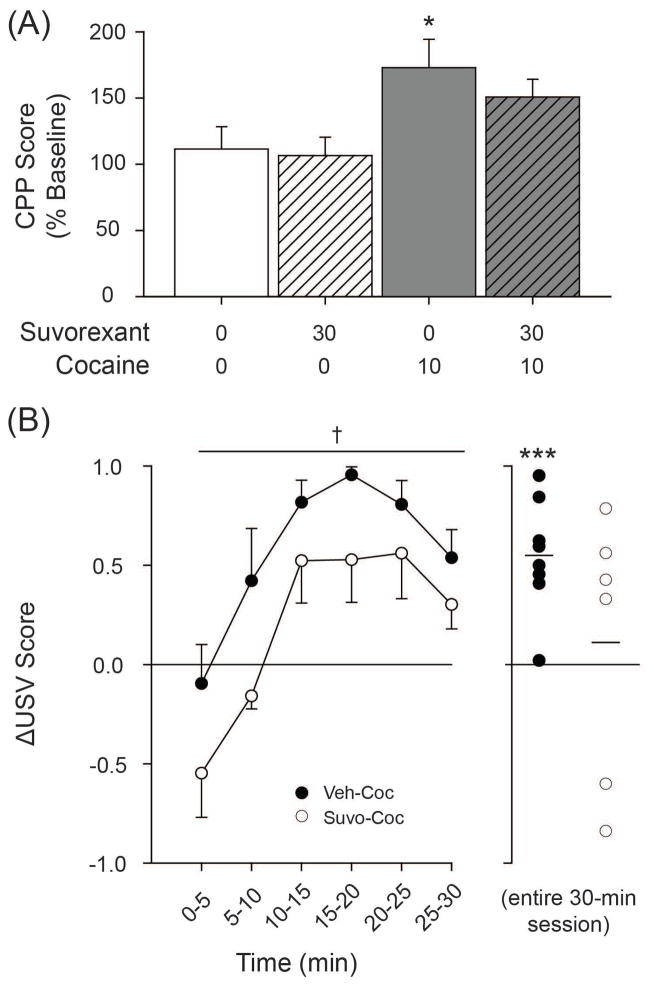
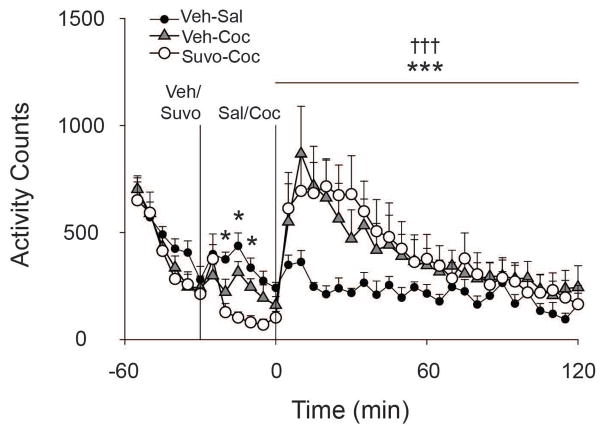
Orexins ('hypocretins') are peptides produced by neurons of the hypothalamus that project to structures implicated in reward and emotion processing. Converging evidence demonstrates functional roles of orexin signaling in arousal, sleep/wakefulness and motivated behaviors for natural and drug rewards. Suvorexant, a dual orexin receptor antagonist, recently received approval from the US Food and Drug Administration to treat insomnia. In Experiment 1, rats self-administered cocaine under a progressive-ratio schedule of reinforcement and the effects of suvorexant on motivation to self-administer cocaine were measured. In Experiment 2, the effects of suvorexant on cocaine reward were assessed by using a place conditioning paradigm, and 50-kHz ultrasonic vocalizations were also recorded to track changes in hedonic reactivity to cocaine. To rule out potentially confounding effects of suvorexant-induced somnolence, locomotor activity was also measured. In Experiment 3, the effects of suvorexant on cocaine-evoked elevations in ventral striatal dopamine were examined. Data reveal that suvorexant (i) reduced the number of cocaine infusions earned during progressive-ratio self-administration; (ii) attenuated initial positive hedonic reactivity to cocaine and prevented cocaine place preference; (iii) did not affect cocaine-induced hyperlocomotion and (iv) reduced cocaine-induced elevations in extracellular ventral striatal dopamine. The present study examined the therapeutic potential of suvorexant in rodent models of cocaine use disorder. These results contribute toward a growing literature supporting therapeutic roles of orexin receptor antagonists in treating substance use disorders.
食欲素(“下丘脑分泌素”)是由下丘脑神经元产生的肽,投射到与奖励和情绪处理有关的结构。越来越多的证据表明,食欲素信号在觉醒、睡眠/觉醒和自然和药物奖励的动机行为中具有功能作用。苏沃雷生是一种双重食欲素受体拮抗剂,最近获得了美国食品和药物管理局的批准,用于治疗失眠。在实验 1 中,大鼠在递增比率强化方案下自行注射可卡因,并测量苏沃雷生对自行注射可卡因的动机的影响。在实验 2 中,通过使用位置条件反射范式评估苏沃雷生对可卡因奖励的影响,还记录了 50-kHz 超声发声,以跟踪对可卡因的愉悦反应的变化。为了排除苏沃雷生引起的嗜睡可能产生的混淆影响,还测量了运动活动。在实验 3 中,研究了苏沃雷生对可卡因引起的腹侧纹状体多巴胺升高的影响。数据显示,苏沃雷生(i)减少了在递增比率自我给药期间获得的可卡因输注次数;(ii)减弱了对可卡因的初始积极愉悦反应,并阻止了可卡因的位置偏好;(iii)不影响可卡因引起的过度运动;(iv)降低了可卡因引起的腹侧纹状体多巴胺的升高。本研究在可卡因使用障碍的啮齿动物模型中检查了苏沃雷生的治疗潜力。这些结果有助于支持食欲素受体拮抗剂在治疗物质使用障碍方面具有治疗作用的越来越多的文献。