Ferrer-Batallé Montserrat, Llop Esther, Ramírez Manel, Aleixandre Rosa Núria, Saez Marc, Comet Josep, de Llorens Rafael, Peracaula Rosa
Biochemistry and Molecular Biology Unit, Department of Biology, University of Girona, 17003 Girona, Spain.
Girona Biomedical Research Institute (IDIBGI), 17190 Salt (Girona), Spain.
Int J Mol Sci. 2017 Apr 17;18(4):845. doi: 10.3390/ijms18040845.
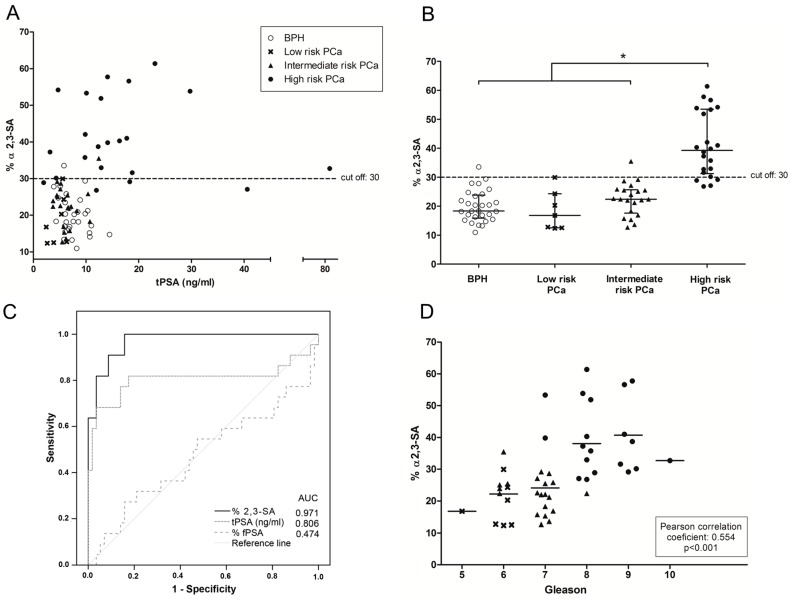
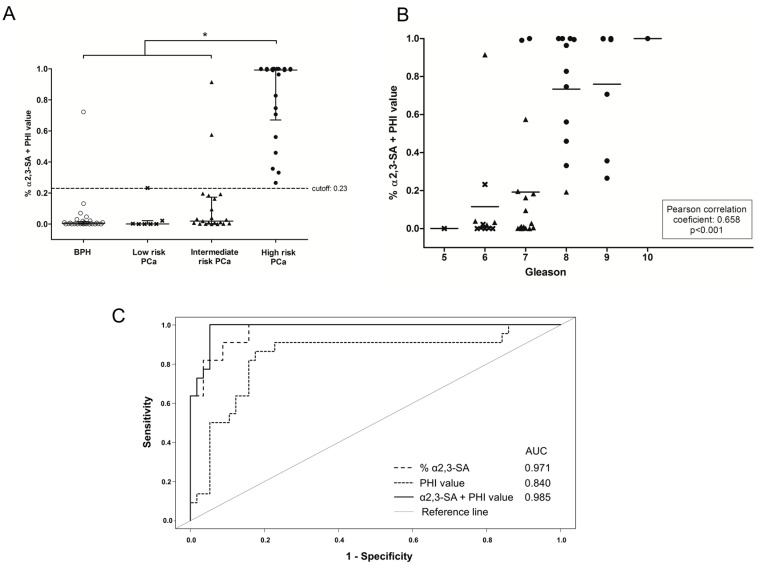
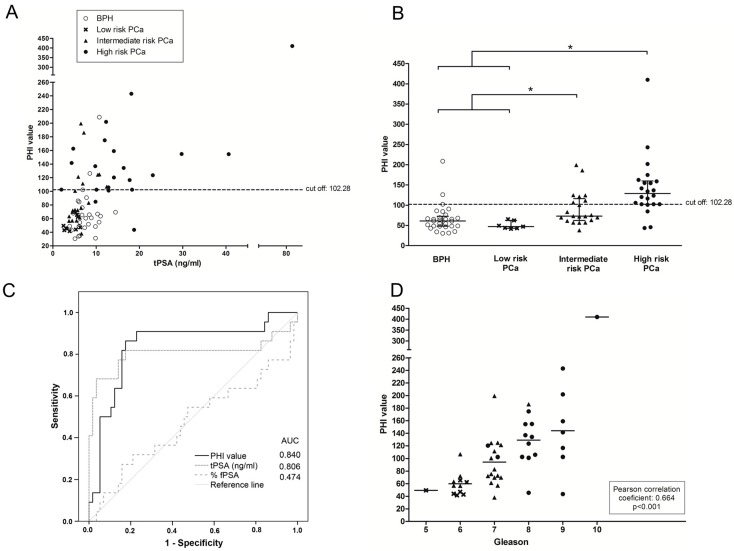
Prostate Specific Antigen (PSA) is the most commonly used serum marker for prostate cancer (PCa), although it is not specific and sensitive enough to allow the differential diagnosis of the more aggressive tumors. For that, new diagnostic methods are being developed, such as PCA-3, PSA isoforms that have resulted in the 4K score or the Prostate Health Index (PHI), and PSA glycoforms. In the present study, we have compared the PHI with our recently developed PSA glycoform assay, based on the determination of the α2,3-sialic acid percentage of serum PSA (% α2,3-SA), in a cohort of 79 patients, which include 50 PCa of different grades and 29 benign prostate hyperplasia (BPH) patients. The % α2,3-SA could distinguish high-risk PCa patients from the rest of patients better than the PHI (area under the curve (AUC) of 0.971 vs. 0.840), although the PHI correlated better with the Gleason score than the % α2,3-SA. The combination of both markers increased the AUC up to 0.985 resulting in 100% sensitivity and 94.7% specificity to differentiate high-risk PCa from the other low and intermediate-risk PCa and BPH patients. These results suggest that both serum markers complement each other and offer an improved diagnostic tool to identify high-risk PCa, which is an important requirement for guiding treatment decisions.
前列腺特异性抗原(PSA)是前列腺癌(PCa)最常用的血清标志物,尽管其特异性和敏感性不足以对侵袭性更强的肿瘤进行鉴别诊断。为此,正在开发新的诊断方法,如PCA-3、可得出4K评分或前列腺健康指数(PHI)的PSA异构体,以及PSA糖型。在本研究中,我们在79例患者队列中,将PHI与我们最近开发的基于测定血清PSA的α2,3-唾液酸百分比(%α2,3-SA)的PSA糖型检测方法进行了比较,该队列包括50例不同分级的PCa患者和29例良性前列腺增生(BPH)患者。%α2,3-SA比PHI能更好地将高危PCa患者与其他患者区分开来(曲线下面积(AUC)分别为0.971和0.840),尽管PHI与Gleason评分的相关性比%α2,3-SA更好。两种标志物联合使用可将AUC提高至0.985,对鉴别高危PCa与其他低危和中危PCa及BPH患者的敏感性达100%,特异性达94.7%。这些结果表明,两种血清标志物相互补充,为识别高危PCa提供了一种改进的诊断工具,这是指导治疗决策的一项重要要求。