Sewerin Philipp, Vordenbaeumen Stefan, Hoyer Annika, Brinks Ralph, Buchbender Christian, Miese Falk, Schleich Christoph, Klein Sabine, Schneider Matthias, Ostendorf Benedikt
Department of Rheumatology & Hiller Research Unit, University Hospital Düsseldorf, Moorenstreet 5, Duesseldorf, 40225, Germany.
German Diabetes Centre, Institute for Biometry and Epidemiology, Auf'm Hennekamp 65, Duesseldorf, 40225, Germany.
BMC Musculoskelet Disord. 2017 Apr 19;18(1):163. doi: 10.1186/s12891-017-1528-y.
Remission is arguably the ultimate therapeutic goal in rheumatoid arthritis (RA). Applying modern strategies, clinical remission can be achieved in a substantial number of patients with early RA (ERA). Even in those patients, the number and scope of erosions can increase. We, therefore, investigated the value of MRI for the detection of radiological progression in patients with DAS28 improvement and/or clinical remission of the German Remission-plus cohort.
Data-sets of 80 RA patients (according to 2010 ACR/EULAR criteria) from the Remission-plus study cohort, who fulfilled the following criteria, were retrospectively analysed: availability of two consecutive MRI scans (low-field MRI, follow-up interval 1 year) of the clinically dominant hand and wrist, and the presence of DAS28 (CRP) scores at both time points, which was used to assess disease activity.
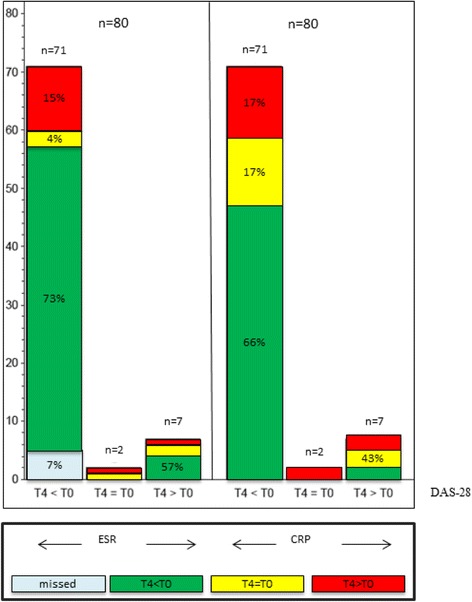
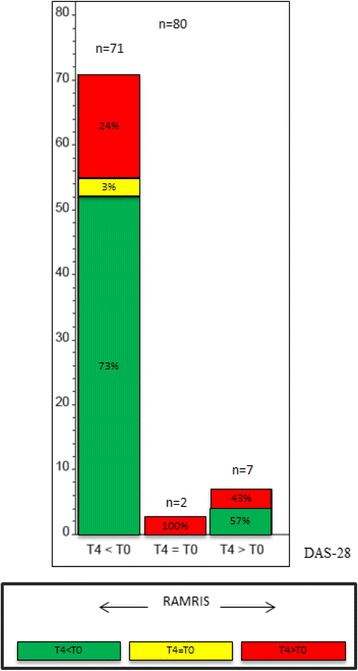
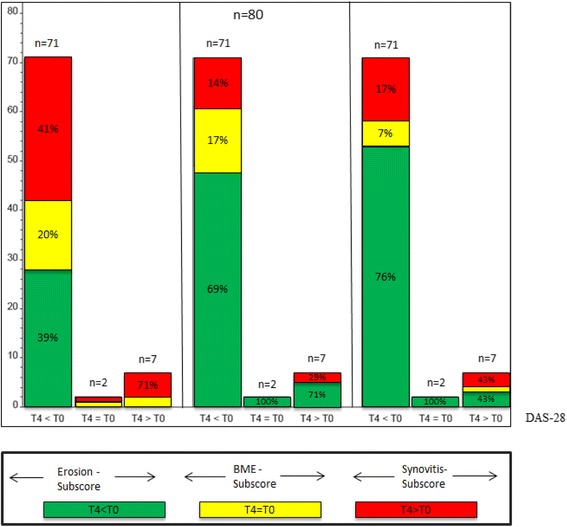
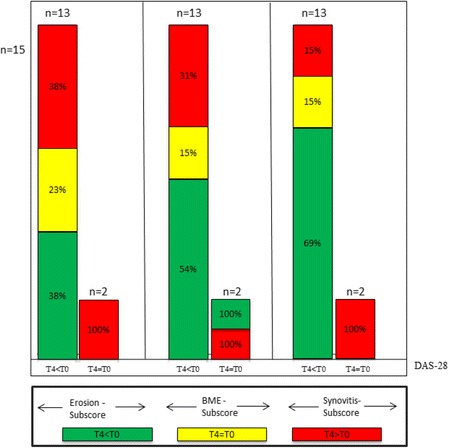
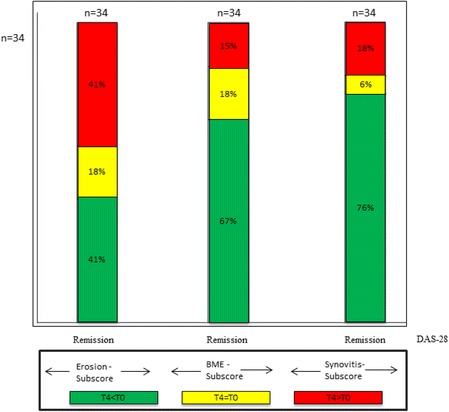
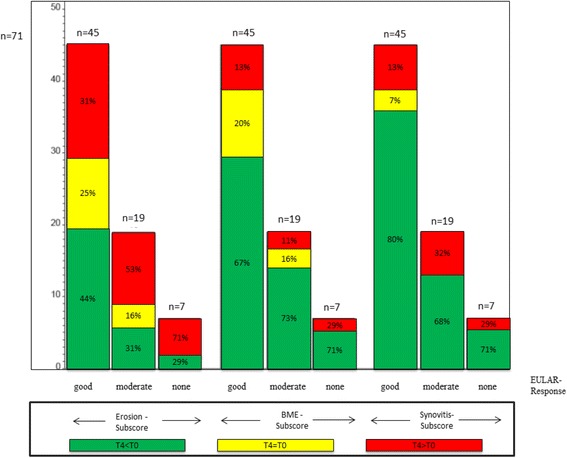
Seventy-one of the 80 investigated patients presented a numerical improvement of the DAS28 (CRP) after 12 months (DAS28(CRP) T0 average (Ø) 4.96, SD 1.2; DAS28 T4 (12 month) Ø 2.6, SD 1.0), 73% of them also improved in the RAMRIS-Score, while 24% demonstrated an increase despite DAS28 improvement and 3% showed equal values. 48% of patients who improved in the DAS28 reached EULAR remission. 41% of these patients had an increase in the RAMRIS Erosion-subscore after 12 months. When considering EULAR response criteria (non-response (n = 7), moderate response (n = 19), good response (n = 45)), an increase of erosions was found in 71.4% of non-responders, 52.6% of moderate responders, and 31.1% of good responders after 12 months, all compared to baseline.
Up to 40% of patients in this study demonstrated a progressive erosive disease detected by MRI despite DAS28 improvement or EULAR remission. Future studies are needed to determine the prognostic clinical impact of disease progression in MRI despite clinical remission, and to investigate if DAS28 remission may be an insufficient therapeutic goal and should be accompanied by MRI remission criteria.
缓解可以说是类风湿关节炎(RA)的最终治疗目标。采用现代治疗策略,相当一部分早期类风湿关节炎(ERA)患者可以实现临床缓解。即便如此,这些患者的骨侵蚀数量和范围仍可能增加。因此,我们对德国缓解加队列研究中疾病活动评分28(DAS28)改善和/或临床缓解的患者进行了MRI检查,以评估其在检测放射学进展方面的价值。
对缓解加研究队列中的80例RA患者(根据2010年美国风湿病学会/欧洲抗风湿病联盟标准)的数据集进行回顾性分析,这些患者需满足以下标准:有临床症状明显的手和腕部连续两次MRI扫描(低场MRI,随访间隔1年),且两个时间点均有DAS28(CRP)评分,用于评估疾病活动度。
80例研究患者中,71例在12个月后DAS28(CRP)评分有数值改善(DAS(CRP) T0平均值(Ø)4.96,标准差1.2;DAS28 T4(12个月)Ø 2.6,标准差1.0),其中73%的患者类风湿关节炎磁共振成像评分(RAMRIS)也有所改善,24%的患者尽管DAS28评分改善但RAMRIS评分仍升高,3%的患者评分无变化。DAS28评分改善的患者中有48%达到了欧洲抗风湿病联盟(EULAR)缓解标准。其中41%的患者在12个月后RAMRIS侵蚀亚评分增加。根据EULAR反应标准(无反应(n = 7)、中度反应(n = 19)、良好反应(n = 45)),与基线相比,12个月后71.4%的无反应者、52.6%的中度反应者和31.1%的良好反应者出现了侵蚀增加。
本研究中高达40%的患者尽管DAS28评分改善或达到EULAR缓解,但MRI检查仍显示有进行性侵蚀性疾病。未来需要开展研究,以确定尽管实现了临床缓解,但MRI显示的疾病进展对预后的临床影响,并探讨DAS28缓解是否可能是一个不充分的治疗目标,是否应辅以MRI缓解标准。