Gwak Jae Moon, Kim Milim, Kim Hyun Jeong, Jang Min Hye, Park So Yeon
Department of Pathology, Seoul National University College of Medicine, Seoul, Republic of Korea.
Green Cross Laboratory, Yongin, Gyeonggi, Republic of Korea.
Oncotarget. 2017 May 30;8(22):36305-36318. doi: 10.18632/oncotarget.16750.
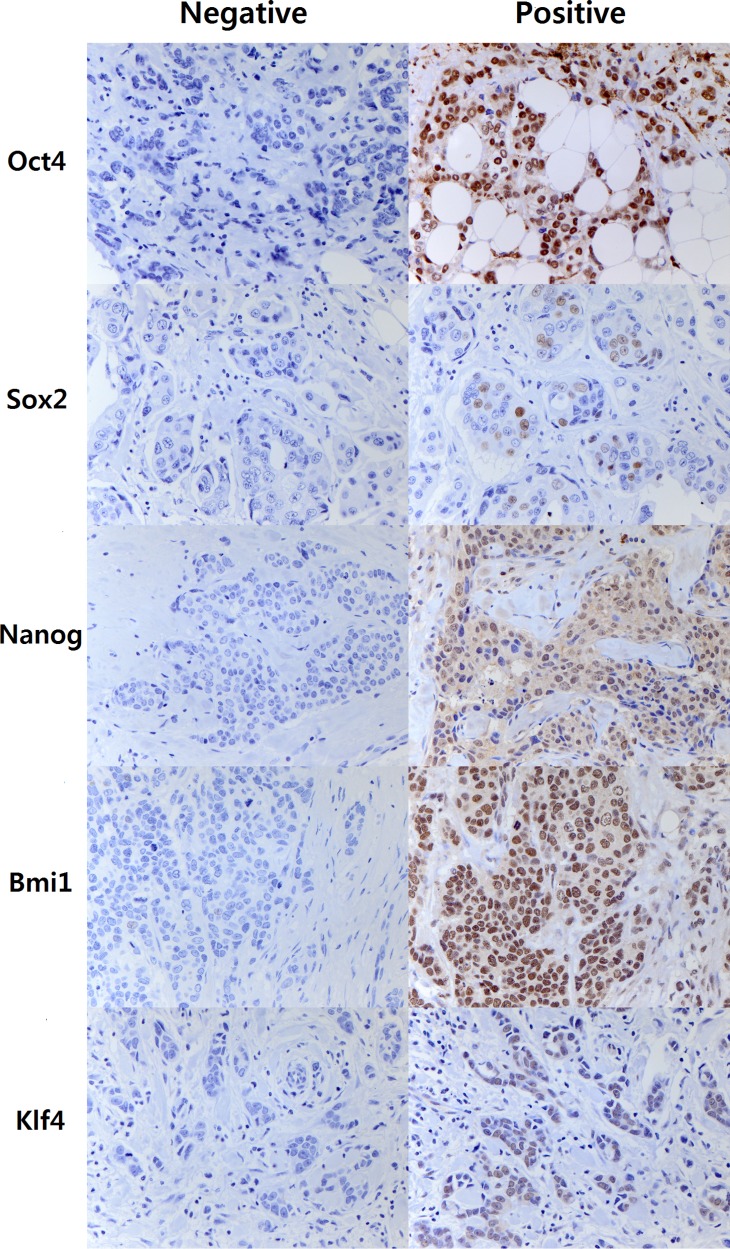
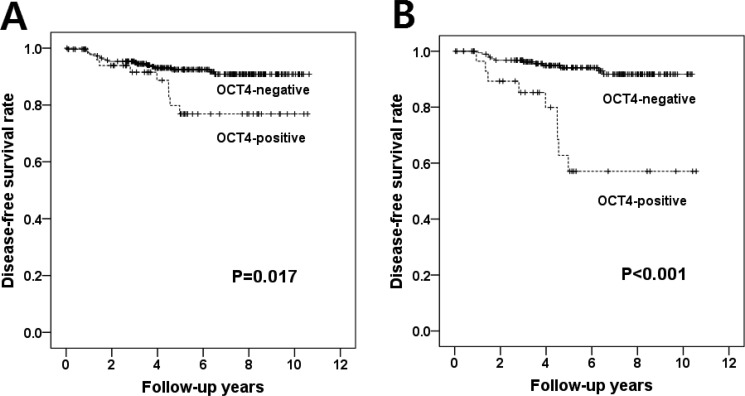
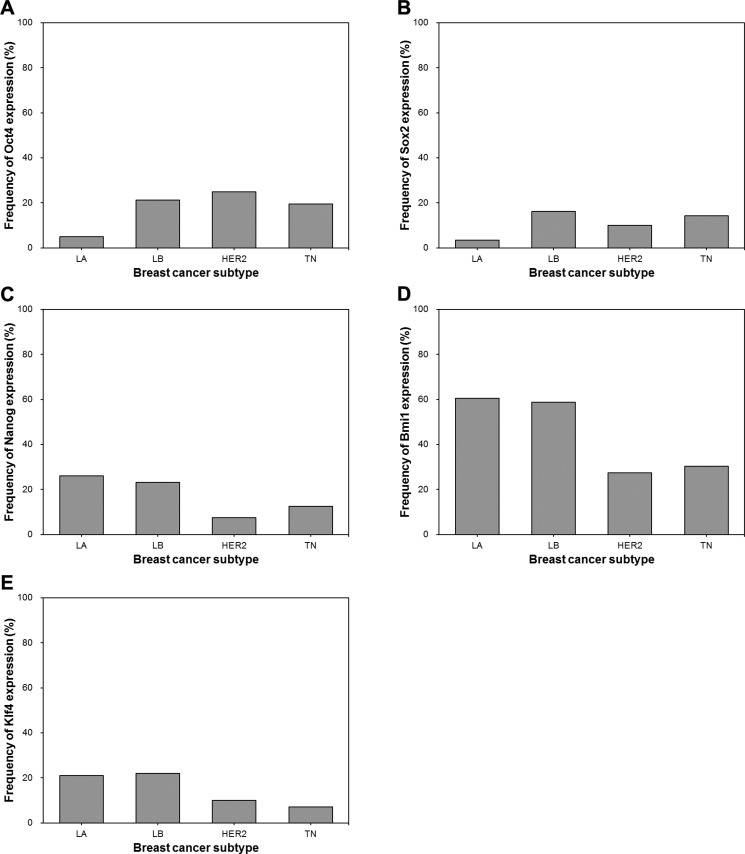
The transcription factors of embryonic stem cells, such as Oct4, Sox2, Nanog, Bmi1, and Klf4, are known to be associated with stemness, epithelial-mesenchymal transition and aggressive tumor behavior. This study was designed to evaluate the clinicopathological significance of their expression in breast cancer. Immunohistochemistry for Oct4, Sox2, Nanog, Bmi1, and Klf4 was performed in 319 cases of invasive breast cancer. The relationship between the expression of these markers and clinicopathologic features of the tumors, including breast cancer stem cell phenotype and epithelial-mesenchymal transition marker expression, and their prognostic value in breast cancer, were analyzed. Expression of Oct4 and Sox2 was commonly associated with high histologic grade and high Ki-67 index in the whole group and in the hormone receptor-positive subgroup. On the other hand, expression of Nanog, Bmi1, and Klf4 was inversely correlated with aggressive features of the breast cancer. Oct4 expression was associated with ALDH1 expression but not with epithelial-mesenchymal transition marker expression. In survival analysis, Oct4 expression was independently associated with poor prognosis in the whole group and in the hormone receptor-positive subgroup, but not in hormone receptor-negative subgroup. Particularly, Oct4 expression was associated with poor clinical outcome in patients with hormone receptor-positive breast cancer treated with tamoxifen. Our results indicate that Oct4 expression is associated with aggressive features, ALDH1 expression, tamoxifen resistance and poor clinical outcomes in hormone receptor-positive breast cancer, and thus may be useful as a predictive and prognostic marker in this subgroup of breast cancer.
胚胎干细胞的转录因子,如Oct4、Sox2、Nanog、Bmi1和Klf4,已知与干性、上皮-间质转化及侵袭性肿瘤行为相关。本研究旨在评估它们在乳腺癌中表达的临床病理意义。对319例浸润性乳腺癌病例进行了Oct4、Sox2、Nanog、Bmi1和Klf4的免疫组织化学检测。分析了这些标志物的表达与肿瘤临床病理特征(包括乳腺癌干细胞表型和上皮-间质转化标志物表达)之间的关系及其在乳腺癌中的预后价值。在整个研究组以及激素受体阳性亚组中,Oct4和Sox2的表达通常与高组织学分级和高Ki-67指数相关。另一方面,Nanog、Bmi1和Klf4的表达与乳腺癌的侵袭性特征呈负相关。Oct4表达与ALDH1表达相关,但与上皮-间质转化标志物表达无关。在生存分析中,Oct4表达在整个研究组和激素受体阳性亚组中与不良预后独立相关,但在激素受体阴性亚组中并非如此。特别地,Oct4表达与接受他莫昔芬治疗的激素受体阳性乳腺癌患者的不良临床结局相关。我们的结果表明,Oct4表达与激素受体阳性乳腺癌的侵袭性特征、ALDH1表达、他莫昔芬耐药及不良临床结局相关,因此可能作为该亚组乳腺癌的预测和预后标志物。