Medina-Ramírez Max, Sanders Rogier W, Sattentau Quentin J
aDepartment of Medical Microbiology, Academic Medical Center, University of Amsterdam, Amsterdam, The Netherlands bDepartment of Microbiology and Immunology, Weill Medical College of Cornell University, New York, USA cSir William Dunn School of Pathology, University of Oxford, South Parks Road, Oxford, UK.
Curr Opin HIV AIDS. 2017 May;12(3):241-249. doi: 10.1097/COH.0000000000000363.
To provide an update on the latest developments in the field of HIV-1 antibody-based soluble envelope glycoprotein (Env) trimer design for vaccine use.
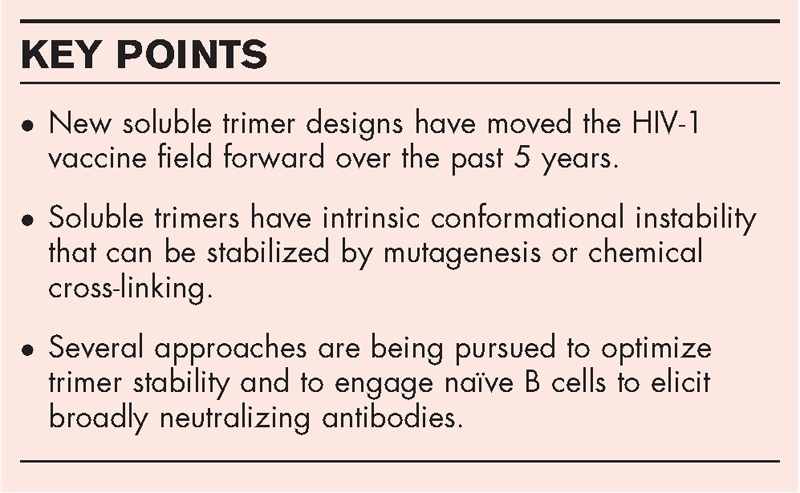
The development of soluble native-like HIV-1 Env trimer immunogens has moved the field of antibody-based vaccine design forward dramatically over the past few years with refinement of various stabilizing approaches. However, despite this progress, significant challenges remain. Firstly, although trimers are relatively stable in solution, they nevertheless sample different conformational states, some of which may be less relevant to binding and induction of broadly neutralizing antibodies (bNAbs). Secondly, these trimers expose unwanted immunodominant surfaces that may distract the adaptive immune response from recognizing more immunorecessive but conserved neutralization-relevant surfaces on the trimer. The availability of atomic-resolution structural information has allowed guided design of mutations that have further stabilized trimers and allowed reduced exposure of unwanted epitopes. Moreover, chemical cross-linking approaches that do not require structural information have also contributed to trimer stabilization and selection of particular conformational forms. However, current knowledge suggests that strategies additional to trimer stabilization will be required to elicit bNAb, including targeting naïve B cell receptors with specific immunogens, and guiding B cell lineages toward recognizing conserved surfaces on Env with high affinity.
This review will give a perspective on these challenges, and summarize current approaches to overcoming them with the aim of developing immunogens to elicit bNAb responses in humans by active vaccination.
提供关于用于疫苗的基于HIV-1抗体的可溶性包膜糖蛋白(Env)三聚体设计领域最新进展的更新。
在过去几年中,随着各种稳定方法的改进,可溶性天然样HIV-1 Env三聚体免疫原的开发极大地推动了基于抗体的疫苗设计领域的发展。然而,尽管取得了这一进展,重大挑战仍然存在。首先,尽管三聚体在溶液中相对稳定,但它们仍会呈现不同的构象状态,其中一些可能与广泛中和抗体(bNAb)的结合和诱导不太相关。其次,这些三聚体暴露了不需要的免疫显性表面,这可能会使适应性免疫反应从识别三聚体上更多免疫隐性但保守的中和相关表面上分散注意力。原子分辨率结构信息的可用性使得能够进行引导性突变设计,进一步稳定了三聚体,并减少了不需要的表位的暴露。此外,不需要结构信息的化学交联方法也有助于三聚体的稳定和特定构象形式的选择。然而,目前的知识表明,引发bNAb还需要三聚体稳定化之外的策略,包括用特定免疫原靶向幼稚B细胞受体,以及引导B细胞谱系以高亲和力识别Env上的保守表面。
本综述将对这些挑战进行展望,并总结当前克服这些挑战的方法,目的是通过主动免疫接种开发能在人体内引发bNAb反应的免疫原。