Chen Yongyu, Peng Yan, Yu Jiahui, Chen Ting, Wu Yaxin, Shi Lei, Li Qing, Wu Jiao, Fu Xiangsheng
Department of Gastroenterology, The Affiliated Hospital of Southwest Medical University, Sichuan, 646000, China.
Oncotarget. 2017 May 9;8(19):31802-31814. doi: 10.18632/oncotarget.15992.
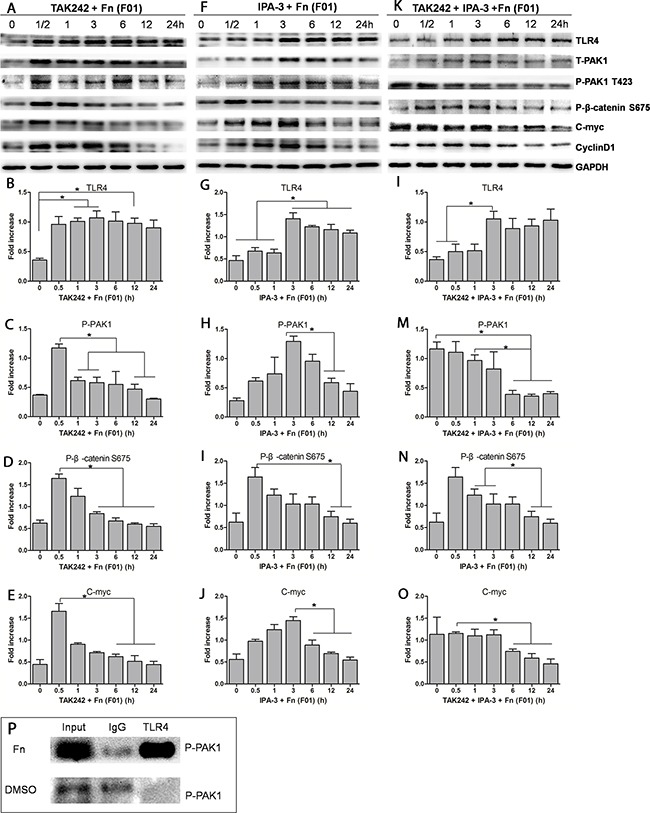
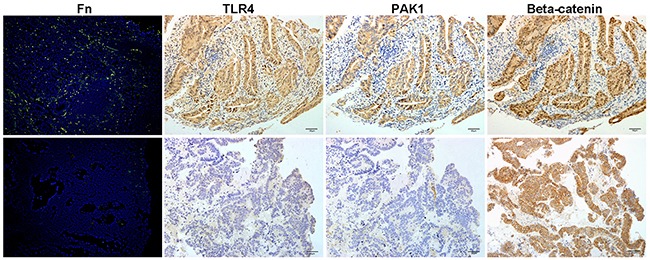
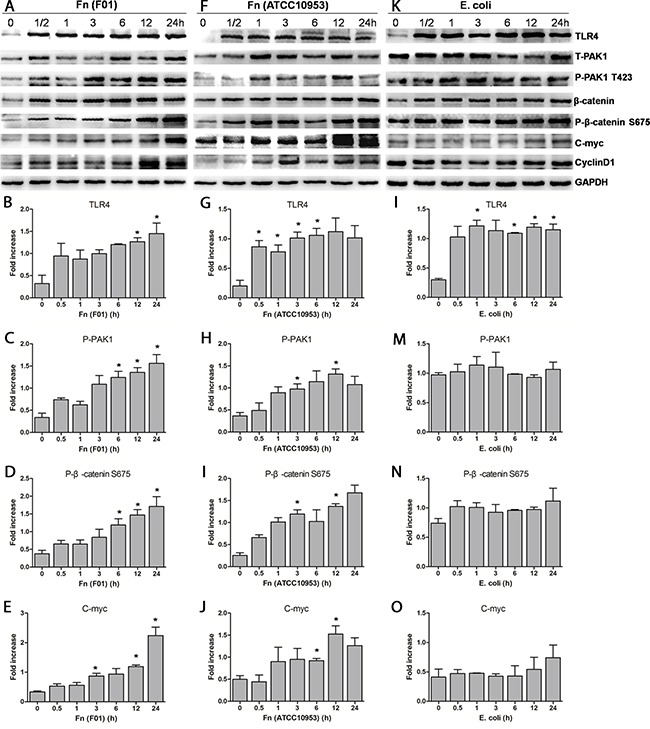
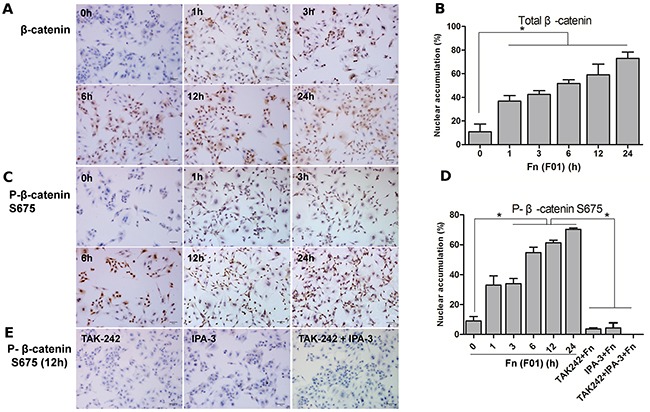
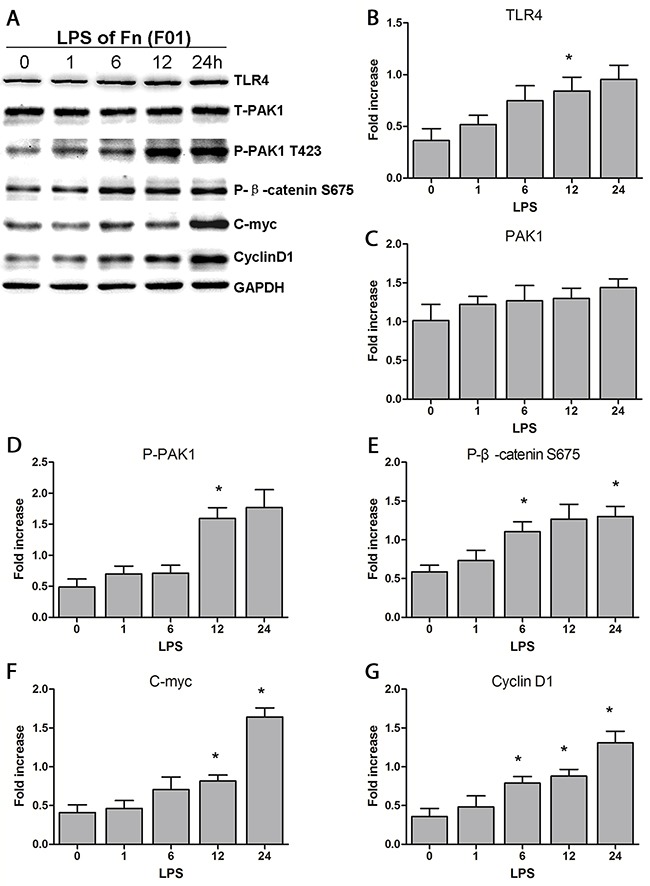
The underlying mechanism of Fusobacterium nucleatum (Fn) in the carcinogenesis of colorectal cancer (CRC) is poorly understood. Here, we examined Fn abundance in CRC tissues, as well as β-catenin, TLR4 and PAK1 protein abundance in Fn positive and Fn negative CRCs. Furthermore, we isolated a strain of Fn (F01) from a CRC tissue and examined whether Fn (F01) infection of colon cancer cells activated β-catenin signaling via the TLR4/P-PAK1/P-β-catenin S675 cascade. Invasive Fn was abundant in 62.2% of CRC tissues. TLR4, PAK1 and nuclear β-catenin proteins were more abundant within Fn-positive over Fn-negative CRCs (P < 0.05). Fn and its lipopolysaccharide induced a significant increase in TLR4/P-PAK1/P-β-catenin S675/C-myc/CyclinD1 protein abundance, as well as in the nuclear translocation of β-catenin. Furthermore, inhibition of TLR4 or PAK1 prior to challenge with Fn significantly decreased protein abundance of P-β-catenin S675, C-myc and Cyclin D1, as well as nuclear β-catenin accumulation. Inhibition of TLR4 significantly decreased P-PAK1 protein abundance, and for the first time, we observed an interaction between TLR4 and P-PAK1 using immunoprecipitation. Our data suggest that invasive Fn activates β-catenin signaling via a TLR4/P-PAK1/P-β-catenin S675 cascade in CRC. Furthermore, TLR4 and PAK1 could be potential pharmaceutical targets for the treatment of Fn-related CRCs.
具核梭杆菌(Fn)在结直肠癌(CRC)致癌过程中的潜在机制尚不清楚。在此,我们检测了CRC组织中Fn的丰度,以及Fn阳性和Fn阴性CRC中β-连环蛋白、TLR4和PAK1蛋白的丰度。此外,我们从一个CRC组织中分离出一株Fn(F01),并检测结肠癌细胞被Fn(F01)感染后是否通过TLR4/P-PAK1/P-β-连环蛋白S675级联激活β-连环蛋白信号通路。62.2%的CRC组织中存在大量侵袭性Fn。在Fn阳性的CRC中,TLR4、PAK1和核β-连环蛋白的含量高于Fn阴性的CRC(P<0.05)。Fn及其脂多糖可显著增加TLR4/P-PAK1/P-β-连环蛋白S675/C- myc/细胞周期蛋白D1的蛋白丰度,以及β-连环蛋白的核转位。此外,在用Fn攻击之前抑制TLR4或PAK1可显著降低P-β-连环蛋白S675、C-myc和细胞周期蛋白D1的蛋白丰度,以及核β-连环蛋白的积累。抑制TLR4可显著降低P-PAK1的蛋白丰度,并且我们首次通过免疫沉淀观察到TLR4与P-PAK1之间的相互作用。我们的数据表明,侵袭性Fn通过CRC中的TLR4/P-PAK1/P-β-连环蛋白S675级联激活β-连环蛋白信号通路。此外,TLR4和PAK1可能是治疗Fn相关CRC的潜在药物靶点。