
骨髓、脂肪和肺组织来源的鼠间质基质细胞释放不同的介质,并在实验性哮喘中差异影响气道和肺实质。
Bone Marrow, Adipose, and Lung Tissue-Derived Murine Mesenchymal Stromal Cells Release Different Mediators and Differentially Affect Airway and Lung Parenchyma in Experimental Asthma.
机构信息
Laboratory of Pulmonary Investigation, Carlos Chagas Filho Institute of Biophysics, Federal University, Rio de Janeiro, Brazil.
Laboratory of Cellular and Molecular Physiology, Carlos Chagas Filho Institute of Biophysics, Federal University, Rio de Janeiro, Brazil.
出版信息
Stem Cells Transl Med. 2017 Jun;6(6):1557-1567. doi: 10.1002/sctm.16-0398. Epub 2017 Apr 20.
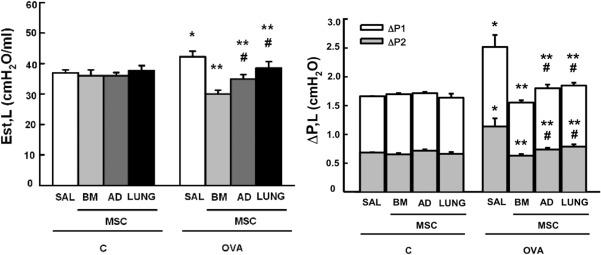
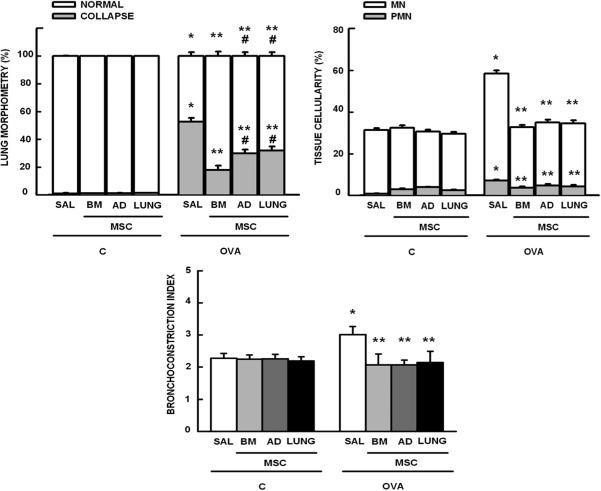
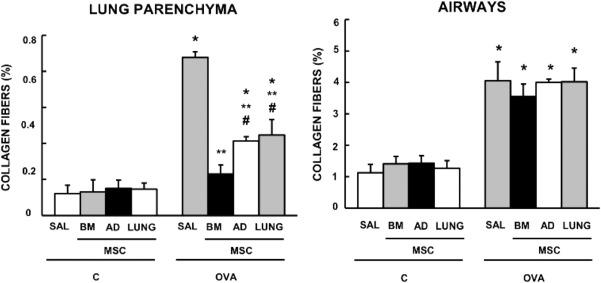
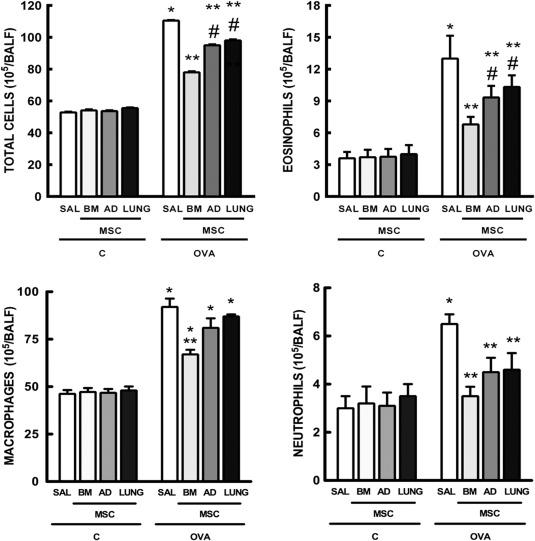
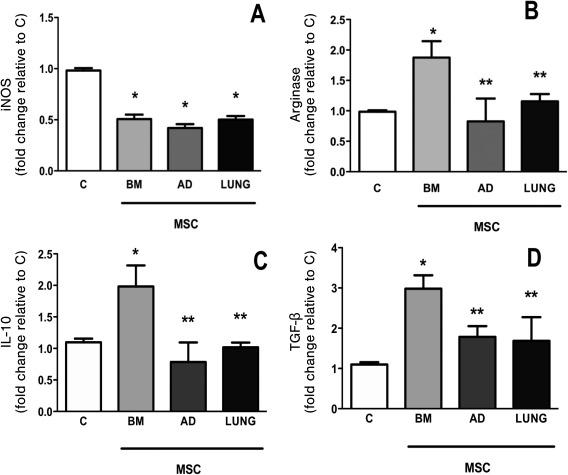
Mesenchymal stromal cells (MSCs) from different sources have differential effects on lung injury. To compare the effects of murine MSCs from bone marrow (BM), adipose tissue (AD), and lung tissue (LUNG) on inflammatory and remodeling processes in experimental allergic asthma, female C57BL/6 mice were sensitized and challenged with ovalbumin (OVA) or saline (C). Twenty-four hours after the last challenge, mice received either saline (50 µl, SAL), BM-MSCs, AD-MSCs, or LUNG-MSCs (10 cells per mouse in 50 µl total volume) intratracheally. At 1 week, BM-MSCs produced significantly greater reductions in resistive and viscoelastic pressures, bronchoconstriction index, collagen fiber content in lung parenchyma (but not airways), eosinophil infiltration, and levels of interleukin (IL)-4, IL-13, transforming growth factor (TGF)-β, and vascular endothelial growth factor (VEGF) in lung homogenates compared to AD-MSCs and LUNG-MSCs. Only BM-MSCs increased IL-10 and interferon (IFN)-γ in lung tissue. In parallel in vitro experiments, BM-MSCs increased M2 macrophage polarization, whereas AD-MSCs and LUNG-MSCs had higher baseline levels of IL-4, insulin-like growth factor (IGF), and VEGF secretion. Exposure of MSCs to serum specimens obtained from asthmatic mice promoted reductions in secretion of these mediators, particularly in BM-MSCs. Intratracheally administered BM-MSCs, AD-MSCs, and LUNG-MSCs were differentially effective at reducing airway inflammation and remodeling and improving lung function in the current model of allergic asthma. In conclusion, intratracheal administration of MSCs from BM, AD, and LUNG were differentially effective at reducing airway inflammation and remodeling and improving lung function comparably reduced inflammation and fibrogenesis in this asthma model. However, altered lung mechanics and lung remodeling responded better to BM-MSCs than to AD-MSCs or LUNG-MSCs. Moreover, each type of MSC was differentially affected in a surrogate in vitro model of the in vivo lung environment. Stem Cells Translational Medicine 2017;6:1557-1567.
间充质基质细胞(MSCs)来自不同的来源,对肺损伤有不同的影响。为了比较骨髓(BM)、脂肪组织(AD)和肺组织(LUNG)来源的鼠 MSCs 对实验性变应性哮喘中炎症和重塑过程的影响,雌性 C57BL/6 小鼠用卵清蛋白(OVA)或生理盐水(C)致敏和激发。最后一次激发后 24 小时,小鼠接受生理盐水(50μl,SAL)、BM-MSCs、AD-MSCs 或 LUNG-MSCs(每只小鼠 50μl 总容积中 10 个细胞)气管内给药。1 周时,BM-MSCs 显著降低阻力和粘性压力、支气管收缩指数、肺实质(而非气道)胶原纤维含量、嗜酸性粒细胞浸润以及肺匀浆中白细胞介素(IL)-4、IL-13、转化生长因子(TGF)-β 和血管内皮生长因子(VEGF)水平,与 AD-MSCs 和 LUNG-MSCs 相比。只有 BM-MSCs 增加了肺组织中的白细胞介素 10 和干扰素(IFN)-γ。在平行的体外实验中,BM-MSCs 增加了 M2 巨噬细胞极化,而 AD-MSCs 和 LUNG-MSCs 具有更高的 IL-4、胰岛素样生长因子(IGF)和 VEGF 分泌的基线水平。将 MSCs 暴露于来自哮喘小鼠的血清标本中,可促进这些介质分泌的减少,特别是在 BM-MSCs 中。气管内给予 BM-MSCs、AD-MSCs 和 LUNG-MSCs 可在当前变应性哮喘模型中,有效降低气道炎症和重塑,改善肺功能。总之,气管内给予 BM、AD 和 LUNG 的 MSC 可有效降低气道炎症和重塑,改善肺功能,在该哮喘模型中同样可降低炎症和纤维化。然而,改变的肺力学和肺重塑对 BM-MSCs 的反应优于 AD-MSCs 或 LUNG-MSCs。此外,每种类型的 MSC 在体内肺环境的替代体外模型中受到不同的影响。干细胞转化医学 2017;6:1557-1567。


 Zotero 插件