de Castro Ligia Lins, Xisto Debora Gonçalves, Kitoko Jamil Zola, Cruz Fernanda Ferreira, Olsen Priscilla Christina, Redondo Patricia Albuquerque Garcia, Ferreira Tatiana Paula Teixeira, Weiss Daniel Jay, Martins Marco Aurélio, Morales Marcelo Marcos, Rocco Patricia Rieken Macedo
Laboratory of Pulmonary Investigation, Carlos Chagas Filho Biophysics Institute, Federal University of Rio de Janeiro, Avenida Carlos Chagas Filho, 373, Bloco G-014, Ilha do Fundão, 21941-902, Rio de Janeiro, RJ, Brazil.
Laboratory of Cellular and Molecular Physiology, Carlos Chagas Filho Biophysics Institute, Federal University of Rio de Janeiro, Rio de Janeiro, RJ, Brazil.
Stem Cell Res Ther. 2017 Jun 24;8(1):151. doi: 10.1186/s13287-017-0600-8.
Asthma is a chronic inflammatory disease that can be difficult to treat due to its complex pathophysiology. Most current drugs focus on controlling the inflammatory process, but are unable to revert the changes of tissue remodeling. Human mesenchymal stromal cells (MSCs) are effective at reducing inflammation and tissue remodeling; nevertheless, no study has evaluated the therapeutic effects of extracellular vesicles (EVs) obtained from human adipose tissue-derived MSCs (AD-MSC) on established airway remodeling in experimental allergic asthma.
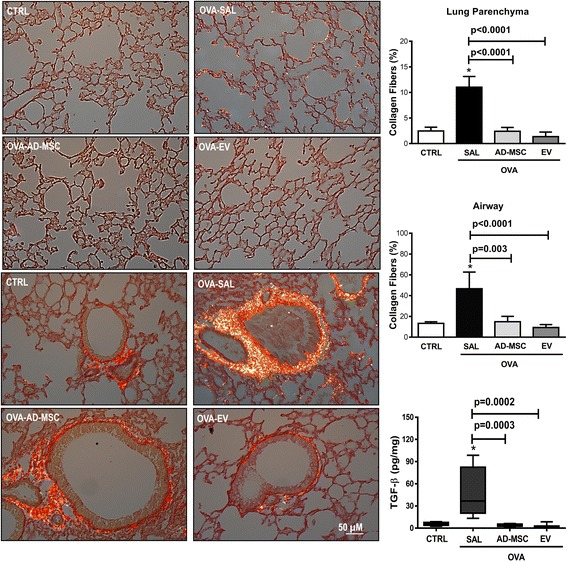
C57BL/6 female mice were sensitized and challenged with ovalbumin (OVA). Control (CTRL) animals received saline solution using the same protocol. One day after the last challenge, each group received saline, 10 human AD-MSCs, or EVs (released by 10 AD-MSCs). Seven days after treatment, animals were anesthetized for lung function assessment and subsequently euthanized. Bronchoalveolar lavage fluid (BALF), lungs, thymus, and mediastinal lymph nodes were harvested for analysis of inflammation. Collagen fiber content of airways and lung parenchyma were also evaluated.
In OVA animals, AD-MSCs and EVs acted differently on static lung elastance and on BALF regulatory T cells, CD3CD4 T cells, and pro-inflammatory mediators (interleukin [IL]-4, IL-5, IL-13, and eotaxin), but similarly reduced eosinophils in lung tissue, collagen fiber content in airways and lung parenchyma, levels of transforming growth factor-β in lung tissue, and CD3CD4 T cell counts in the thymus. No significant changes were observed in total cell count or percentage of CD3CD4 T cells in the mediastinal lymph nodes.
In this immunocompetent mouse model of allergic asthma, human AD-MSCs and EVs effectively reduced eosinophil counts in lung tissue and BALF and modulated airway remodeling, but their effects on T cells differed in lung and thymus. EVs may hold promise for asthma; however, further studies are required to elucidate the different mechanisms of action of AD-MSCs versus their EVs.
哮喘是一种慢性炎症性疾病,由于其复杂的病理生理学,可能难以治疗。目前大多数药物专注于控制炎症过程,但无法逆转组织重塑的变化。人间充质基质细胞(MSCs)在减轻炎症和组织重塑方面有效;然而,尚无研究评估从人脂肪组织来源的MSCs(AD-MSC)获得的细胞外囊泡(EVs)对实验性过敏性哮喘中已建立的气道重塑的治疗效果。
C57BL/6雌性小鼠用卵清蛋白(OVA)致敏并激发。对照组(CTRL)动物按相同方案接受生理盐水溶液。最后一次激发后一天,每组接受生理盐水、10个人AD-MSCs或EVs(由10个AD-MSCs释放)。治疗7天后,对动物进行麻醉以评估肺功能,随后实施安乐死。收集支气管肺泡灌洗液(BALF)、肺、胸腺和纵隔淋巴结用于炎症分析。还评估了气道和肺实质的胶原纤维含量。
在OVA动物中,AD-MSCs和EVs对静态肺弹性和BALF调节性T细胞、CD3CD4 T细胞及促炎介质(白细胞介素[IL]-4、IL-5、IL-13和嗜酸性粒细胞趋化因子)的作用不同,但同样降低了肺组织中的嗜酸性粒细胞、气道和肺实质中的胶原纤维含量、肺组织中转化生长因子-β的水平以及胸腺中CD3CD4 T细胞计数。纵隔淋巴结中CD3CD4 T细胞的总数或百分比未观察到显著变化。
在这个具有免疫活性的过敏性哮喘小鼠模型中,人AD-MSCs和EVs有效降低了肺组织和BALF中的嗜酸性粒细胞计数并调节了气道重塑,但它们对T细胞的作用在肺和胸腺中有所不同。EVs可能对哮喘有治疗前景;然而,需要进一步研究以阐明AD-MSCs与其EVs不同的作用机制。