Zhang Yanfei, Kouril Theresa, Snoep Jacky L, Siebers Bettina, Barberis Matteo, Westerhoff Hans V
Synthetic Systems Biology and Nuclear Organization, Swammerdam Institute for Life Sciences, University of Amsterdam, 1098 XH Amsterdam, The Netherlands.
Molecular Enzyme Technology and Biochemistry (MEB), Biofilm Centre, Centre for Water and Environment Research (CWE), University Duisburg-Essen, Universitätsstr. 5, 45141 Essen, Germany.
Int J Mol Sci. 2017 Apr 20;18(4):876. doi: 10.3390/ijms18040876.
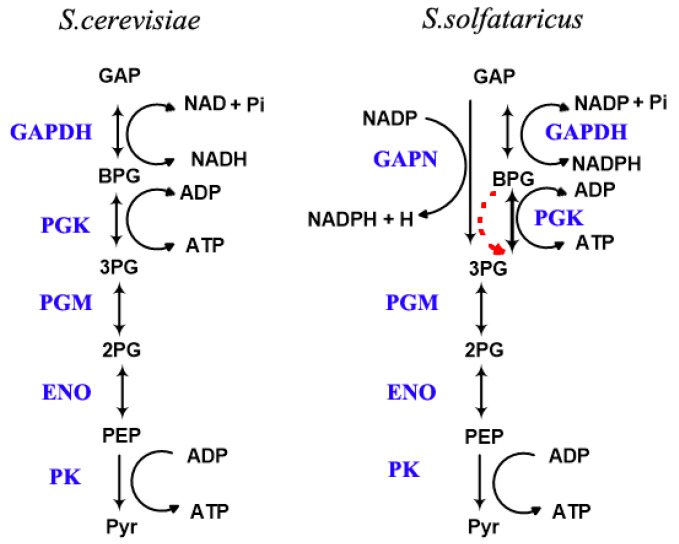
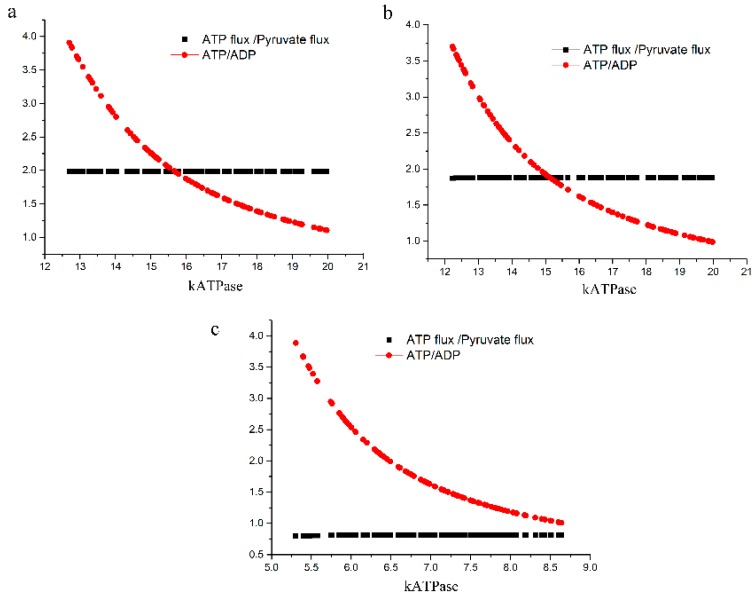
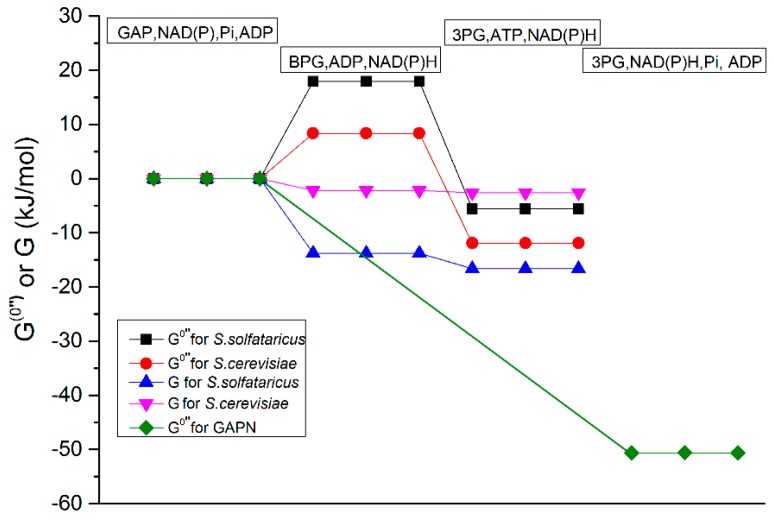
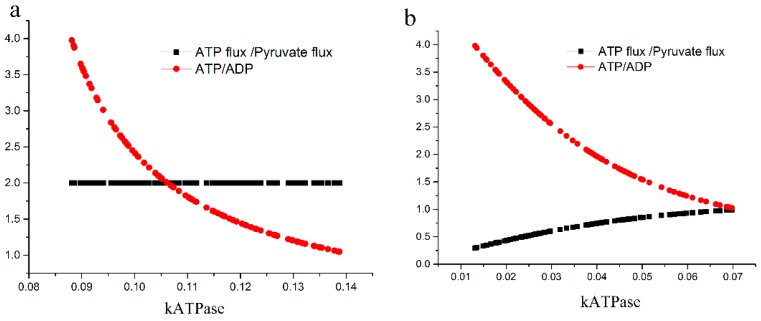
Mathematical models are key to systems biology where they typically describe the topology and dynamics of biological networks, listing biochemical entities and their relationships with one another. Some (hyper)thermophilic Archaea contain an enzyme, called non-phosphorylating glyceraldehyde-3-phosphate dehydrogenase (GAPN), which catalyzes the direct oxidation of glyceraldehyde-3-phosphate to 3-phosphoglycerate omitting adenosine 5'-triphosphate (ATP) formation by substrate-level-phosphorylation via phosphoglycerate kinase. In this study we formulate three hypotheses that could explain functionally why GAPN exists in these Archaea, and then construct and use mathematical models to test these three hypotheses. We used kinetic parameters of enzymes of () which is a thermo-acidophilic archaeon that grows optimally between 60 and 90 °C and between pH 2 and 4. For comparison, we used a model of (), an organism that can live at moderate temperatures. We find that both the first hypothesis, i.e., that the glyceraldehyde-3-phosphate dehydrogenase (GAPDH) plus phosphoglycerate kinase (PGK) route (the alternative to GAPN) is thermodynamically too much uphill and the third hypothesis, i.e., that GAPDH plus PGK are required to carry the flux in the gluconeogenic direction, are correct. The second hypothesis, i.e., that the GAPDH plus PGK route delivers less than the 1 ATP per pyruvate that is delivered by the GAPN route, is only correct when GAPDH reaction has a high rate and 1,3--phosphoglycerate (BPG) spontaneously degrades to 3PG at a high rate.
数学模型是系统生物学的关键,在系统生物学中,数学模型通常描述生物网络的拓扑结构和动态变化,列出生物化学实体及其相互关系。一些嗜热古菌含有一种名为非磷酸化甘油醛-3-磷酸脱氢酶(GAPN)的酶,该酶催化甘油醛-3-磷酸直接氧化为3-磷酸甘油酸,省略了通过磷酸甘油酸激酶进行底物水平磷酸化形成腺苷5'-三磷酸(ATP)的过程。在本研究中,我们提出了三个假设来从功能上解释为什么这些古菌中存在GAPN,然后构建并使用数学模型来检验这三个假设。我们使用了嗜酸嗜热古菌()的酶动力学参数,该古菌在60至90°C以及pH值在2至4之间时生长最佳。为了进行比较,我们使用了中温生物()的模型。我们发现,第一个假设,即甘油醛-3-磷酸脱氢酶(GAPDH)加磷酸甘油酸激酶(PGK)途径(GAPN的替代途径)在热力学上过于耗能,以及第三个假设,即GAPDH加PGK是糖异生方向通量所必需的,都是正确的。第二个假设,即GAPDH加PGK途径产生的ATP比GAPN途径每丙酮酸产生的ATP少1个,只有在GAPDH反应速率高且1,3-二磷酸甘油酸(BPG)以高速率自发降解为3-磷酸甘油酸(3PG)时才正确。