Schumacher Steven E, Shim Byoung Yong, Corso Giovanni, Ryu Min-Hee, Kang Yoon-Koo, Roviello Franco, Saksena Gordon, Peng Shouyong, Shivdasani Ramesh A, Bass Adam J, Beroukhim Rameen
Department of Medical Oncology, Dana-Farber Cancer Institute, Boston, Massachusetts, United States of America.
Cancer Program, Broad Institute of MIT and Harvard, Cambridge, Massachusetts, United States of America.
PLoS One. 2017 Apr 20;12(4):e0176045. doi: 10.1371/journal.pone.0176045. eCollection 2017.
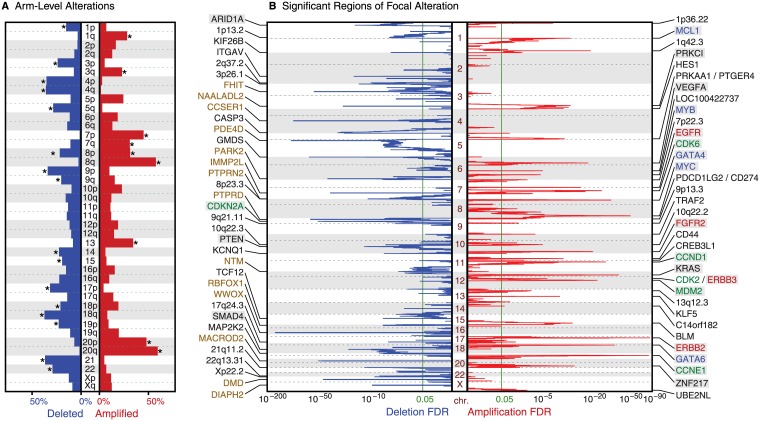
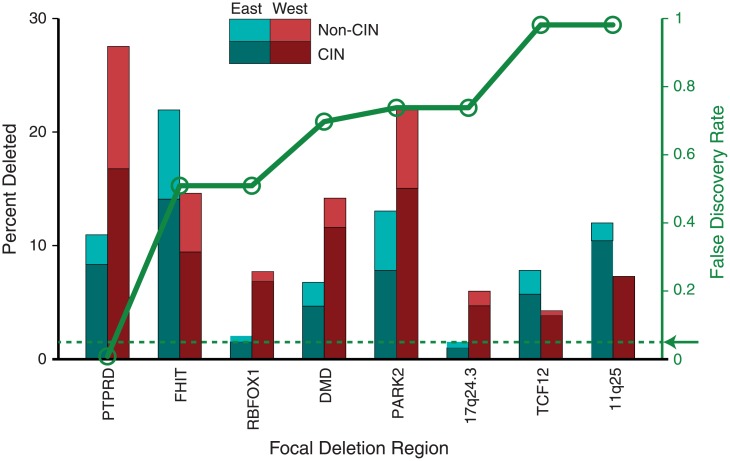
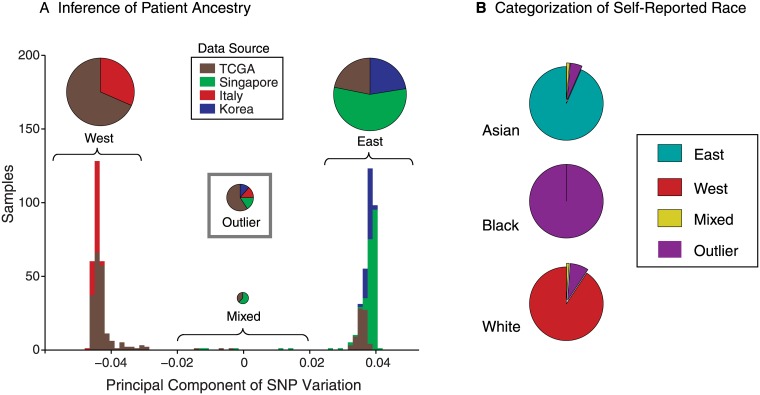
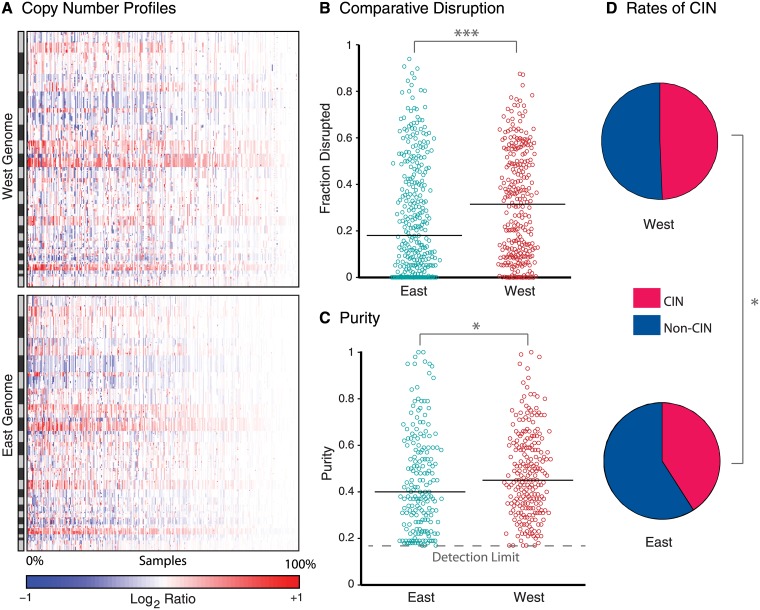
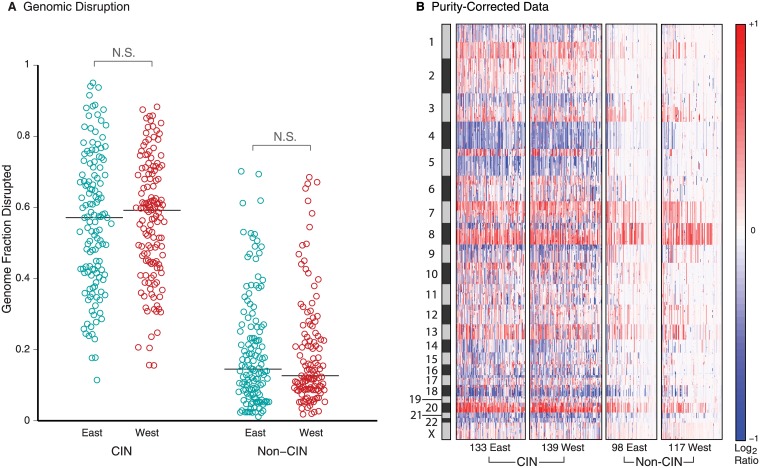
Gastric cancer, a leading worldwide cause of cancer mortality, shows high geographic and ethnic variation in incidence rates, which are highest in East Asia. The anatomic locations and clinical behavior also differ by geography, leading to the controversial idea that Eastern and Western forms of the disease are distinct. In view of these differences, we investigated whether gastric cancers from Eastern and Western patients show distinct genomic profiles. We used high-density profiling of somatic copy-number aberrations to analyze the largest collection to date of gastric adenocarcinomas and utilized genotyping data to rigorously annotate ethnic status. The size of this collection allowed us to accurately identify regions of significant copy-number alteration and separately to evaluate tumors arising in Eastern and Western patients. Among molecular subtypes classified by The Cancer Genome Atlas, the frequency of gastric cancers showing chromosomal instability was modestly higher in Western patients. After accounting for this difference, however, gastric cancers arising in Easterners and Westerners have highly similar somatic copy-number patterns. Only one genomic event, focal deletion of the phosphatase gene PTPRD, was significantly enriched in Western cases, though also detected in Eastern cases. Thus, despite the different risk factors and clinical features, gastric cancer appears to be a fundamentally similar disease in both populations and the divergent clinical outcomes cannot be ascribed to different underlying structural somatic genetic aberrations.
胃癌是全球癌症死亡的主要原因之一,其发病率在地理和种族上存在很大差异,在东亚地区最高。胃癌的解剖位置和临床行为也因地域而异,这导致了一种有争议的观点,即东西方的胃癌形式是不同的。鉴于这些差异,我们研究了东西方患者的胃癌是否具有不同的基因组特征。我们使用体细胞拷贝数畸变的高密度分析方法,分析了迄今为止最大规模的胃腺癌样本集,并利用基因分型数据严格确定种族身份。样本集的规模使我们能够准确识别显著拷贝数改变的区域,并分别评估东西方患者发生的肿瘤。在癌症基因组图谱分类的分子亚型中,显示染色体不稳定的胃癌在西方患者中的频率略高。然而,在考虑到这一差异后,东方人和西方人发生的胃癌具有高度相似的体细胞拷贝数模式。只有一个基因组事件,即磷酸酶基因PTPRD的局灶性缺失,在西方病例中显著富集,尽管在东方病例中也有发现。因此,尽管存在不同的风险因素和临床特征,但胃癌在这两个人群中似乎本质上是相似的疾病,不同的临床结果不能归因于不同的潜在结构性体细胞基因畸变。