Richer Wilfrid, Masliah-Planchon Julien, Clement Nathalie, Jimenez Irene, Maillot Laetitia, Gentien David, Albaud Benoît, Chemlali Walid, Galant Christine, Larousserie Frederique, Boudou-Rouquette Pascaline, Leruste Amaury, Chauvin Celine, Han Zhi Yan, Coindre Jean-Michel, Varlet Pascale, Freneaux Paul, Ranchère-Vince Dominique, Delattre Olivier, Bourdeaut Franck
Paris-Sciences-Lettres, Institut Curie Research Center, INSERMU830 & SiRIC, Laboratory of Translational Research in Pediatric Oncology, 75248 Paris Cedex 5, France.
Paris-Sciences-Lettres, Institut Curie Hospital, Laboratory of Somatic Genetics, 75248 Paris Cedex 5, France.
Oncotarget. 2017 May 23;8(21):34245-34257. doi: 10.18632/oncotarget.15939.
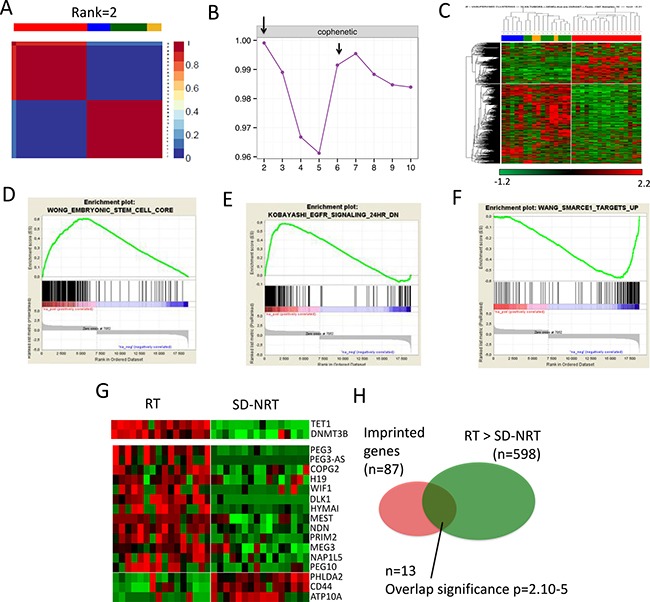
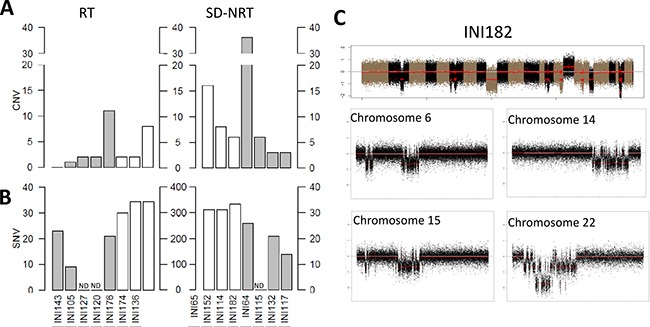
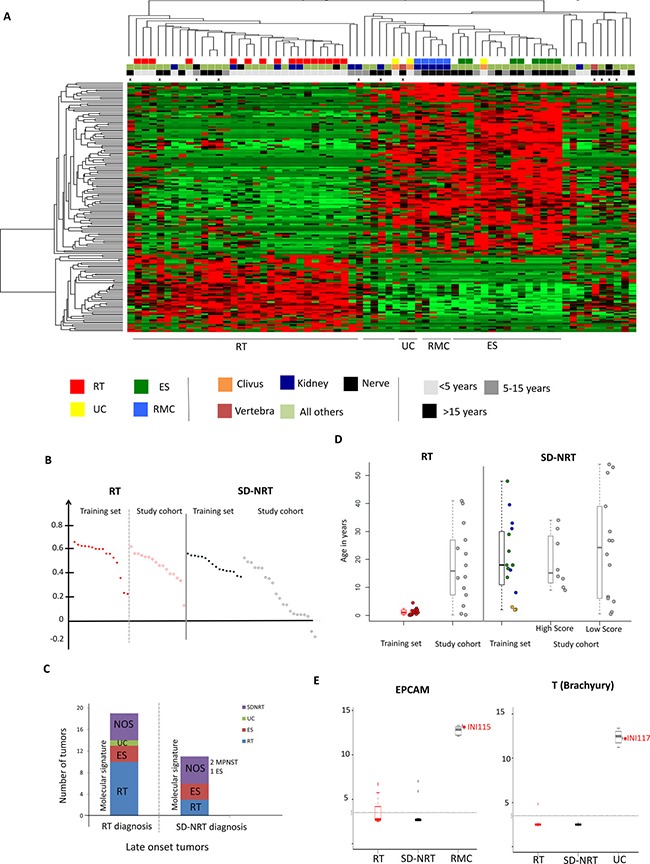
Extra-cranial rhabdoid tumors (RT) are highly aggressive malignancies of infancy, characterized by undifferentiated histological features and loss of SMARCB1 expression. The diagnosis is all the more challenging that other poorly differentiated cancers lose SMARCB1 expression, such as epithelioid sarcomas (ES), renal medullary carcinomas (RMC) or undifferentiated chordomas (UC). Moreover, late cases occurring in adults are now increasingly reported, raising the question of differential diagnoses and emphasizing nosological issues. To address this issue, we have analyzed the expression profiles of a training set of 32 SMARCB1-deficient tumors (SDT), with ascertained diagnosis of RT (n = 16, all < 5 years of age), ES (n = 8, all > 10 years of age), UC (n = 3) and RMC (n = 5). As compared with other SDT, RT are characterized by an embryonic signature, and up-regulation of key-actors of de novo DNA methylation processes. Using this signature, we then analysed the expression profiling of 37 SDT to infer the appropriate diagnosis. Thirteen adult onset tumors showed strong similarity with pediatric RT, in spite of older age; by exome sequencing, these tumors also showed genomic features indistinguishable from pediatric RT. In contrary, 8 tumors were reclassified within carcinoma, ES or UC categories, while the remaining could not be related to any of those entities. Our results demonstrate that embryonic signature is shared by all RT, whatever the age at diagnosis; they also illustrate that many adult-onset SDT of ambiguous histological diagnosis are clearly different from RT. Finally, our study paves the way for the routine use of expression-based signatures to give accurate diagnosis of SDT.
颅外横纹肌样肿瘤(RT)是婴儿期高度侵袭性的恶性肿瘤,其特征为未分化的组织学特征以及SMARCB1表达缺失。诊断颇具挑战性,因为其他低分化癌症也会出现SMARCB1表达缺失,如上皮样肉瘤(ES)、肾髓质癌(RMC)或未分化脊索瘤(UC)。此外,现在越来越多地报道了发生在成人中的晚期病例,这引发了鉴别诊断的问题,并突出了疾病分类学问题。为解决这一问题,我们分析了一组32例SMARCB1缺陷肿瘤(SDT)的表达谱,这些肿瘤已确诊为RT(n = 16,均<5岁)、ES(n = 8,均>10岁)、UC(n = 3)和RMC(n = 5)。与其他SDT相比,RT的特征是具有胚胎特征,以及从头DNA甲基化过程的关键因子上调。利用这一特征,我们随后分析了37例SDT的表达谱以推断出合适的诊断。尽管年龄较大,但13例成人发病的肿瘤与儿童RT表现出高度相似性;通过外显子测序,这些肿瘤还显示出与儿童RT无法区分的基因组特征。相反,8例肿瘤被重新分类为癌、ES或UC类别,而其余的则与这些实体均无关。我们的结果表明,无论诊断时的年龄如何,所有RT都具有胚胎特征;它们还表明,许多组织学诊断不明确的成人发病SDT与RT明显不同。最后,我们的研究为常规使用基于表达的特征来准确诊断SDT铺平了道路。