Department of Chemistry, University of California, Irvine, California 92697-2025, USA.
Multiphase Chemistry Department, Max Planck Institute for Chemistry, 55128 Mainz, Germany.
Nat Commun. 2017 Apr 21;8:15002. doi: 10.1038/ncomms15002.
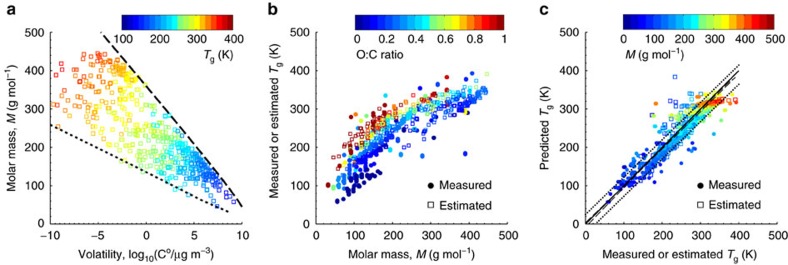
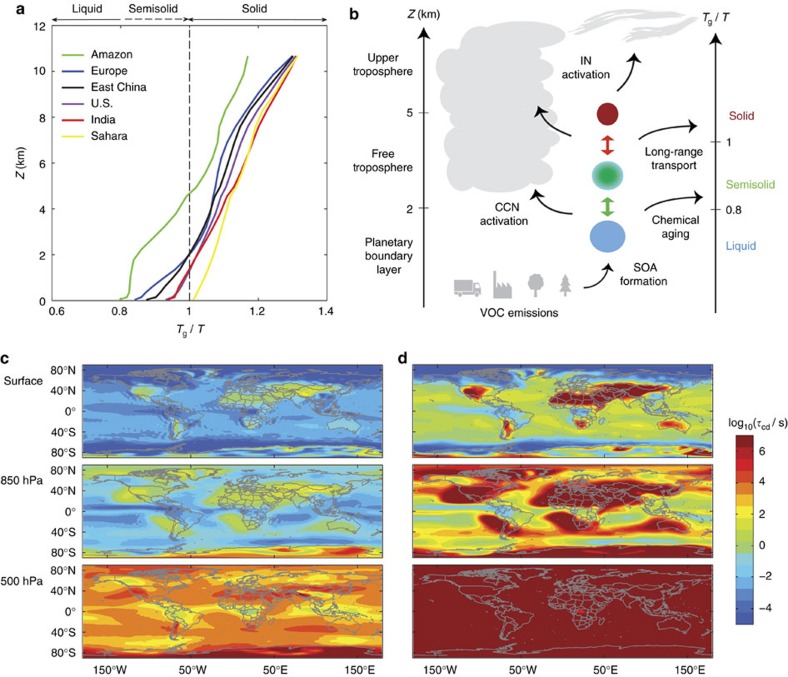
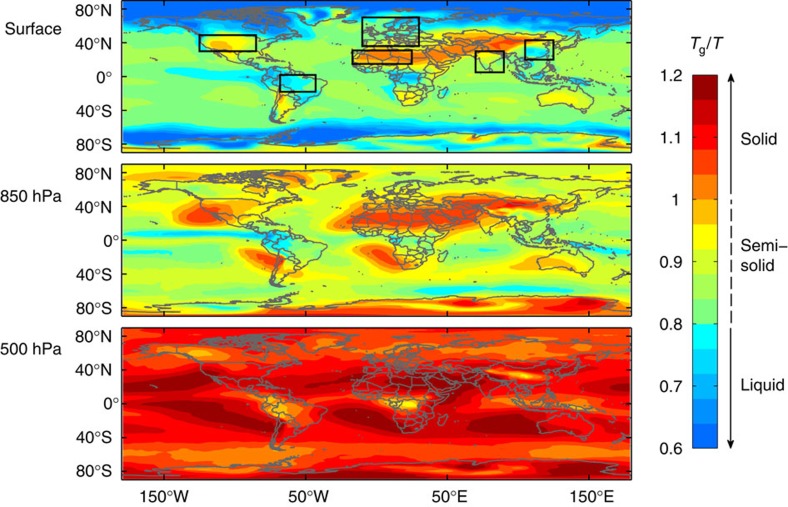
Secondary organic aerosols (SOA) are a large source of uncertainty in our current understanding of climate change and air pollution. The phase state of SOA is important for quantifying their effects on climate and air quality, but its global distribution is poorly characterized. We developed a method to estimate glass transition temperatures based on the molar mass and molecular O:C ratio of SOA components, and we used the global chemistry climate model EMAC with the organic aerosol module ORACLE to predict the phase state of atmospheric SOA. For the planetary boundary layer, global simulations indicate that SOA are mostly liquid in tropical and polar air with high relative humidity, semi-solid in the mid-latitudes and solid over dry lands. We find that in the middle and upper troposphere SOA should be mostly in a glassy solid phase state. Thus, slow diffusion of water, oxidants and organic molecules could kinetically limit gas-particle interactions of SOA in the free and upper troposphere, promote ice nucleation and facilitate long-range transport of reactive and toxic organic pollutants embedded in SOA.
次生有机气溶胶(SOA)是我们目前对气候变化和空气污染理解的一个主要不确定因素。SOA 的相态对于量化其对气候和空气质量的影响很重要,但它的全球分布特征描述很差。我们开发了一种基于 SOA 成分的摩尔质量和分子 O:C 比来估算玻璃化转变温度的方法,并使用全球化学气候模型 EMAC 和有机气溶胶模块 ORACLE 来预测大气 SOA 的相态。对于行星边界层,全球模拟表明,在相对湿度高的热带和极地空气中,SOA 主要呈液态,中纬度地区呈半固态,干燥地区呈固态。我们发现,在中层和高层大气中,SOA 应该主要处于玻璃态固态。因此,水、氧化剂和有机分子的缓慢扩散可能会在动力学上限制自由和高层大气中 SOA 的气粒相互作用,促进冰核形成,并有利于嵌入 SOA 的反应性和有毒有机污染物的长距离传输。