Palermo Jennifer, Dart Allison B, De Mello Alanna, Devarajan Prasad, Gottesman Ronald, Garcia Guerra Gonzalo, Hansen Greg, Joffe Ari R, Mammen Cherry, Majesic Nick, Morgan Catherine, Skippen Peter, Pizzi Michael, Palijan Ana, Zappitelli Michael
1Divisions of Nephrology and Pediatric Critical Care Medicine, Department of Pediatrics, Montreal Children's Hospital, McGill University Health Centre, Montreal, Quebec, Canada. 2Section of Nephrology, Department of Pediatrics and Child Health, University of Manitoba, Winnipeg, Manitoba, Canada 3Division of Nephrology, British Columbia Children's Hospital, University of British Columbia, Vancouver, BC, Canada. 4Nephrology and Hypertension, Cincinnati Children's Hospital Medical Center, Cincinnati Children's Hospital Medical Center, Cincinnati, OH. 5Department of Pediatrics, University of Alberta, Women and Children's Health Research Institute, Edmonton, AL, Canada. 6Section of Pediatric Intensive Care, Department of Pediatrics and Child Health, University of Manitoba, Children's Hospital, Winnipeg, Manitoba, Canada. 7Division of Nephrology, Department of Pediatrics, University of Alberta, Edmonton, AL, Canada. 8Pediatric Intensive Care Unit, Children's Heart Centre, British Columbia Children's Hospital, Vancouver, BC, Canada.
Pediatr Crit Care Med. 2017 Jun;18(6):e235-e244. doi: 10.1097/PCC.0000000000001183.
Acute kidney injury occurs early in PICU admission and increases risks for poor outcomes. We evaluated the feasibility of a multicenter acute kidney injury biomarker urine collection protocol and measured diagnostic characteristics of urine neutrophil gelatinase-associated lipocalin, interleukin-18, and liver fatty acid binding protein to predict acute kidney injury and prolonged acute kidney injury.
Prospective observational pilot cohort study.
Four Canadian tertiary healthcare PICUs.
Eighty-one children 1 month to 18 years old. Exclusion criteria were as follows: cardiac surgery, baseline severe kidney disease, and inadequate urine or serum for PICU days 1-3.
PICUs performed standardized urine collection protocol to obtain early PICU admission urine samples, with deferred consent.
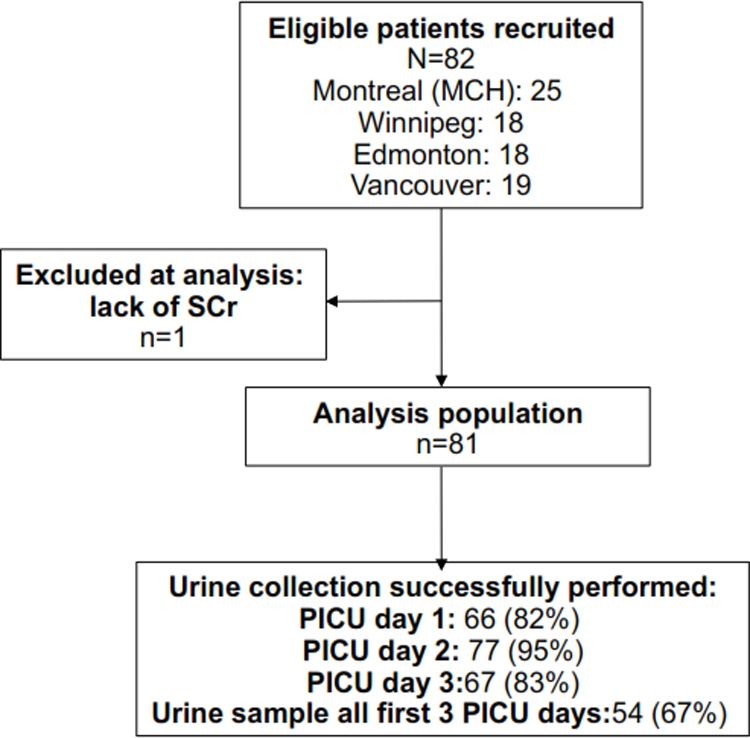
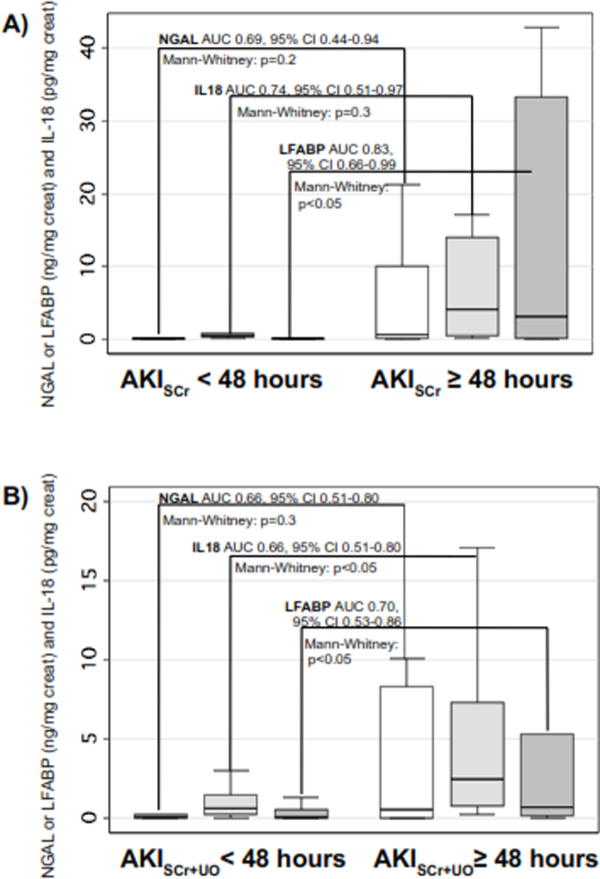
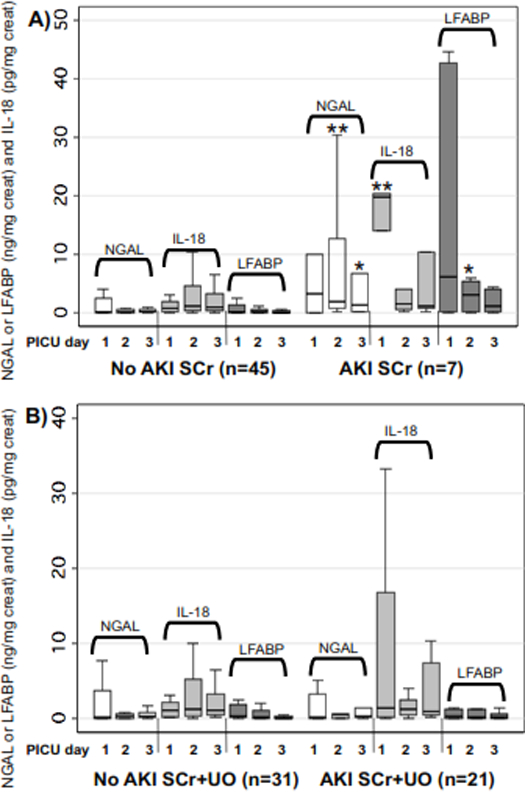
Study barriers and facilitators were recorded. Acute kidney injury was defined based on Kidney Disease: Improving Global Outcomes serum creatinine criteria (acute kidney injuryserum creatinine) and by serum creatinine and urine output criteria (acute kidney injuryserum creatinine+urine output) Prolonged acute kidney injury was defined as acute kidney injury duration of 48 hours or more. PICU days 1-3 neutrophil gelatinase-associated lipocalin, interleukin-18, and liver fatty acid binding protein were evaluated for acute kidney injury prediction (area under the curve). Biomarkers on the first day of acute kidney injury attainment (day 1 acute kidney injury) were evaluated for predicting prolonged acute kidney injury. Eighty-two to 95% of subjects had urine collected from PICU days 1-3. Acute kidney injuryserum creatinine developed in 16 subjects (20%); acute kidney injuryserum creatinine+urine output developed in 38 (47%). On PICU day 1, interleukin-18 predicted acute kidney injuryserum creatinine with area under the curve=0.82, but neutrophil gelatinase-associated lipocalin and liver fatty acid binding protein predicted acute kidney injuryserum creatinine with area under the curve of less than or equal to 0.69; on PICU day 2, area under the curve was higher (not shown). Interleukin-18 and liver fatty acid binding protein on day 1 acute kidney injury predicted prolonged acute kidney injuryserum creatinine (area under the curve=0.74 and 0.83, respectively). When acute kidney injuryserum creatinine+urine output was used to define acute kidney injury, biomarker area under the curves were globally lower.
Protocol urine collection to procure early admission samples is feasible. Individual biomarker acute kidney injury prediction performance is highly variable and modest. Larger studies should evaluate utility and cost effectiveness of using early acute kidney injury biomarkers.
急性肾损伤在儿科重症监护病房(PICU)住院早期就会发生,并增加不良预后的风险。我们评估了一项多中心急性肾损伤生物标志物尿液采集方案的可行性,并测定了尿中性粒细胞明胶酶相关脂质运载蛋白、白细胞介素-18和肝脂肪酸结合蛋白的诊断特征,以预测急性肾损伤和持续性急性肾损伤。
前瞻性观察性试点队列研究。
加拿大的四家三级医疗PICU。
81名年龄在1个月至18岁之间的儿童。排除标准如下:心脏手术、基线严重肾脏疾病以及在PICU第1至3天尿液或血清不足。
PICU执行标准化尿液采集方案,在延迟同意的情况下获取PICU住院早期的尿液样本。
记录了研究的障碍因素和促进因素。急性肾损伤根据《改善全球肾脏病预后组织》的血清肌酐标准(急性肾损伤血清肌酐)以及血清肌酐和尿量标准(急性肾损伤血清肌酐+尿量)来定义。持续性急性肾损伤定义为急性肾损伤持续时间达48小时或更长。对PICU第1至3天的尿中性粒细胞明胶酶相关脂质运载蛋白、白细胞介素-18和肝脂肪酸结合蛋白进行评估,以预测急性肾损伤(曲线下面积)。对急性肾损伤达到当天(急性肾损伤第1天)的生物标志物进行评估,以预测持续性急性肾损伤。82%至95%的受试者在PICU第1至3天采集了尿液。16名受试者(20%)出现急性肾损伤血清肌酐;38名受试者(47%)出现急性肾损伤血清肌酐+尿量。在PICU第1天,白细胞介素-18预测急性肾损伤血清肌酐的曲线下面积=0.82,但尿中性粒细胞明胶酶相关脂质运载蛋白和肝脂肪酸结合蛋白预测急性肾损伤血清肌酐的曲线下面积小于或等于0.69;在PICU第2天,曲线下面积更高(未显示)。急性肾损伤第1天的白细胞介素-18和肝脂肪酸结合蛋白预测持续性急性肾损伤血清肌酐(曲线下面积分别为0.74和0.83)。当使用急性肾损伤血清肌酐+尿量来定义急性肾损伤时,生物标志物的曲线下面积总体较低。
采集住院早期样本的方案尿液采集是可行的。单个生物标志物预测急性肾损伤的性能差异很大且效果一般。更大规模的研究应评估使用早期急性肾损伤生物标志物的效用和成本效益。