Varadarajan Supraja G, Kong Jennifer H, Phan Keith D, Kao Tzu-Jen, Panaitof S Carmen, Cardin Julie, Eltzschig Holger, Kania Artur, Novitch Bennett G, Butler Samantha J
Department of Neurobiology, University of California, Los Angeles, Los Angeles, CA 90095, USA; Eli and Edythe Broad Center of Regenerative Medicine and Stem Cell Research, University of California, Los Angeles, Los Angeles, CA 90095, USA; Neuroscience Interdisciplinary Graduate Program, University of California, Los Angeles, Los Angeles, CA 90095, USA.
Department of Neurobiology, University of California, Los Angeles, Los Angeles, CA 90095, USA; Eli and Edythe Broad Center of Regenerative Medicine and Stem Cell Research, University of California, Los Angeles, Los Angeles, CA 90095, USA.
Neuron. 2017 May 17;94(4):790-799.e3. doi: 10.1016/j.neuron.2017.03.007. Epub 2017 Apr 21.
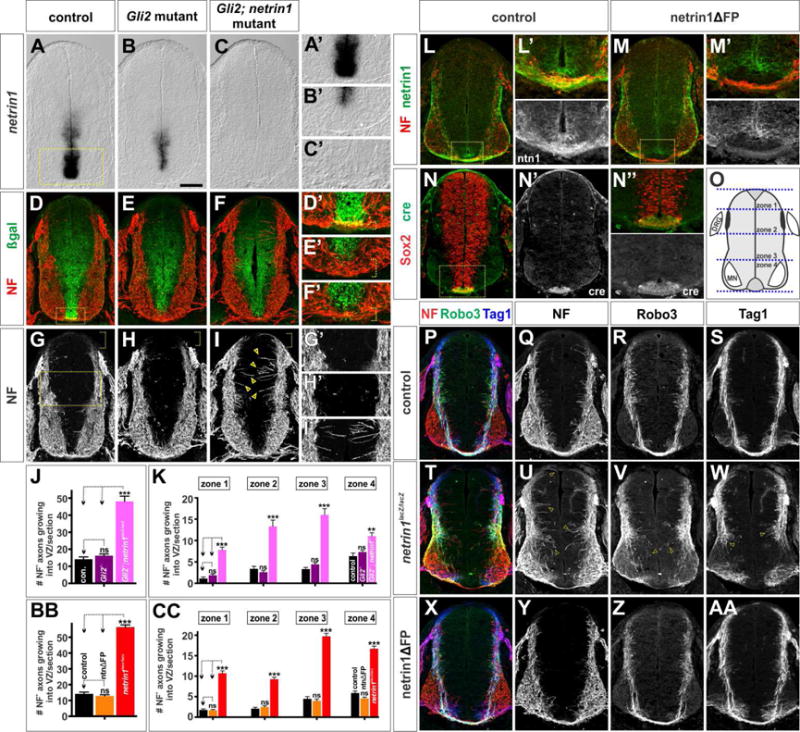
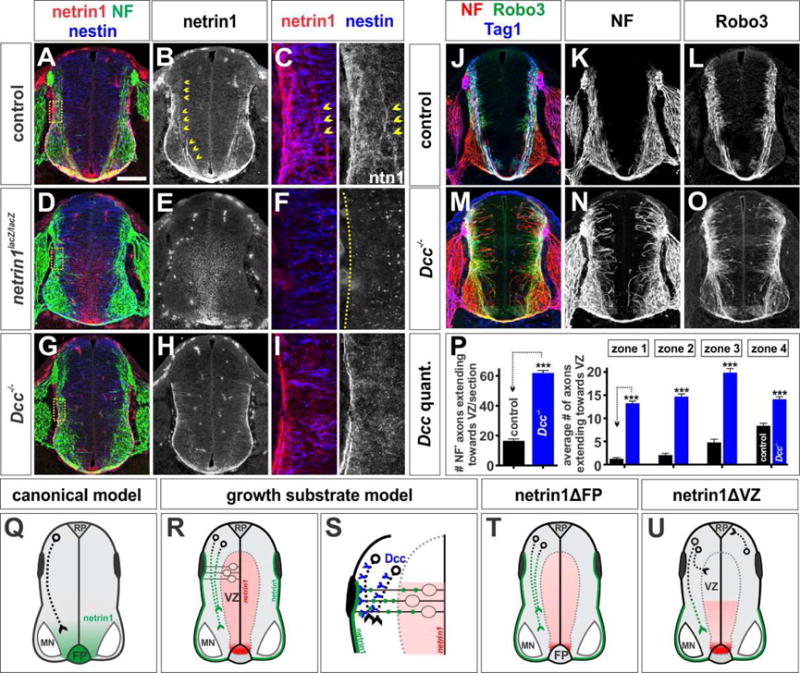
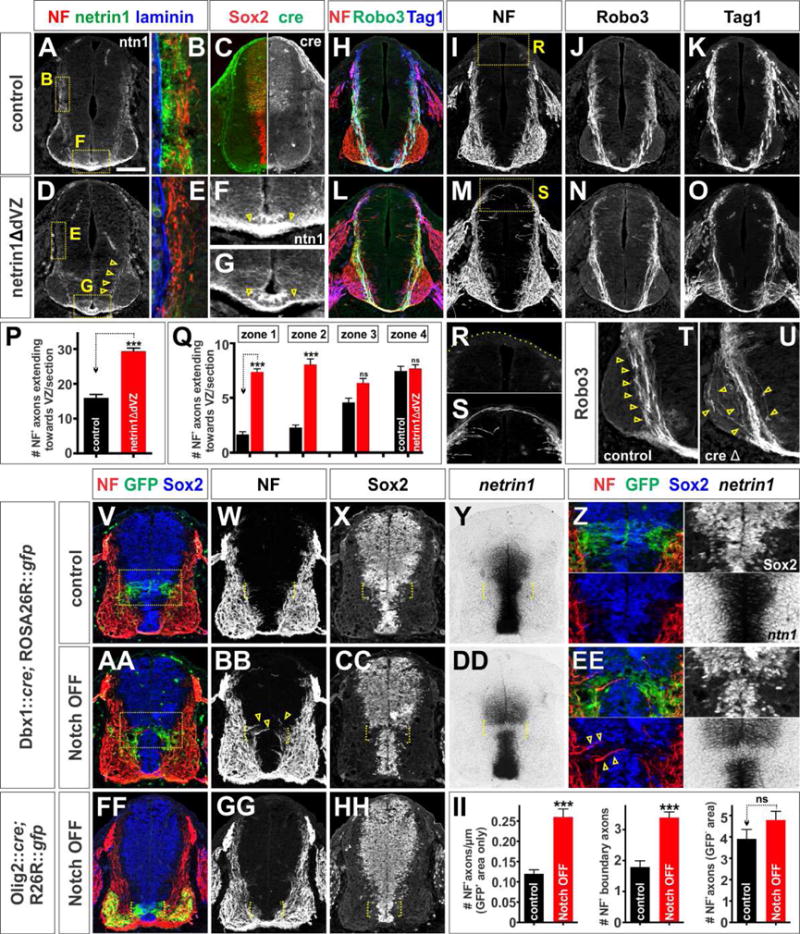
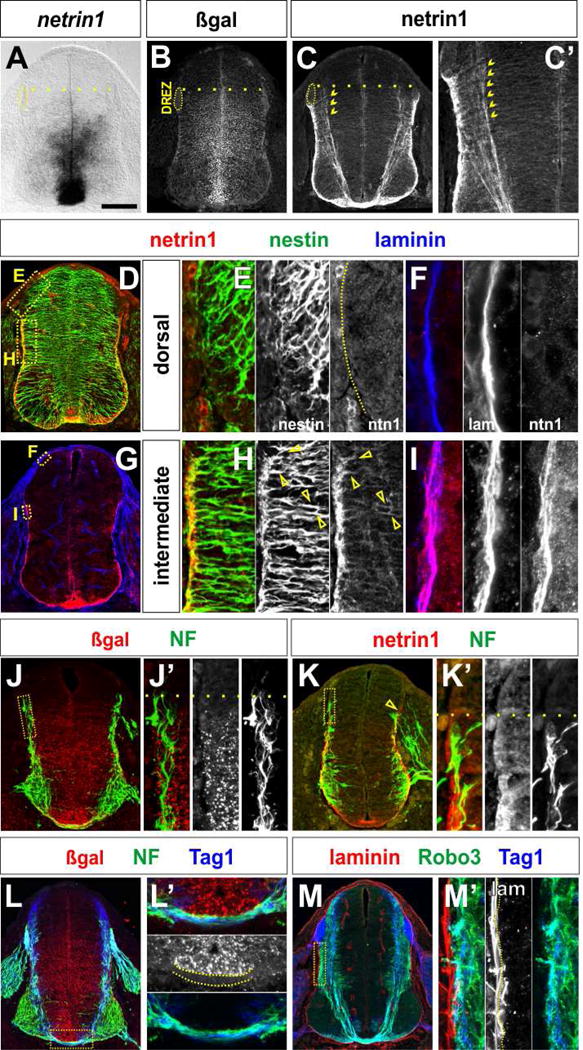
Netrin1 has been proposed to act from the floor plate (FP) as a long-range diffusible chemoattractant for commissural axons in the embryonic spinal cord. However, netrin1 mRNA and protein are also present in neural progenitors within the ventricular zone (VZ), raising the question of which source of netrin1 promotes ventrally directed axon growth. Here, we use genetic approaches in mice to selectively remove netrin from different regions of the spinal cord. Our analyses show that the FP is not the source of netrin1 directing axons to the ventral midline, while local VZ-supplied netrin1 is required for this step. Furthermore, rather than being present in a gradient, netrin1 protein accumulates on the pial surface adjacent to the path of commissural axon extension. Thus, netrin1 does not act as a long-range secreted chemoattractant for commissural spinal axons but instead promotes ventrally directed axon outgrowth by haptotaxis, i.e., directed growth along an adhesive surface.
网蛋白1(Netrin1)被认为是从脊髓底板(FP)起作用,作为胚胎脊髓中连合轴突的一种远距离可扩散化学引诱剂。然而,网蛋白1的信使核糖核酸(mRNA)和蛋白质也存在于脑室区(VZ)的神经祖细胞中,这就提出了一个问题:网蛋白1的哪个来源促进轴突向腹侧生长。在这里,我们利用小鼠的遗传学方法,从脊髓的不同区域选择性去除网蛋白。我们的分析表明,脊髓底板不是引导轴突到达腹侧中线的网蛋白1的来源,而这一步骤需要脑室区局部提供的网蛋白1。此外,网蛋白1蛋白并非以梯度形式存在,而是积聚在与连合轴突延伸路径相邻的软膜表面。因此,网蛋白1并非作为连合脊髓轴突的远距离分泌化学引诱剂起作用,而是通过趋触性,即沿着粘附表面的定向生长,来促进轴突向腹侧生长。