Simpson Grant G, Hahn Hallie R, Powel Alex A, Leverence Robert R, Morris Linda A, Thompson Lara G, Zumberg Marc S, Borde Deepa J, Tyndall Joseph A, Shuster Jonathan J, Yealy Donald M, Allen Brandon R
University of Florida, Department of Pharmacology, Gainesville, Florida.
University of Florida, Department of Emergency Medicine, Gainesville, Florida.
West J Emerg Med. 2017 Apr;18(3):335-339. doi: 10.5811/westjem.2016.11.32273. Epub 2017 Feb 7.
A subpopulation of sickle-cell disease patients, termed super-utilizers, presents frequently to emergency departments (EDs) for vaso-occlusive events and may consume disproportionate resources without broader health benefit. To address the healthcare needs of this vulnerable patient population, we piloted a multidisciplinary intervention seeking to create and use individualized patient care plans that alter utilization through coordinated care. Our goals were to assess feasibility primarily, and to assess resource use secondarily.
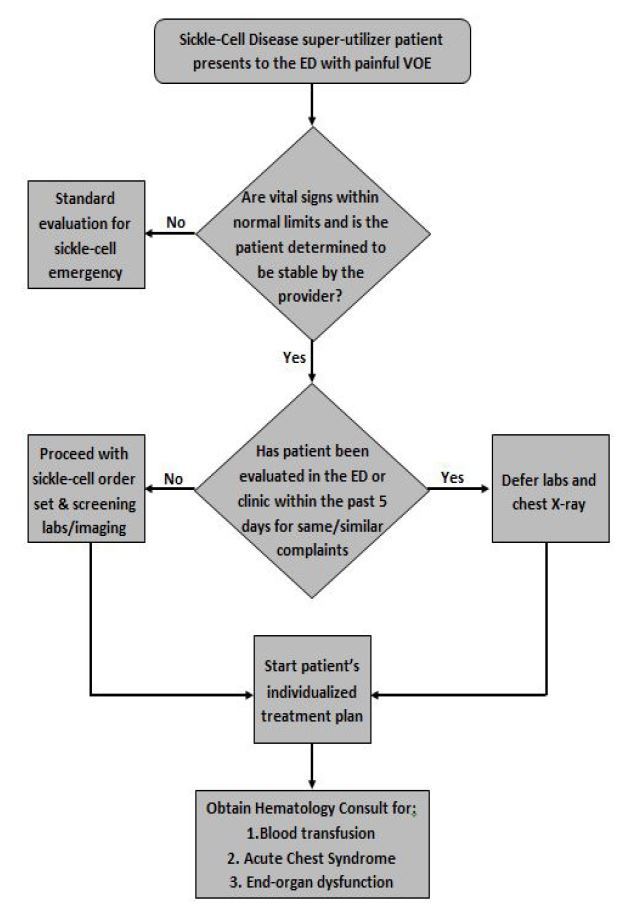
We evaluated the effects of a single-site interventional study targeted at a population of adult sickle-cell disease super-utilizers using a pre- and post-implementation design. The pre-intervention period was 06/01/13 to 12/31/13 (seven months) and the post-intervention period was 01/01/14 to 02/28/15 (14 months). Our approach included patient-specific best practice advisories (BPA); an ED management protocol; and formation of a "medical home" for these patients.
For 10 subjects targeted initially we developed and implemented coordinated care plans; after deployment, we observed a tendency toward reduction in ED and inpatient utilization across all measured indices. Between the annualized pre- and post-implementation periods we found the following: ED visits decreased by 16.5 visits/pt-yr (95% confidence interval [CI] [-1.32-34.2]); ED length of state (LOS) decreased by 115.3 hours/pt-yr (95% CI [-82.9-313.5]); in-patient admissions decreased by 4.20 admissions/pt-yr (95% CI [-1.73-10.1]); in-patient LOS decreased by 35.8 hours/pt-yr (95% CI [-74.9-146.7]); and visits where the patient left before treatment were reduced by an annualized total of 13.7 visits. We observed no patient mortality in our 10 subjects, and no patient required admission to the intensive care unit 72 hours following discharge.
This effort suggests that a targeted approach is both feasible and potentially effective, laying a foundation for broader study.
镰状细胞病患者中有一部分被称为“超级使用者”,他们频繁因血管闭塞性事件前往急诊科就诊,可能消耗了不成比例的资源却未带来更广泛的健康益处。为满足这一弱势群体的医疗需求,我们开展了一项多学科干预试点,旨在制定并使用个性化患者护理计划,通过协调护理来改变医疗资源的使用情况。我们的目标首先是评估可行性,其次是评估资源使用情况。
我们采用实施前和实施后的设计,对一项针对成年镰状细胞病超级使用者群体的单中心干预研究的效果进行了评估。干预前期为2013年6月1日至2013年12月31日(七个月),干预后期为2014年1月1日至2015年2月28日(14个月)。我们的方法包括针对患者的最佳实践建议(BPA)、急诊科管理方案以及为这些患者组建“医疗之家”。
对于最初选定的10名受试者,我们制定并实施了协调护理计划;实施后,我们观察到所有测量指标的急诊科和住院资源使用都有减少的趋势。在实施前和实施后的年度化期间,我们发现以下情况:急诊科就诊次数减少了16.5次/患者年(95%置信区间[CI][-1.32 - 34.2]);急诊科住院时长(LOS)减少了115.3小时/患者年(95% CI [-82.9 - 313.5]);住院入院次数减少了4.20次/患者年(95% CI [-1.73 - 10.1]);住院LOS减少了35.8小时/患者年(95% CI [-74.9 - 146.7]);患者在治疗前离开的就诊次数年度化总计减少了13.7次。我们观察到10名受试者中无患者死亡,且出院后72小时内无患者需要入住重症监护病房。
这项工作表明,有针对性的方法既可行又可能有效,为更广泛的研究奠定了基础。