Puskarich Michael A, Nandi Utsav, Long Ben G, Jones Alan E
Department of Emergency Medicine, University of Mississippi Medical Center, Jackson, MS, USA.
School of Medicine, University of Mississippi Medical Center, Jackson, MS, USA.
Clin Exp Emerg Med. 2017 Mar 30;4(1):2-9. doi: 10.15441/ceem.16.144. eCollection 2017 Mar.
Vital sign trends are used in clinical practice to assess treatment response and aid in disposition, yet quantitative data to support this practice are lacking. This study aimed to determine the prognostic value of vital sign normalization.
Secondary analysis of a prospective cohort of adult emergency department (ED) patients admitted a single urban tertiary care hospital. A random sample of 182 days was chosen, and a manual review of all admissions was undertaken. Persistent tachycardia or tachypnea was defined as failure to decrease to a normal value in the ED. Elevated upon admission was defined as an abnormal value at the last set of vital signs documented. The primary outcome was in-hospital mortality.
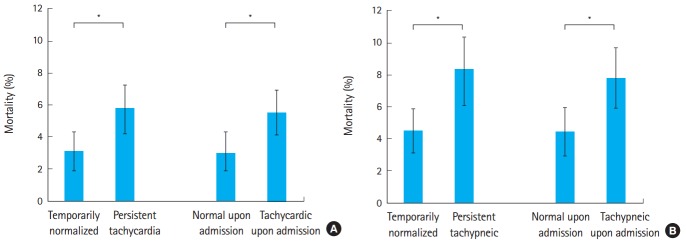
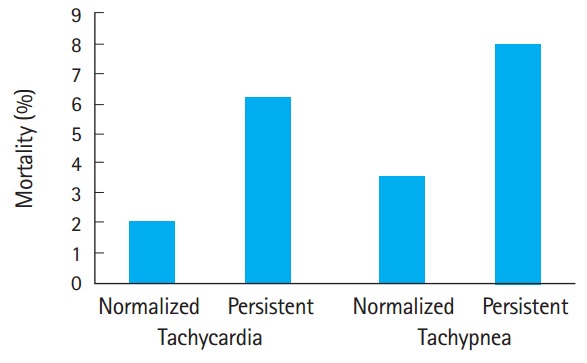
4,878 patients were enrolled and 4.5 (±3.8) sets of vital signs were checked per patient. 1,770 patients were tachycardic and 1,499 were tachypneic. Among tachycardic patients, 941 (53%) were persistently tachycardic and 1,074 (61%) were tachycardic upon admission. Among tachypneic patients 639 (42%) were persistently tachypneic and 768 (51%) were tachypneic upon admission. Mortality was higher in patients persistently tachycardic (5.7% vs. 3.1%, P=0.008) or tachycardic upon admission (5.5% vs. 3.0%, P=0.014). Similar results were found in tachypneic patients (8.3% vs. 4.5%, P=0.003; 7.8% vs. 4.4%, P=0.006).
Persistent tachycardia and tachypnea are associated with an increased risk of mortality in ED patients admitted to the hospital. Further study is necessary to determine if improved recognition or earlier interventions can affect outcomes.
生命体征趋势在临床实践中用于评估治疗反应并辅助进行处置,但缺乏支持这种做法的定量数据。本研究旨在确定生命体征恢复正常的预后价值。
对一家城市三级护理医院收治的成年急诊科患者的前瞻性队列进行二次分析。选取182天的随机样本,并对所有入院病例进行人工审查。持续性心动过速或呼吸急促定义为在急诊科未降至正常值。入院时升高定义为最后记录的一组生命体征中的异常值。主要结局是院内死亡率。
纳入4878例患者,每位患者平均检查4.5(±3.8)组生命体征。1770例患者心动过速,1499例患者呼吸急促。在心动过速患者中,941例(53%)持续性心动过速,1074例(61%)入院时心动过速。在呼吸急促患者中,639例(42%)持续性呼吸急促,768例(51%)入院时呼吸急促。持续性心动过速患者(5.7%对3.1%,P = 0.008)或入院时心动过速患者(5.5%对3.0%,P = 0.014)的死亡率更高。呼吸急促患者也有类似结果(8.3%对4.5%,P = 0.003;7.8%对4.4%,P = 0.006)。
持续性心动过速和呼吸急促与入院的急诊科患者死亡风险增加相关。有必要进一步研究以确定改善识别或早期干预是否能影响结局。