• 文献检索
  • 文档翻译
  • 深度研究
  • 学术资讯
  • Suppr Zotero 插件Zotero 插件
  • 邀请有礼
  • 套餐&价格
  • 历史记录
应用&插件
Suppr Zotero 插件Zotero 插件浏览器插件Mac 客户端Windows 客户端微信小程序
定价
高级版会员购买积分包购买API积分包
服务
文献检索文档翻译深度研究API 文档MCP 服务
关于我们
关于 Suppr公司介绍联系我们用户协议隐私条款
关注我们

Suppr 超能文献

核心技术专利:CN118964589B侵权必究
粤ICP备2023148730 号-1Suppr @ 2026

文献检索

告别复杂PubMed语法,用中文像聊天一样搜索,搜遍4000万医学文献。AI智能推荐,让科研检索更轻松。

立即免费搜索

文件翻译

保留排版,准确专业,支持PDF/Word/PPT等文件格式,支持 12+语言互译。

免费翻译文档

深度研究

AI帮你快速写综述,25分钟生成高质量综述,智能提取关键信息,辅助科研写作。

立即免费体验

快速序贯器官衰竭评估(qSOFA)评分在预测严重脓毒症及死亡率方面表现不佳——一项针对急诊科收治的感染患者的前瞻性研究。

Poor performance of quick-SOFA (qSOFA) score in predicting severe sepsis and mortality - a prospective study of patients admitted with infection to the emergency department.

作者信息

Askim Åsa, Moser Florentin, Gustad Lise T, Stene Helga, Gundersen Maren, Åsvold Bjørn Olav, Dale Jostein, Bjørnsen Lars Petter, Damås Jan Kristian, Solligård Erik

机构信息

Clinic of Anesthesia and Intensive Care, St Olav University Hospital, Trondheim, Norway.

Department of Circulation and Medical Imaging, NTNU, Norwegian University of Science and Technology, Po box 8905, N-7491, Trondheim, Norway.

出版信息

Scand J Trauma Resusc Emerg Med. 2017 Jun 9;25(1):56. doi: 10.1186/s13049-017-0399-4.

DOI:10.1186/s13049-017-0399-4
PMID:28599661
原文链接:https://pmc.ncbi.nlm.nih.gov/articles/PMC5466747/
Abstract

BACKGROUND

We aimed to evaluate the clinical usefulness of qSOFA as a risk stratification tool for patients admitted with infection compared to traditional SIRS criteria or our triage system; the Rapid Emergency Triage and Treatment System (RETTS).

METHODS

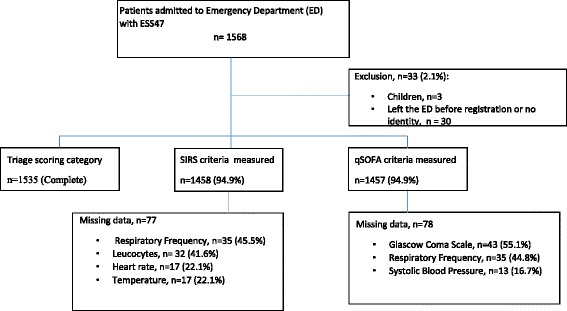
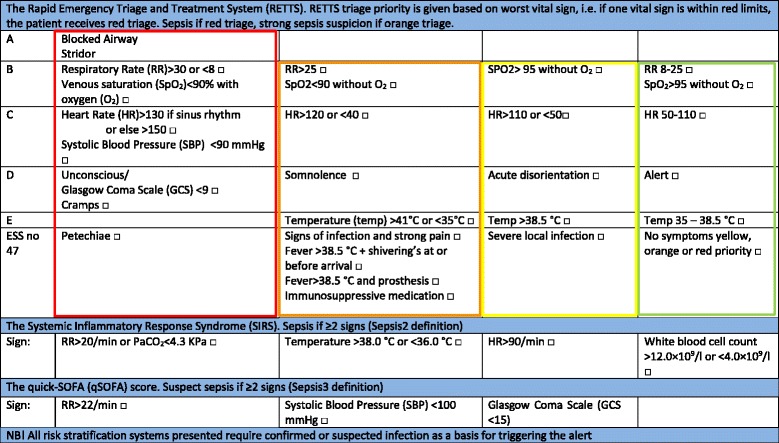
The study was an observational cohort study performed at one Emergency Department (ED) in an urban university teaching hospital in Norway, with approximately 20,000 visits per year. All patients >16 years presenting with symptoms or clinical signs suggesting an infection (n = 1535) were prospectively included in the study from January 1 to December 31, 2012. At arrival in the ED, vital signs were recorded and all patients were triaged according to RETTS vital signs, presenting infection, and sepsis symptoms. These admission data were also used to calculate qSOFA and SIRS. Treatment outcome was later retrieved from the patients' electronic records (EPR) and mortality data from the Norwegian population registry.

RESULTS

Of the 1535 admitted patients, 108 (7.0%) fulfilled the Sepsis2 criteria for severe sepsis. The qSOFA score ≥2 identified only 33 (sensitivity 0.32, specificity 0.98) of the patients with severe sepsis, whilst the RETTS-alert ≥ orange identified 92 patients (sensitivity 0.85, specificity 0.55). Twenty-six patients died within 7 days of admission; four (15.4%) of them had a qSOFA ≥2, and 16 (61.5%) had RETTS ≥ orange alert. Of the 68 patients that died within 30 days, only eight (11.9%) scored ≥2 on the qSOFA, and 45 (66.1%) had a RETTS ≥ orange alert.

DISCUSSION

In order to achieve timely treatment for sepsis, a sensitive screening tool is more important than a specific one. Our study is the fourth study were qSOFA finds few of the sepsis cases in prehospital or at arrival to the ED. We add information on the RETTS triage system, the two highest acuity levels together had a high sensitivity (85%) for identifying sepsis at arrival to the ED - and thus, RETTS should not be replaced by qSOFA as a screening and trigger tool for sepsis at arrival.

CONCLUSION

In this observational cohort study, qSOFA failed to identify two thirds of the patients admitted to an ED with severe sepsis. Further, qSOFA failed to be a risk stratification tool as the sensitivity to predict 7-day and 30-day mortality was low. The sensitivity was poorer than the other warning scores already in use at the study site, RETTS-triage and the SIRS criteria.

摘要

背景

我们旨在评估与传统全身炎症反应综合征(SIRS)标准或我们的分诊系统——快速急诊分诊与治疗系统(RETTS)相比,qSOFA作为感染入院患者风险分层工具的临床实用性。

方法

本研究是一项观察性队列研究,在挪威一所城市大学教学医院的一个急诊科进行,每年约有20000人次就诊。2012年1月1日至12月31日,前瞻性纳入所有年龄>16岁、出现提示感染症状或体征的患者(n = 1535)。到达急诊科时,记录生命体征,并根据RETTS生命体征、出现的感染及脓毒症症状对所有患者进行分诊。这些入院数据也用于计算qSOFA和SIRS。随后从患者电子病历(EPR)中获取治疗结果,并从挪威人口登记处获取死亡率数据。

结果

1535例入院患者中,108例(7.0%)符合脓毒症2标准的严重脓毒症。qSOFA评分≥2仅识别出33例(敏感性0.32,特异性0.98)严重脓毒症患者,而RETTS警报≥橙色识别出92例患者(敏感性0.85,特异性0.55)。26例患者在入院7天内死亡;其中4例(15.4%)qSOFA≥2,16例(61.5%)RETTS≥橙色警报。在30天内死亡的68例患者中,只有8例(11.9%)qSOFA评分≥2,45例(66.1%)RETTS≥橙色警报。

讨论

为了实现脓毒症的及时治疗,一个敏感的筛查工具比一个特异的工具更重要。我们的研究是第四项发现qSOFA在院前或到达急诊科时发现的脓毒症病例很少的研究。我们补充了关于RETTS分诊系统的信息,两个最高 acuity 级别一起对到达急诊科时识别脓毒症具有较高的敏感性(85%)——因此,RETTS不应被qSOFA取代作为到达时脓毒症的筛查和触发工具。

结论

在这项观察性队列研究中,qSOFA未能识别三分之二入住急诊科的严重脓毒症患者。此外,qSOFA未能成为一种风险分层工具,因为其预测7天和30天死亡率的敏感性较低。其敏感性比研究地点已在使用的其他预警评分——RETTS分诊和SIRS标准更差。
https://cdn.ncbi.nlm.nih.gov/pmc/blobs/15ad/5466747/3a60e9f64b32/13049_2017_399_Fig2_HTML.jpg
https://cdn.ncbi.nlm.nih.gov/pmc/blobs/15ad/5466747/cf991bdd2b10/13049_2017_399_Fig1_HTML.jpg
https://cdn.ncbi.nlm.nih.gov/pmc/blobs/15ad/5466747/3a60e9f64b32/13049_2017_399_Fig2_HTML.jpg
https://cdn.ncbi.nlm.nih.gov/pmc/blobs/15ad/5466747/cf991bdd2b10/13049_2017_399_Fig1_HTML.jpg
https://cdn.ncbi.nlm.nih.gov/pmc/blobs/15ad/5466747/3a60e9f64b32/13049_2017_399_Fig2_HTML.jpg

相似文献

1
Poor performance of quick-SOFA (qSOFA) score in predicting severe sepsis and mortality - a prospective study of patients admitted with infection to the emergency department.快速序贯器官衰竭评估(qSOFA)评分在预测严重脓毒症及死亡率方面表现不佳——一项针对急诊科收治的感染患者的前瞻性研究。
Scand J Trauma Resusc Emerg Med. 2017 Jun 9;25(1):56. doi: 10.1186/s13049-017-0399-4.
2
Low sensitivity of qSOFA, SIRS criteria and sepsis definition to identify infected patients at risk of complication in the prehospital setting and at the emergency department triage.qSOFA、SIRS 标准和脓毒症定义对识别院前环境和急诊科分诊中感染风险患者的并发症的敏感性较低。
Scand J Trauma Resusc Emerg Med. 2017 Nov 3;25(1):108. doi: 10.1186/s13049-017-0449-y.
3
Comparison of qSOFA and SIRS for predicting adverse outcomes of patients with suspicion of sepsis outside the intensive care unit.qSOFA与SIRS用于预测非重症监护病房疑似脓毒症患者不良结局的比较。
Crit Care. 2017 Mar 26;21(1):73. doi: 10.1186/s13054-017-1658-5.
4
Systemic Inflammatory Response Syndrome, Quick Sequential Organ Function Assessment, and Organ Dysfunction: Insights From a Prospective Database of ED Patients With Infection.全身炎症反应综合征、快速序贯器官功能评估与器官功能障碍:来自急诊感染患者前瞻性数据库的见解
Chest. 2017 Mar;151(3):586-596. doi: 10.1016/j.chest.2016.10.057. Epub 2016 Nov 19.
5
The Combined SIRS + qSOFA (qSIRS) Score is More Accurate Than qSOFA Alone in Predicting Mortality in Patients with Surgical Sepsis in an LMIC Emergency Department.联合 SIRS + qSOFA(qSIRS)评分比单独 qSOFA 更能准确预测中低收入国家急诊外科脓毒症患者的死亡率。
World J Surg. 2020 Jan;44(1):21-29. doi: 10.1007/s00268-019-05181-x.
6
Clinical Scores and Formal Triage for Screening of Sepsis and Adverse Outcomes on Arrival in an Emergency Department All-Comer Cohort.急诊科全人群队列中用于筛查脓毒症及入院时不良结局的临床评分与正式分诊
J Emerg Med. 2019 Oct;57(4):453-460.e2. doi: 10.1016/j.jemermed.2019.06.036. Epub 2019 Sep 26.
7
Comparison of QSOFA score and SIRS criteria as screening mechanisms for emergency department sepsis.QSOFA评分与全身炎症反应综合征(SIRS)标准作为急诊科脓毒症筛查机制的比较。
Am J Emerg Med. 2017 Nov;35(11):1730-1733. doi: 10.1016/j.ajem.2017.07.001. Epub 2017 Jul 6.
8
Prognostic accuracy of SIRS criteria and qSOFA score for in-hospital mortality among influenza patients in the emergency department.急诊流感患者中 SIRS 标准和 qSOFA 评分对院内死亡率的预后准确性。
BMC Infect Dis. 2020 May 29;20(1):385. doi: 10.1186/s12879-020-05102-7.
9
Comparison of SIRS, qSOFA, and NEWS for the early identification of sepsis in the Emergency Department.比较 SIRS、qSOFA 和 NEWS 在急诊科早期识别脓毒症中的作用。
Am J Emerg Med. 2019 Aug;37(8):1490-1497. doi: 10.1016/j.ajem.2018.10.058. Epub 2018 Nov 7.
10
Prognostic accuracy of qSOFA in predicting 28-day mortality among infected patients in an emergency department: a prospective validation study.qSOFA 在急诊科感染患者中预测 28 天死亡率的预后准确性:一项前瞻性验证研究。
Emerg Med J. 2019 Dec;36(12):722-728. doi: 10.1136/emermed-2019-208456. Epub 2019 Oct 25.

引用本文的文献

1
Nomogram and scoring system for preoperative prediction of the risk of systemic inflammatory response syndrome in one-stage flexible ureteroscopy lithotripsy.一期软性输尿管镜碎石术中全身炎症反应综合征风险术前预测的列线图及评分系统
Front Surg. 2025 May 9;12:1592507. doi: 10.3389/fsurg.2025.1592507. eCollection 2025.
2
Balancing Precision and Practicality: SOFA qSOFA in the Diagnosis and Management of Sepsis.平衡精准度与实用性:序贯器官衰竭评估(SOFA)和快速序贯器官衰竭评估(qSOFA)在脓毒症诊断与管理中的应用
Maedica (Bucur). 2024 Dec;19(4):789-795. doi: 10.26574/maedica.2024.19.4.789.
3
Explainable machine learning for early prediction of sepsis in traumatic brain injury: A discovery and validation study.

本文引用的文献

1
qSOFA Has Poor Sensitivity for Prehospital Identification of Severe Sepsis and Septic Shock.qSOFA对院前严重脓毒症和脓毒性休克的识别敏感性较差。
Prehosp Emerg Care. 2017 Jul-Aug;21(4):489-497. doi: 10.1080/10903127.2016.1274348. Epub 2017 Jan 25.
2
Prognostic Accuracy of Sepsis-3 Criteria for In-Hospital Mortality Among Patients With Suspected Infection Presenting to the Emergency Department.Sepsis-3 标准对急诊科疑似感染患者住院死亡率的预后准确性。
JAMA. 2017 Jan 17;317(3):301-308. doi: 10.1001/jama.2016.20329.
3
Pitfalls in the Treatment of Sepsis.
用于创伤性脑损伤中脓毒症早期预测的可解释机器学习:一项发现和验证研究。
PLoS One. 2024 Nov 11;19(11):e0313132. doi: 10.1371/journal.pone.0313132. eCollection 2024.
4
Differential expression of plasma cytokines in sepsis patients and their clinical implications.脓毒症患者血浆细胞因子的差异表达及其临床意义。
World J Clin Cases. 2024 Sep 6;12(25):5681-5696. doi: 10.12998/wjcc.v12.i25.5681.
5
Importance of qSOFA Score in Terms of Prognosis and Mortality in Critical Care Patients.qSOFA评分在危重症患者预后和死亡率方面的重要性。
Yonago Acta Med. 2024 Aug 27;67(3):225-232. doi: 10.33160/yam.2024.08.009. eCollection 2024 Aug.
6
Association between prehospital ROX index with 30-day mortality among septic shock.创伤患者院前 ROX 指数与 30 天死亡率的相关性研究。
Eur J Med Res. 2024 May 31;29(1):304. doi: 10.1186/s40001-024-01902-8.
7
Risk Factors and Scoring Systems to Predict the Mortality Risk of Afebrile Adult Patients with Monomicrobial Gram-Negative Bacteremia: A 10-Year Observational Study in the Emergency Department.预测非发热性成年单微生物革兰氏阴性菌血症患者死亡风险的危险因素及评分系统:急诊科的一项10年观察性研究
Diagnostics (Basel). 2024 Apr 23;14(9):869. doi: 10.3390/diagnostics14090869.
8
Risk Factors for Systemic Inflammatory Response Syndrome After Percutaneous Transhepatic Cholangioscopic Lithotripsy.经皮经肝胆道镜碎石术后全身炎症反应综合征的危险因素
J Inflamm Res. 2024 Apr 25;17:2575-2587. doi: 10.2147/JIR.S453653. eCollection 2024.
9
The prehospital NEW score to assess septic shock in-hospital, 30-day and 90-day mortality.用于评估院内、30 天和 90 天死亡率的院前 NEW 评分用于评估脓毒性休克。
BMC Infect Dis. 2024 Feb 16;24(1):213. doi: 10.1186/s12879-024-09104-7.
10
Nurses' and Physicians' Experiences After Implementation of a Quality Improvement Project to Improve Sepsis Awareness in Hospitals.医院实施提高脓毒症认知质量改进项目后护士和医生的经历
J Multidiscip Healthc. 2024 Jan 4;17:29-41. doi: 10.2147/JMDH.S439017. eCollection 2024.
脓毒症治疗中的陷阱
Emerg Med Clin North Am. 2017 Feb;35(1):185-198. doi: 10.1016/j.emc.2016.09.008.
4
Systemic Inflammatory Response Syndrome, Quick Sequential Organ Function Assessment, and Organ Dysfunction: Insights From a Prospective Database of ED Patients With Infection.全身炎症反应综合征、快速序贯器官功能评估与器官功能障碍:来自急诊感染患者前瞻性数据库的见解
Chest. 2017 Mar;151(3):586-596. doi: 10.1016/j.chest.2016.10.057. Epub 2016 Nov 19.
5
The new sepsis consensus definitions: the good, the bad and the ugly.新的脓毒症共识定义:优点、缺点与不足。
Intensive Care Med. 2016 Dec;42(12):2024-2026. doi: 10.1007/s00134-016-4604-0. Epub 2016 Nov 3.
6
Quick Sepsis-related Organ Failure Assessment, Systemic Inflammatory Response Syndrome, and Early Warning Scores for Detecting Clinical Deterioration in Infected Patients outside the Intensive Care Unit.快速脓毒症相关器官功能衰竭评估、全身炎症反应综合征及早期预警评分用于检测重症监护病房以外感染患者的临床病情恶化
Am J Respir Crit Care Med. 2017 Apr 1;195(7):906-911. doi: 10.1164/rccm.201604-0854OC.
7
Early identification of sepsis in hospital inpatients by ward nurses increases 30-day survival.病房护士对医院住院患者败血症的早期识别可提高30天生存率。
Crit Care. 2016 Aug 5;20(1):244. doi: 10.1186/s13054-016-1423-1.
8
Opening the Debate on the New Sepsis Definition Change Is Not Necessarily Progress: Revision of the Sepsis Definition Should Be Based on New Scientific Insights.开启关于新的脓毒症定义变更的讨论未必是进步:脓毒症定义的修订应基于新的科学见解。
Am J Respir Crit Care Med. 2016 Jul 1;194(1):16-8. doi: 10.1164/rccm.201604-0734ED.
9
The association between vital signs and mortality in a retrospective cohort study of an unselected emergency department population.一项针对未经筛选的急诊科患者群体的回顾性队列研究中生命体征与死亡率之间的关联。
Scand J Trauma Resusc Emerg Med. 2016 Mar 3;24:21. doi: 10.1186/s13049-016-0213-8.
10
New Sepsis Criteria: A Change We Should Not Make.新的脓毒症标准:一项我们不应做出的改变。
Chest. 2016 May;149(5):1117-8. doi: 10.1016/j.chest.2016.02.653. Epub 2016 Feb 27.