Suppr超能文献

利用脉搏波速度测量改进压力轮廓分析以估计心搏量

Improved pressure contour analysis for estimating cardiac stroke volume using pulse wave velocity measurement.

作者信息

Kamoi Shun, Pretty Christopher, Balmer Joel, Davidson Shaun, Pironet Antoine, Desaive Thomas, Shaw Geoffrey M, Chase J Geoffrey

机构信息

Department of Mechanical Engineering, University of Canterbury, Christchurch, New Zealand.

GIGA Cardiovascular Science, University of Liege, Liege, Belgium.

出版信息

Biomed Eng Online. 2017 Apr 24;16(1):51. doi: 10.1186/s12938-017-0341-z.

Abstract

BACKGROUND

Pressure contour analysis is commonly used to estimate cardiac performance for patients suffering from cardiovascular dysfunction in the intensive care unit. However, the existing techniques for continuous estimation of stroke volume (SV) from pressure measurement can be unreliable during hemodynamic instability, which is inevitable for patients requiring significant treatment. For this reason, pressure contour methods must be improved to capture changes in vascular properties and thus provide accurate conversion from pressure to flow.

METHODS

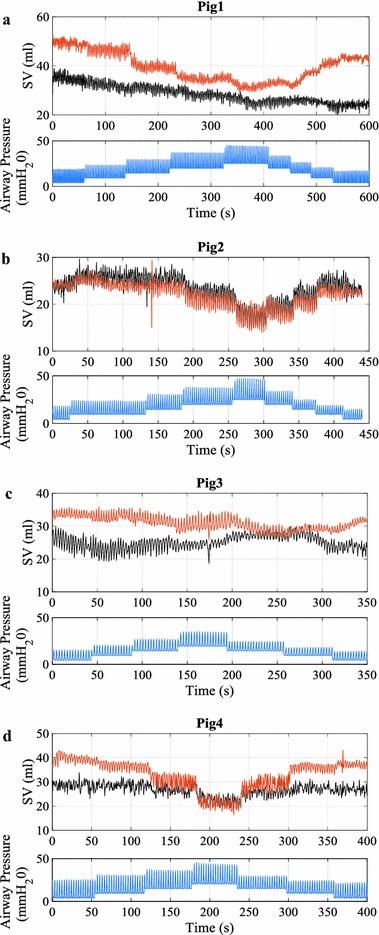
This paper presents a novel pressure contour method utilizing pulse wave velocity (PWV) measurement to capture vascular properties. A three-element Windkessel model combined with the reservoir-wave concept are used to decompose the pressure contour into components related to storage and flow. The model parameters are identified beat-to-beat from the water-hammer equation using measured PWV, wave component of the pressure, and an estimate of subject-specific aortic dimension. SV is then calculated by converting pressure to flow using identified model parameters. The accuracy of this novel method is investigated using data from porcine experiments (N = 4 Pietrain pigs, 20-24.5 kg), where hemodynamic properties were significantly altered using dobutamine, fluid administration, and mechanical ventilation. In the experiment, left ventricular volume was measured using admittance catheter, and aortic pressure waveforms were measured at two locations, the aortic arch and abdominal aorta.

RESULTS

Bland-Altman analysis comparing gold-standard SV measured by the admittance catheter and estimated SV from the novel method showed average limits of agreement of ±26% across significant hemodynamic alterations. This result shows the method is capable of estimating clinically acceptable absolute SV values according to Critchely and Critchely.

CONCLUSION

The novel pressure contour method presented can accurately estimate and track SV even when hemodynamic properties are significantly altered. Integrating PWV measurements into pressure contour analysis improves identification of beat-to-beat changes in Windkessel model parameters, and thus, provides accurate estimate of blood flow from measured pressure contour. The method has great potential for overcoming weaknesses associated with current pressure contour methods for estimating SV.

摘要

背景

压力轮廓分析常用于评估重症监护病房中心血管功能障碍患者的心脏功能。然而,现有的通过压力测量连续估算每搏输出量(SV)的技术在血流动力学不稳定时可能不可靠,而对于需要大量治疗的患者来说,血流动力学不稳定是不可避免的。因此,必须改进压力轮廓方法以捕捉血管特性的变化,从而实现从压力到流量的准确转换。

方法

本文提出了一种利用脉搏波速度(PWV)测量来捕捉血管特性的新型压力轮廓方法。采用结合了储器 - 波概念的三元风箱模型将压力轮廓分解为与储存和流量相关的分量。使用测量的PWV、压力的波分量以及特定个体主动脉尺寸的估计值,从水击方程逐搏识别模型参数。然后使用识别出的模型参数将压力转换为流量来计算SV。使用来自猪实验的数据(N = 4头皮特兰猪,体重20 - 24.5千克)研究了这种新方法的准确性,在实验中通过多巴酚丁胺、液体输注和机械通气显著改变血流动力学特性。在实验中,使用导纳导管测量左心室容积,并在主动脉弓和腹主动脉两个位置测量主动脉压力波形。

结果

通过布兰德 - 奥特曼分析比较导纳导管测量的金标准SV和新方法估算的SV,结果显示在显著的血流动力学改变范围内,平均一致性界限为±26%。根据克里奇利和克里奇利的标准,该结果表明该方法能够估算出临床上可接受的绝对SV值。

结论

所提出的新型压力轮廓方法即使在血流动力学特性显著改变时也能准确估算和跟踪SV。将PWV测量整合到压力轮廓分析中可改善风箱模型参数逐搏变化的识别,从而根据测量的压力轮廓准确估算血流量。该方法在克服当前用于估算SV的压力轮廓方法的弱点方面具有巨大潜力。

https://cdn.ncbi.nlm.nih.gov/pmc/blobs/d41c/5404318/3914222288b7/12938_2017_341_Fig1_HTML.jpg

相似文献

2
Incorporating pulse wave velocity into model-based pulse contour analysis method for estimation of cardiac stroke volume.
Comput Methods Programs Biomed. 2020 Oct;195:105553. doi: 10.1016/j.cmpb.2020.105553. Epub 2020 May 26.
5
Echocardiographic Assessment of Aortic Pulse-Wave Velocity: Validation against Invasive Pressure Measurements.
J Am Soc Echocardiogr. 2016 Nov;29(11):1109-1116. doi: 10.1016/j.echo.2016.07.013. Epub 2016 Sep 7.
6
Cardiac output and stroke volume estimation using a hybrid of three Windkessel models.
Annu Int Conf IEEE Eng Med Biol Soc. 2010;2010:4971-4. doi: 10.1109/IEMBS.2010.5627225.
7
Tube-load model: A clinically applicable pulse contour analysis method for estimation of cardiac stroke volume.
Comput Methods Programs Biomed. 2021 Jun;204:106062. doi: 10.1016/j.cmpb.2021.106062. Epub 2021 Mar 26.
8
Beat-to-beat noninvasive stroke volume from arterial pressure and Doppler ultrasound.
Eur J Appl Physiol. 2003 Sep;90(1-2):131-7. doi: 10.1007/s00421-003-0901-8. Epub 2003 Jul 8.
9
Quantification of wave reflection using peripheral blood pressure waveforms.
IEEE J Biomed Health Inform. 2015 Jan;19(1):309-16. doi: 10.1109/JBHI.2014.2307273.
10
Pulse wave velocity and digital volume pulse as indirect estimators of blood pressure: pilot study on healthy volunteers.
Cardiovasc Eng. 2009 Sep;9(3):104-12. doi: 10.1007/s10558-009-9080-5. Epub 2009 Aug 6.

引用本文的文献

1
An algorithm to detect dicrotic notch in arterial blood pressure and photoplethysmography waveforms using the iterative envelope mean method.
Comput Methods Programs Biomed. 2024 Sep;254:108283. doi: 10.1016/j.cmpb.2024.108283. Epub 2024 Jun 10.
2
A structural approach to 3D-printing arterial phantoms with physiologically comparable mechanical characteristics: Preliminary observations.
Proc Inst Mech Eng H. 2022 Sep;236(9):1388-1402. doi: 10.1177/09544119221114207. Epub 2022 Aug 1.
3
Non-Invasive Wearable Patch Utilizing Seismocardiography for Peri-Operative Use in Surgical Patients.
IEEE J Biomed Health Inform. 2021 May;25(5):1572-1582. doi: 10.1109/JBHI.2020.3032938. Epub 2021 May 11.
4
Estimating central blood pressure from aortic flow: development and assessment of algorithms.
Am J Physiol Heart Circ Physiol. 2021 Feb 1;320(2):H494-H510. doi: 10.1152/ajpheart.00241.2020. Epub 2020 Oct 16.
6
Blood pressure waveform contour analysis for assessing peripheral resistance changes in sepsis.
Biomed Eng Online. 2018 Nov 20;17(1):171. doi: 10.1186/s12938-018-0603-4.

本文引用的文献

1
Structural identifiability analysis of a cardiovascular system model.
Med Eng Phys. 2016 May;38(5):433-41. doi: 10.1016/j.medengphy.2016.02.005. Epub 2016 Mar 9.
2
Consensus on circulatory shock and hemodynamic monitoring. Task force of the European Society of Intensive Care Medicine.
Intensive Care Med. 2014 Dec;40(12):1795-815. doi: 10.1007/s00134-014-3525-z. Epub 2014 Nov 13.
5
The case for the reservoir-wave approach.
Int J Cardiol. 2014 Mar 15;172(2):299-306. doi: 10.1016/j.ijcard.2013.12.178. Epub 2014 Jan 8.
6
Left ventricular ejection time, not heart rate, is an independent correlate of aortic pulse wave velocity.
J Appl Physiol (1985). 2013 Dec;115(11):1610-7. doi: 10.1152/japplphysiol.00475.2013. Epub 2013 Sep 19.
8
9
Noninvasive cardiac output monitors: a state-of the-art review.
J Cardiothorac Vasc Anesth. 2013 Feb;27(1):121-34. doi: 10.1053/j.jvca.2012.03.022. Epub 2012 May 19.
10
Arterial reservoir-excess pressure and ventricular work.
Med Biol Eng Comput. 2012 Apr;50(4):419-24. doi: 10.1007/s11517-012-0872-1. Epub 2012 Feb 26.

文献AI研究员

20分钟写一篇综述,助力文献阅读效率提升50倍。

立即体验

用中文搜PubMed

大模型驱动的PubMed中文搜索引擎

马上搜索

文档翻译

学术文献翻译模型,支持多种主流文档格式。

立即体验