Department of Surgery, University of Virginia Health System, Charlottesville, VA, USA.
Department of Anesthesiology, University of Virginia Health System, Charlottesville, VA, USA.
Support Care Cancer. 2017 Oct;25(10):3103-3112. doi: 10.1007/s00520-017-3718-4. Epub 2017 Apr 24.
Few studies have assessed patient-reported outcomes following colorectal surgery. The absence of this information makes it difficult to inform patients about the near-term effects of surgery, beyond outcomes assessed by traditional clinical measures. This study was designed to provide information about the effects of colorectal surgery on physical, mental, and social well-being outcomes.
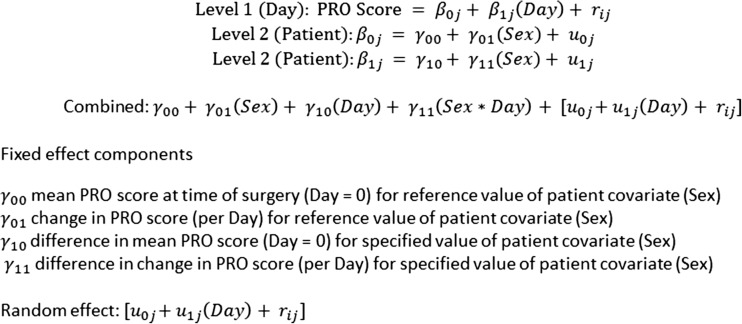
The NIH Patient-Reported Outcomes Measurement Information System (PROMIS®) Assessment Center was used to collect patient responses prior to surgery and at their routine postoperative visit. Four domains were selected based on patient consultation and clinical experience: depression, pain interference, ability to participate in social roles and activities, and interest in sexual activity. Multilevel random coefficient models were used to assess the change in scores during the follow-up period and to assess the statistical significance of differences in trends over time associated with key clinical measures.
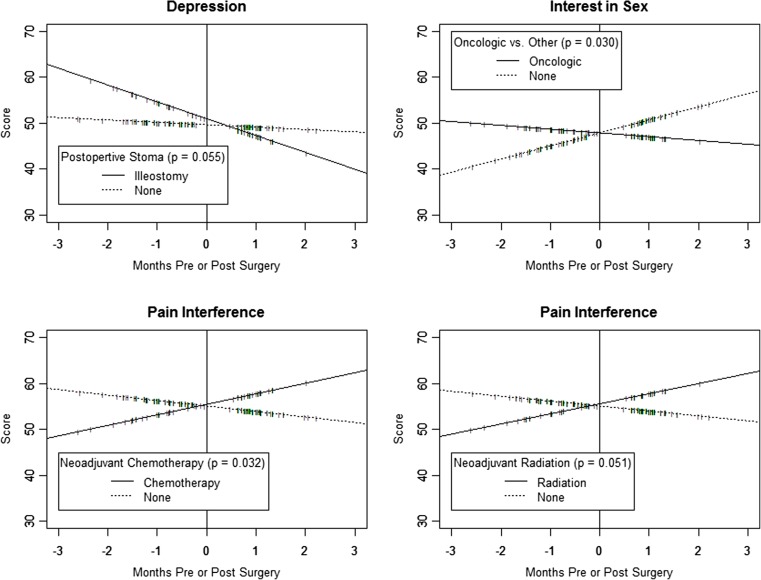
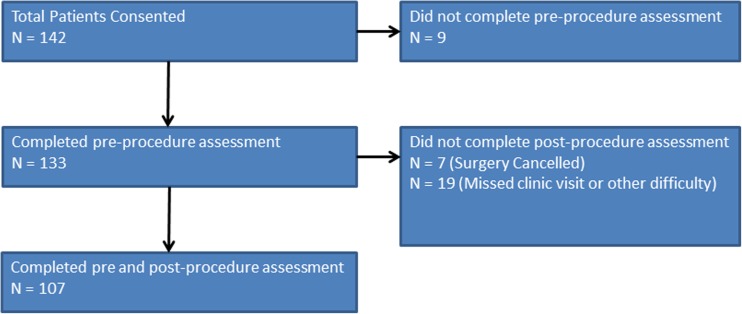
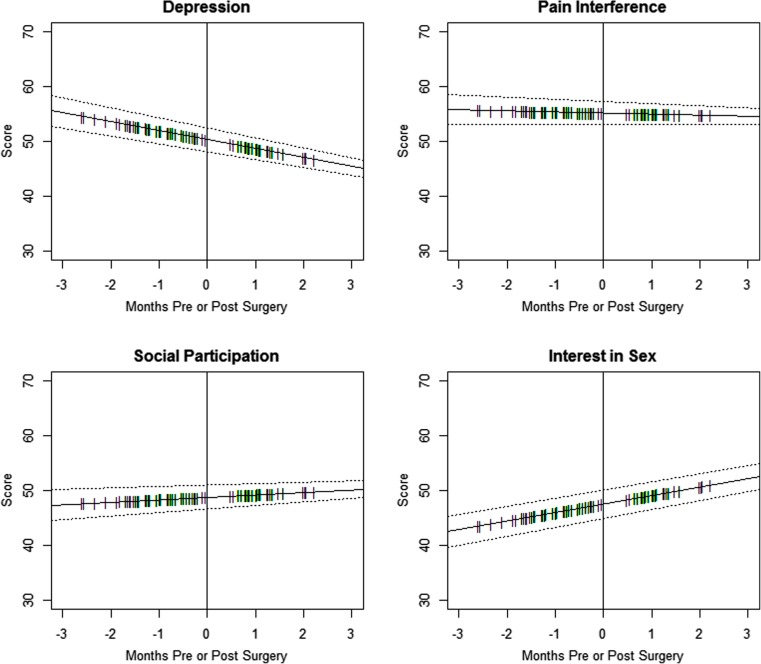
In total, 142 patients were consented, with 107 patients completing pre- and postoperative assessments (75%). Preoperative assessments were typically completed 1 month prior to surgery (mean 29.5 days before, SD = 19.7) and postoperative assessments 1 month after surgery (mean 30.7 days after, SD = 9.2), with a mean of 60.3 days between assessment dates. Patients demonstrated no statistically significant changes in scores for pain interference (-0.18 points, p = 0.80) or the ability to participate in social roles and activities (0.44 points, p = 0.55), but had significant decreases in depression scores between pre- and postoperative assessments (-1.6 points, p = 0.03) and near significant increases in scores for interest in sex (1.5 points, p = 0.06). Pain interference scores for patients with neoadjuvant chemotherapy significantly increased (3.5 points, p = 0.03). Scores for the interest in sex domain decreased (worsened) for patients with oncologic etiology (-3.7 points, p = 0.03). No other differences in score trends by patient characteristics were large enough to be statistically significant at the p < 0.05 threshold.
These data suggest that the majority of patients quickly return to baseline physical, mental, and social function following colorectal surgery. This information can be used preoperatively to counsel patients about the typical impact of colorectal surgery on quality of life.
鲜有研究评估结直肠手术后患者报告的结局。缺乏此类信息会导致难以向患者告知手术的近期影响,而传统临床评估措施无法涵盖这些影响。本研究旨在提供有关结直肠手术对生理、心理和社会健康结局影响的信息。
利用 NIH 患者报告结局测量信息系统(PROMIS®)评估中心,在术前和术后常规就诊时收集患者的应答。根据患者咨询和临床经验,选择了四个领域:抑郁、疼痛干扰、参与社会角色和活动的能力以及对性活动的兴趣。采用多层次随机系数模型评估随访期间评分的变化,并评估与关键临床评估相关的时间趋势差异的统计学显著性。
共征得 142 名患者的同意,其中 107 名患者完成了术前和术后评估(75%)。术前评估通常在手术前 1 个月进行(平均 29.5 天前,SD=19.7),术后评估在手术后 1 个月进行(平均 30.7 天,SD=9.2),两次评估之间的平均间隔为 60.3 天。患者在疼痛干扰(-0.18 分,p=0.80)或参与社会角色和活动的能力(0.44 分,p=0.55)方面的评分无统计学意义上的变化,但在术前和术后评估之间,抑郁评分显著下降(-1.6 分,p=0.03),对性的兴趣评分有显著增加(1.5 分,p=0.06)。接受新辅助化疗的患者疼痛干扰评分显著升高(3.5 分,p=0.03)。有肿瘤病因的患者对性的兴趣评分降低(恶化)(-3.7 分,p=0.03)。其他患者特征的评分趋势差异没有大到足以达到 p<0.05 的统计学显著性水平。
这些数据表明,大多数患者在结直肠手术后很快恢复到基线的生理、心理和社会功能。这些信息可在术前用于向患者提供关于结直肠手术对生活质量的典型影响的咨询。