Department of Global Health Policy, Graduate School of Medicine, The University of Tokyo, Tokyo, Japan.
Global Health Nursing, Graduate School of Nursing Science, St. Luke's International University, Tokyo, Japan.
Sci Rep. 2017 Apr 25;7:46681. doi: 10.1038/srep46681.
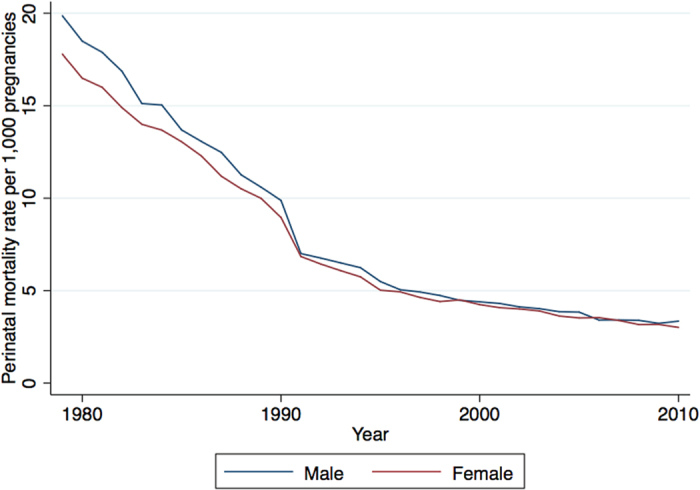
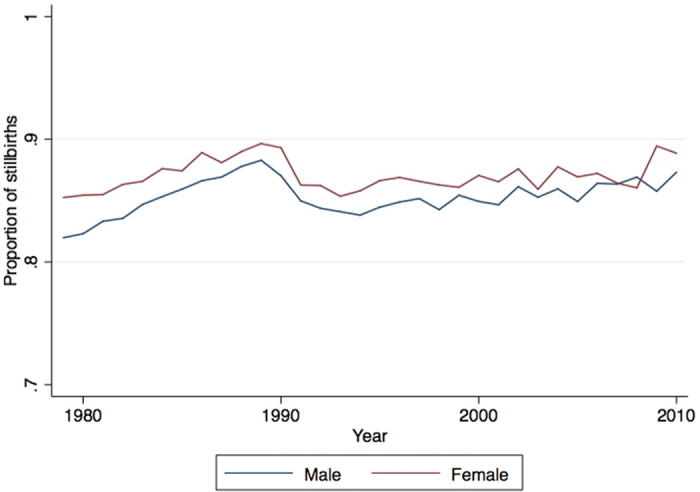
As Japan has achieved one of the lowest perinatal mortality rates (PMR), our study aims to estimate trends in and risk factors for perinatal mortality among singleton births in Japan. We used Japanese vital registration data to assess trends in and risk factors for perinatal outcomes between 1979 and 2010. Birth and death registration data were merged. An autoregressive integrated moving average model was fitted separately by sex to the PMR and the proportion of stillbirths. A multilevel Poisson regression model was used to estimate risk factors for perinatal mortality. Between 1979 and 2010 there were 40,833,957 pregnancies and 355,193 perinatal deaths, the PMR decreased from 18.86 per 1,000 all births to 3.25 per 1,000 all births, and the proportion of stillbirths increased from 83.6% to 92.1%. Key risk factors for perinatal mortality were low or high birth weight, prematurity and post maturity, and being from poorer or unemployed families. A higher proportion of excess perinatal deaths could be averted by effective policies to prevent stillbirths and improved research into their interventions and risk factors. As the cost and challenge of maintaining perinatal mortality gains increases, policies need to be targeted towards higher risk groups and social determinants of health.
由于日本已经实现了最低的围产儿死亡率(PMR)之一,我们的研究旨在评估日本单胎出生围产儿死亡率的趋势和危险因素。我们使用日本生命登记数据评估了 1979 年至 2010 年间围产儿结局的趋势和危险因素。出生和死亡登记数据进行了合并。使用自回归积分移动平均模型分别按性别对 PMR 和死产比例进行拟合。使用多水平泊松回归模型来估计围产儿死亡的危险因素。在 1979 年至 2010 年期间,有 40833957 例妊娠和 355193 例围产儿死亡,PMR 从每 1000 例活产 18.86 例降至每 1000 例活产 3.25 例,死产比例从 83.6%升至 92.1%。围产儿死亡的主要危险因素是低出生体重或高出生体重、早产和过期产,以及来自贫困或失业家庭。通过有效的预防死产政策和对其干预措施和危险因素的研究,可以避免更多的围产儿死亡。随着维持围产儿死亡率收益的成本和挑战的增加,政策需要针对高风险群体和健康的社会决定因素。