Long Doug E, Peck Bailey D, Martz Jenny L, Tuggle S Craig, Bush Heather M, McGwin Gerald, Kern Philip A, Bamman Marcas M, Peterson Charlotte A
College of Health Sciences and Center for Muscle Biology, University of Kentucky, Lexington, KY, USA.
Center for Exercise Medicine and Department of Cell, Developmental, and Integrative Biology, University of Alabama at Birmingham, Birmingham, AL, USA.
Trials. 2017 Apr 26;18(1):192. doi: 10.1186/s13063-017-1932-5.
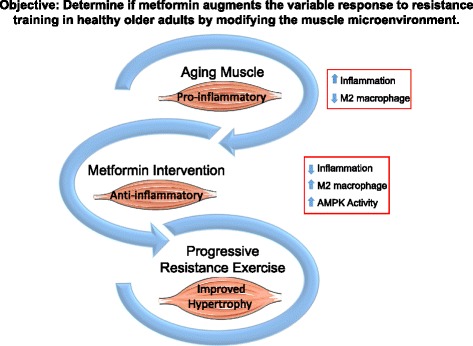
Muscle mass and strength are strong determinants of a person's quality of life and functional independence with advancing age. While resistance training is the most effective intervention to combat age-associated muscle atrophy (sarcopenia), the ability of older adults to increase muscle mass and strength in response to training is blunted and highly variable. Thus, finding novel ways to complement resistance training to improve muscle response and ultimately quality of life among older individuals is critical. The purpose of this study is to determine whether a commonly prescribed medication called metformin can be repurposed to improve the response to resistance exercise training by altering the muscle tissue inflammatory environment.
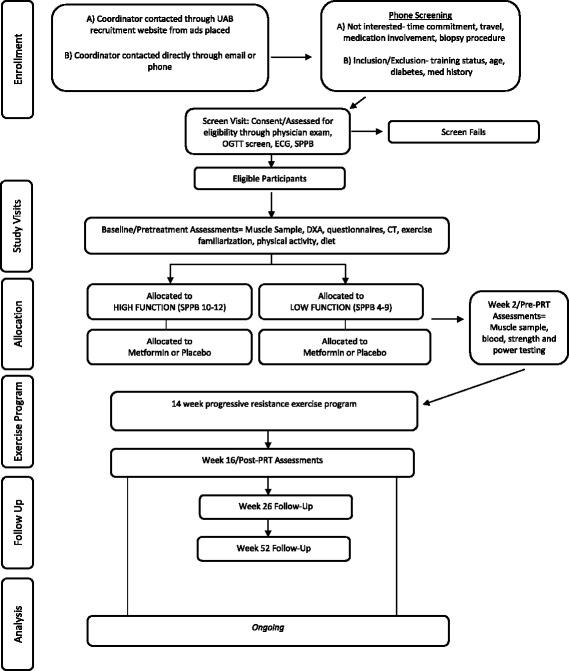
METHODS/DESIGN: Individuals aged 65 and older are participating in a two-site, randomized, double-blind, placebo-controlled trial testing the effects of metformin or placebo on muscle size, strength, and physical function when combined with a progressive resistance training program. Participants consume 1700 mg of metformin per day or placebo for 2 weeks before engaging in a 14-week progressive resistance training regimen, with continued metformin or placebo. Participants are then monitored post-training to determine if the group taking metformin derived greater overall benefit from training in terms of muscle mass and strength gains than those on placebo. Muscle biopsies are taken from the vastus lateralis at three time points to assess individual cellular and molecular adaptations to resistance training and also changes in response to metformin.
The response of aged muscles to a resistance training program does not always result in a positive outcome; some individuals even experience a loss in muscle mass following resistance training. Thus, adjuvant therapies, including pharmacological ones, are required to optimize response to training in those who do not respond and may be at increased risk of frailty. This is the first known metformin repurposing trial in non-diseased individuals, aimed specifically at the resistance exercise "non-responder" phenotype present in the aging population. The overall goal of this trial is to determine if combined exercise-metformin intervention therapy will benefit older individuals by promoting muscle hypertrophy and strength gains, thereby maintaining functional independence.
ClinicalTrials.gov, NCT02308228 . Registered on 25 November 2014.
随着年龄的增长,肌肉质量和力量是决定一个人生活质量和功能独立性的重要因素。虽然抗阻训练是对抗与年龄相关的肌肉萎缩(肌肉减少症)最有效的干预措施,但老年人对训练做出反应以增加肌肉质量和力量的能力减弱且差异很大。因此,找到新的方法来补充抗阻训练,以改善老年人的肌肉反应并最终提高生活质量至关重要。本研究的目的是确定一种常用药物二甲双胍是否可以通过改变肌肉组织炎症环境来重新用于改善对抗阻运动训练的反应。
方法/设计:65岁及以上的个体正在参与一项双中心、随机、双盲、安慰剂对照试验,该试验测试二甲双胍或安慰剂与渐进性抗阻训练计划联合使用时对肌肉大小、力量和身体功能的影响。参与者在进行为期14周的渐进性抗阻训练方案之前,每天服用1700毫克二甲双胍或安慰剂,持续2周,并继续服用二甲双胍或安慰剂。训练后对参与者进行监测,以确定服用二甲双胍的组在肌肉质量和力量增加方面是否比服用安慰剂的组从训练中获得更大的总体益处。在三个时间点从股外侧肌取肌肉活检样本,以评估个体对抗阻训练的细胞和分子适应性以及对二甲双胍反应的变化。
老年肌肉对抗阻训练计划的反应并不总是产生积极结果;一些人在抗阻训练后甚至出现肌肉质量下降。因此,需要辅助治疗,包括药物治疗,以优化对训练无反应且可能面临更高衰弱风险的人的训练反应。这是首次在非患病个体中进行的已知二甲双胍重新利用试验,专门针对老年人群中存在的抗阻运动“无反应者”表型。该试验的总体目标是确定联合运动-二甲双胍干预疗法是否会通过促进肌肉肥大和力量增加,从而维持功能独立性,使老年人受益。
ClinicalTrials.gov,NCT02308228。于2014年11月2日注册。