Gao Ke, Lai Yutian, Huang Jian, Wang Yifan, Wang Xiaowei, Che Guowei
Department of Thoracic and Cardiovascular Surgery, the Second People's Hospital of Chengdu, Chengdu 610017, China;Department of Thoracic and Cardiovascular Surgery, West China Hospital of Sichuan University, Chengdu 610041, China.
Department of Thoracic and Cardiovascular Surgery, West China Hospital of Sichuan University, Chengdu 610041, China.
Zhongguo Fei Ai Za Zhi. 2017 Apr 20;20(4):239-247. doi: 10.3779/j.issn.1009-3419.2017.04.03.
Surgical procedure is the main method of treating lung cancer. Meanwhile, postoperative pneumonia (POP) is the major cause of perioperative mortality in lung cancer surgery. The preoperative pathogenic airway bacterial colonization is an independent risk factor causing postoperative pulmonary complications (PPC). This cross-sectional study aimed to explore the relationship between preoperative pathogenic airway bacterial colonization and POP in lung cancer and to identify the high-risk factors of preoperative pathogenic airway bacterial colonization.
A total of 125 patients with non-small cell lung cancer (NSCLC) underwent thoracic surgery in six hospitals of Chengdu between May 2015 and January 2016. Preoperative pathogenic airway bacterial colonization was detected in all patients via fiber bronchoscopy. Patients' PPC, high-risk factors, clinical characteristics, and the serum surfactant protein D (SP-D) level were also analyzed.
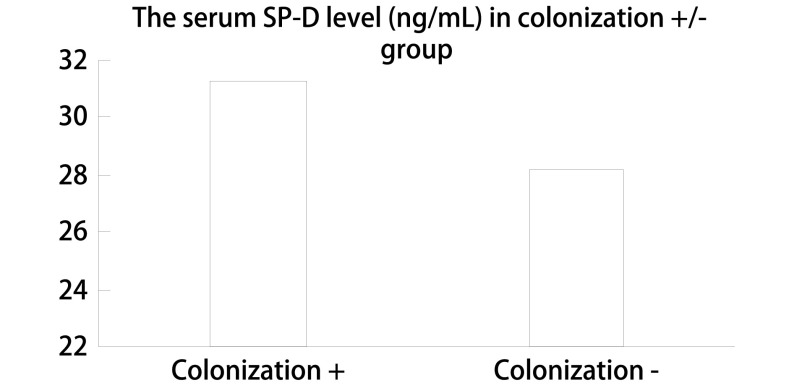
The incidence of preoperative pathogenic airway bacterial colonization among NSCLC patients was 15.2% (19/125). Up to 22 strains were identified in the colonization positive group, with Gram-negative bacteria being dominant (86.36%, 19/22). High-risk factors of pathogenic airway bacterial colonization were age (≥75 yr) and smoking index (≥400 cigarettes/year). PPC incidence was significantly higher in the colonization-positive group (42.11%, 8/19) than that in the colonization-negative group (16.04%, 17/106)(P=0.021). POP incidence was significantly higher in the colonization-positive group (26.32%, 5/19) than that in the colonization-negative group (6.60%, 7/106)(P=0.019). The serum SP-D level of patients in the colonization-positive group was remarkably higher than that in the colonization-negative group (31.25±6.09) vs (28.17±5.23). The incidence of preoperative pathogenic airway bacterial colonization among NSCLC patients with POP was 41.67% (5/12). This value was 3.4 times higher than that among the patients without POP (OR=3.363, 95%CI: 1.467-7.711).
An intimate correlation was observed between POP and pathogenic airway bacterial colonization in lung cancer. The high-risk factors of pathogenic airway bacterial colonization were age and smoking index.
手术是治疗肺癌的主要方法。同时,术后肺炎(POP)是肺癌手术围手术期死亡的主要原因。术前气道致病性细菌定植是导致术后肺部并发症(PPC)的独立危险因素。本横断面研究旨在探讨肺癌患者术前气道致病性细菌定植与POP之间的关系,并确定术前气道致病性细菌定植的高危因素。
2015年5月至2016年1月期间,共有125例非小细胞肺癌(NSCLC)患者在成都的6家医院接受了胸外科手术。通过纤维支气管镜检查对所有患者进行术前气道致病性细菌定植检测。还分析了患者的PPC、高危因素、临床特征以及血清表面活性蛋白D(SP-D)水平。
NSCLC患者术前气道致病性细菌定植的发生率为15.2%(19/125)。定植阳性组共鉴定出22株菌株,以革兰氏阴性菌为主(86.36%,19/22)。气道致病性细菌定植的高危因素为年龄(≥75岁)和吸烟指数(≥400支/年)。定植阳性组的PPC发生率(42.11%,8/19)显著高于定植阴性组(16.04%,17/106)(P = 0.021)。定植阳性组的POP发生率(26.32%,5/19)显著高于定植阴性组(6.60%,7/106)(P = 0.019)。定植阳性组患者的血清SP-D水平显著高于定植阴性组[(31.25±6.09)对(28.17±5.23)](P = 0.023)。发生POP的NSCLC患者术前气道致病性细菌定植的发生率为41.67%(5/12)。该值比未发生POP的患者高3.4倍(OR = 3.363,95%CI:1.467 - 7.711)。
观察到肺癌中POP与气道致病性细菌定植之间存在密切相关性。气道致病性细菌定植的高危因素为年龄和吸烟指数。