Liang Xiaohui, Sun Baocun, Han Jiyuan, Zhao Xiulan, Liu Zenghui
Department of Pathology, Tianjin Medical University, Tianjin 300070, China.
Zhongguo Fei Ai Za Zhi. 2017 Apr 20;20(4):259-263. doi: 10.3779/j.issn.1009-3419.2017.04.06.
Progesterone and adiponectin receptor family member 3 (PAQR3) is a recently discovered tumor suppressor gene, which affects the development of a tumor by inhibiting cell proliferation, cell malignant transformation, angiogenesis, and tumor metastasis. This study investigates the expression of PAQR3 in lung cancer and its clinical significance.
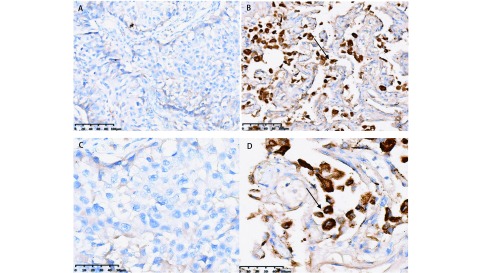
A total of 106 patients with lung cancer received surgical treatment in hospital, and adjacent normal tissues of these patients were utilized as control group. The diagnosis of all patients was confirmed through clinical pathology. The expression of PAQR3 protein was detected by immunohistochemistry in lung cancer and adjacent normal tissues. The clinical significance of its expression was also investigated.
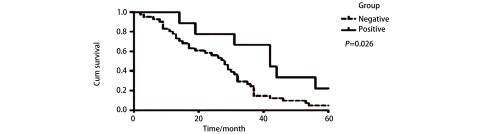
The positive expression rate of PAQR3 protein in lung cancer was lower than that in adjacent normal tissues (P<0.01). The positive expression rate of PAQR3 protein was unrelated to age, tumor size, and gender, but it exhibited a significant relationship with the pathological type and differentiation, TNM staging, and lymph node metastasis (P<0.05). Kaplan-Meier survival analysis showed that the five-year survival rate of patients with PAQR3 protein positive expression was higher than that in patients with negative expression (P=0.026).
The expression of PAQR3 protein significantly decreased in lung cancer, indicating that PAQR3 protein plays an important role in the pathogenesis of PAQR3 in lung cancer.
孕酮和脂联素受体家族成员3(PAQR3)是最近发现的一种肿瘤抑制基因,它通过抑制细胞增殖、细胞恶性转化、血管生成和肿瘤转移来影响肿瘤的发展。本研究旨在探讨PAQR3在肺癌中的表达及其临床意义。
共有106例肺癌患者在我院接受手术治疗,将这些患者的癌旁正常组织作为对照组。所有患者均经临床病理确诊。采用免疫组织化学法检测肺癌组织及癌旁正常组织中PAQR3蛋白的表达,并探讨其表达的临床意义。
肺癌组织中PAQR3蛋白的阳性表达率低于癌旁正常组织(P<0.01)。PAQR3蛋白的阳性表达率与年龄、肿瘤大小和性别无关,但与病理类型、分化程度、TNM分期及淋巴结转移有显著相关性(P<0.05)。Kaplan-Meier生存分析显示,PAQR3蛋白阳性表达患者的五年生存率高于阴性表达患者(P=0.026)。
肺癌组织中PAQR3蛋白表达明显降低,提示PAQR3蛋白在肺癌发病机制中起重要作用。