Hay Jennifer L, Berwick Marianne, Zielaskowski Kate, White Kirsten Am, Rodríguez Vivian M, Robers Erika, Guest Dolores D, Sussman Andrew, Talamantes Yvonne, Schwartz Matthew R, Greb Jennie, Bigney Jessica, Kaphingst Kimberly A, Hunley Keith, Buller David B
Memorial Sloan Kettering Cancer Center, Department of Psychiatry & Behavioral Sciences, New York, NY, United States.
University of New Mexico, Albuquerque, NM, United States.
JMIR Res Protoc. 2017 Apr 25;6(4):e52. doi: 10.2196/resprot.7158.
Limited translational genomic research currently exists to guide the availability, comprehension, and appropriate use of personalized genomics in diverse general population subgroups. Melanoma skin cancers are preventable, curable, common in the general population, and disproportionately increasing in Hispanics.
Variants in the melanocortin-1 receptor (MC1R) gene are present in approximately 50% of the population, are major factors in determining sun sensitivity, and confer a 2-to-3-fold increase in melanoma risk in the general population, even in populations with darker skin. Therefore, feedback regarding MC1R risk status may raise risk awareness and protective behavior in the general population.
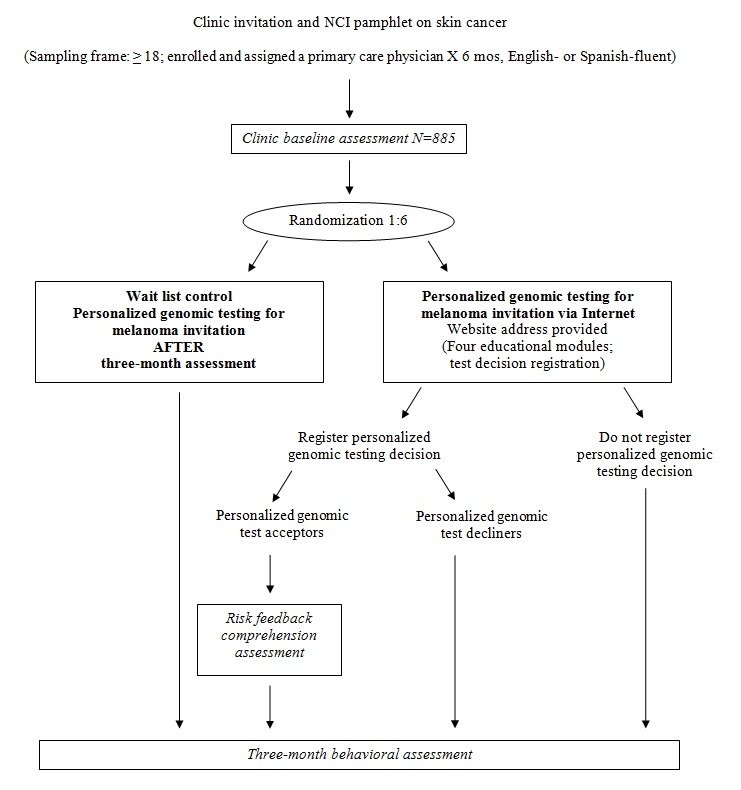
We are conducting a randomized controlled trial examining Internet presentation of the risks and benefits of personalized genomic testing for MC1R gene variants that are associated with increased melanoma risk. We will enroll a total of 885 participants (462 participants are currently enrolled), who will be randomized 6:1 to personalized genomic testing for melanoma risk versus waiting list control. Control participants will be offered testing after outcome assessments. Participants will be balanced across self-reported Hispanic versus non-Hispanic ethnicity (n=750 in personalized genomic testing for melanoma risk arm; n=135 in control arm), and will be recruited from a general population cohort in Albuquerque, New Mexico, which is subject to year-round sun exposure. Baseline surveys will be completed in-person with study staff and follow-up measures will be completed via telephone.
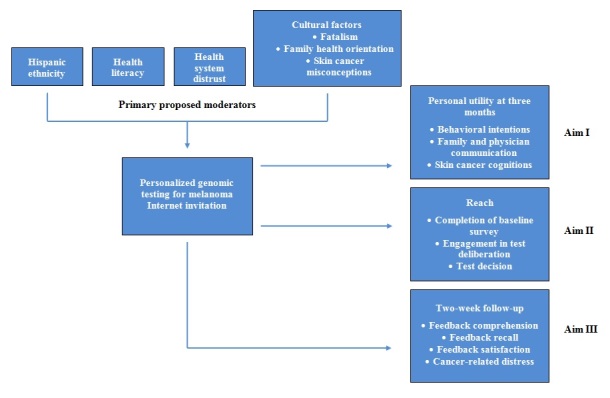
Aim 1 of the trial will examine the personal utility of personalized genomic testing for melanoma risk in terms of short-term (3-month) sun protection and skin screening behaviors, family and physician communication, and melanoma threat and control beliefs (ie, putative mediators of behavior change). We will also examine potential unintended consequences of testing among those who receive average-risk personalized genomic testing for melanoma risk findings, and examine predictors of sun protection at 3 months as the outcome. These findings will be used to develop messages for groups that receive average-risk feedback. Aim 2 will compare rates of test consideration in Hispanics versus non-Hispanics, including consideration of testing pros and cons and registration of a decision to either accept or decline testing. Aim 3 will examine personalized genomic testing for melanoma risk feedback comprehension, recall, satisfaction, and cancer-related distress in those who undergo testing, and whether these outcomes differ by ethnicity (Hispanic vs non-Hispanic), or sociocultural or demographic factors. Final outcome data collection is anticipated to be complete by October 2017, at which point data analysis will commence.
This study has important implications for personalized genomics in the context of melanoma risk, and may be broadly applicable as a model for delivery of personalized genomic feedback for other health conditions.
目前,用于指导个性化基因组学在不同普通人群亚组中的可及性、理解和合理使用的转化基因组学研究有限。皮肤黑色素瘤是可预防、可治愈的,在普通人群中很常见,且在西班牙裔人群中的发病率呈不成比例的上升趋势。
黑皮质素-1受体(MC1R)基因变异存在于约50%的人群中,是决定对阳光敏感性的主要因素,即使在皮肤较深的人群中,也会使普通人群患黑色素瘤的风险增加2至3倍。因此,关于MC1R风险状态的反馈可能会提高普通人群的风险意识和保护行为。
我们正在进行一项随机对照试验,研究在互联网上展示与黑色素瘤风险增加相关的MC1R基因变异的个性化基因组检测的风险和益处。我们总共将招募885名参与者(目前已招募462名),他们将以6:1的比例随机分为接受黑色素瘤风险个性化基因组检测组和等待名单对照组。对照组参与者将在结果评估后接受检测。参与者将在自我报告的西班牙裔与非西班牙裔种族之间保持平衡(黑色素瘤风险个性化基因组检测组n = 750;对照组n = 135),并将从新墨西哥州阿尔伯克基的一个普通人群队列中招募,该队列全年暴露于阳光下。基线调查将由研究人员亲自完成,后续措施将通过电话完成。
该试验的目标1将从短期(3个月)的防晒和皮肤筛查行为、与家人和医生的沟通以及黑色素瘤威胁和控制信念(即行为改变的假定中介因素)方面,研究黑色素瘤风险个性化基因组检测的个人效用。我们还将研究那些接受黑色素瘤风险平均水平个性化基因组检测结果的人群中检测的潜在意外后果,并将3个月时的防晒预测因素作为结果进行研究。这些结果将用于为收到平均风险反馈的人群制定信息。目标2将比较西班牙裔与非西班牙裔人群中检测考虑率,包括对检测利弊的考虑以及做出接受或拒绝检测决定的登记情况。目标3将研究接受检测的人群对黑色素瘤风险反馈的理解、回忆、满意度和癌症相关困扰,以及这些结果是否因种族(西班牙裔与非西班牙裔)、社会文化或人口统计学因素而有所不同。预计最终结果数据收集将于2017年10月完成,届时将开始数据分析。
本研究对黑色素瘤风险背景下的个性化基因组学具有重要意义,并且可能广泛适用于作为为其他健康状况提供个性化基因组反馈的模型。