Department of Physics, Bilkent University, Ankara 06800, Turkey.
Department of Electrical and Electronics Engineering, Bilkent University, Ankara 06800, Turkey.
Nat Commun. 2017 Apr 26;8:14942. doi: 10.1038/ncomms14942.
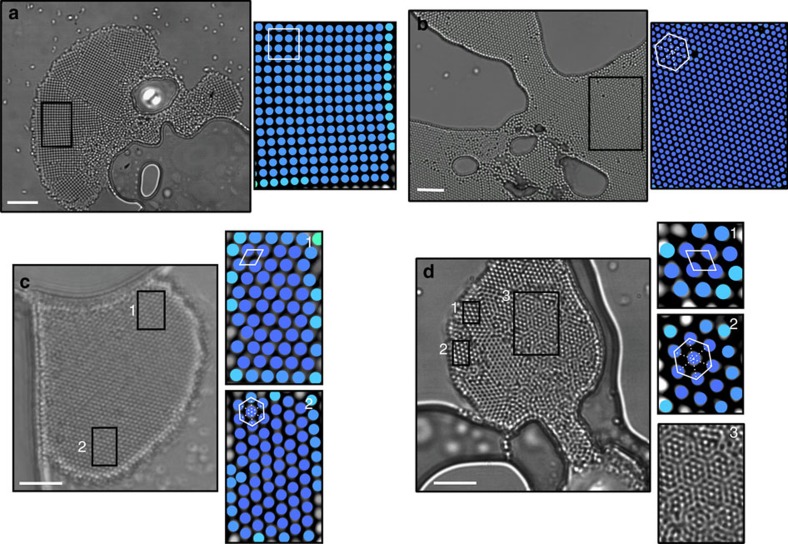
A profoundly fundamental question at the interface between physics and biology remains open: what are the minimum requirements for emergence of complex behaviour from nonliving systems? Here, we address this question and report complex behaviour of tens to thousands of colloidal nanoparticles in a system designed to be as plain as possible: the system is driven far from equilibrium by ultrafast laser pulses that create spatiotemporal temperature gradients, inducing Marangoni flow that drags particles towards aggregation; strong Brownian motion, used as source of fluctuations, opposes aggregation. Nonlinear feedback mechanisms naturally arise between flow, aggregate and Brownian motion, allowing fast external control with minimal intervention. Consequently, complex behaviour, analogous to those seen in living organisms, emerges, whereby aggregates can self-sustain, self-regulate, self-replicate, self-heal and can be transferred from one location to another, all within seconds. Aggregates can comprise only one pattern or bifurcated patterns can coexist, compete, endure or perish.
从非生命系统中涌现出复杂行为需要哪些最低要求?在这里,我们解决了这个问题,并报告了胶体纳米粒子在一个尽可能简单的系统中的复杂行为:该系统通过超快激光脉冲驱动远离平衡,这些激光脉冲会产生时空温度梯度,引发 Marangoni 流,将粒子拖向聚集;强布朗运动被用作波动源,与聚集相反。在流动、聚集和布朗运动之间自然会出现非线性反馈机制,从而允许快速的外部控制,而干预最小。因此,类似于在生物体中看到的复杂行为出现了,其中聚集体可以自我维持、自我调节、自我复制、自我修复,并可以在几秒钟内从一个位置转移到另一个位置。聚集体可以只包含一种模式,也可以共存分叉模式,竞争、持续或消亡。