Schwertner Alessandro, Almeida Renato Rodrigues de, Gonini Alcides, Almeida Marcio Rodrigues de
Department of Orthodontics, Universidad Católica Nuestra Señora de la Asunción, Hernandarias, Paraguay.
Department of Orthodontics, Bauru Dental School, Universidade de São Paulo, Bauru, SP, Brazil.
Dental Press J Orthod. 2017 Feb;22(1):57-64. doi: 10.1590/2177-6709.22.1.057-064.oar.
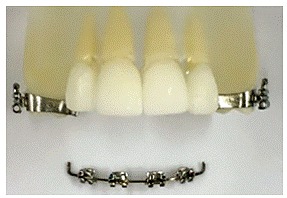
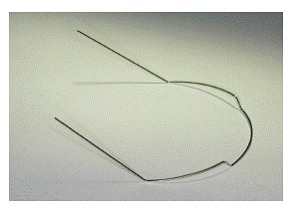
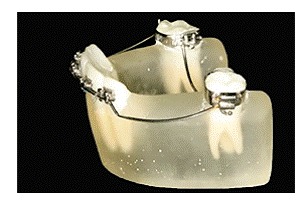
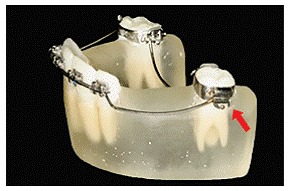
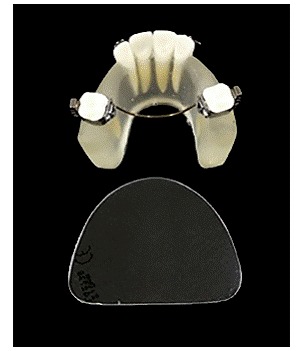
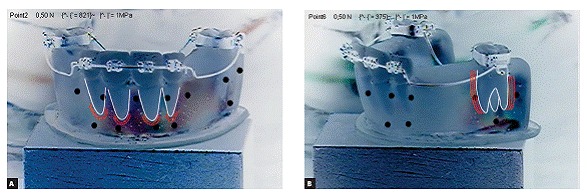
The present in vitro study evaluated, by means of the photoelastic technique, the effects generated by the Connecticut Intrusion Arch (CIA), with a 90o bend on the distal surface of molar tubes and using the 4 x 2 appliance on the anterior and posterior regions of the upper dental arch.
Five models were manufactured, in which two different clinical situations were correlated: 1) use of intrusion arch not cinched back and transpalatal bar for anchorage (Group 1); 2) use of intrusion arch cinched back and transpalatal bar for anchorage (Group 2). Stress generated in the apical and middle regions of tooth roots of maxillary anterior teeth and maxillary first molars was evaluated.
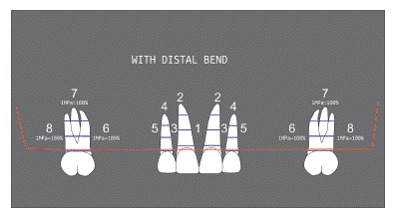
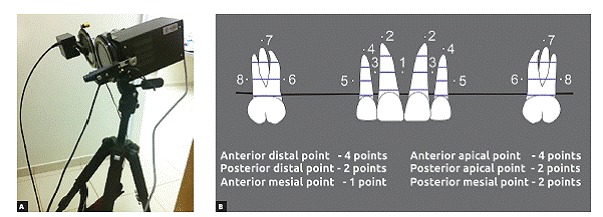
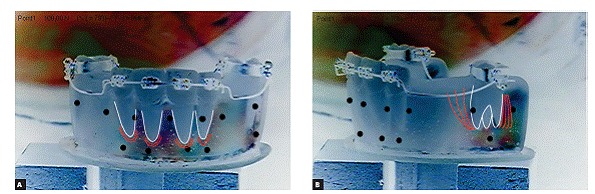
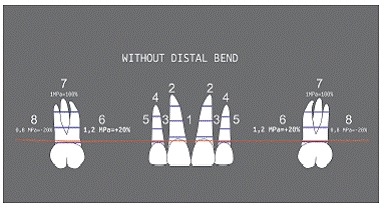
Taking a reference value of 1.0 MPa = 100%, qualitative descriptive analysis was performed, which showed uniformity between stress values in the apical region of anterior teeth of both groups (G1 and G2). In the posterior region, for models with the arch cinched back (G2), stress remained within 100%. As for G1 models (with the arch not cinched back), variations in the mesial surface of first molars were observed, with an increase of 20% in the generated stress. The apical region did not undergo any changes, while in the distal region of molars there was a decrease of 20% in stress.
Laboratory results revealed differences in stress between Groups 1 and 2 in the molar region, thereby indicating that there was a tendency towards mesial root tipping of first molars when the distal end of the CIA was not cinched back.
本体外研究通过光弹性技术评估了康涅狄格侵入弓(CIA)在磨牙管远中面呈90°弯曲并在上颌牙弓前后区域使用4×2矫治器时所产生的效果。
制作了五个模型,其中关联了两种不同的临床情况:1)使用未收紧的侵入弓和横腭杆作为支抗(第1组);2)使用收紧的侵入弓和横腭杆作为支抗(第2组)。评估上颌前牙和上颌第一磨牙根尖及牙根中部区域产生的应力。
以1.0 MPa = 100%作为参考值进行定性描述分析,结果显示两组(G1和G2)前牙根尖区域的应力值具有一致性。在后部区域,对于弓被收紧的模型(G2),应力保持在100%以内。至于G1模型(弓未收紧),观察到第一磨牙近中面有变化,产生的应力增加了20%。根尖区域未发生任何变化,而磨牙远中区域的应力降低了20%。
实验室结果显示第1组和第2组在磨牙区域的应力存在差异,从而表明当CIA远端未收紧时,第一磨牙有近中根倾斜的趋势。