Baroncini Liz Andréa Villela, Sylvestre Lucimary de Castro, Baroncini Camila Varotto, Pecoits Roberto
Pontifícia Universidade Católica do Paraná (PUCPR), Curitiba, PR - Brazil.
Universidade Federal do Paraná (UFPR), Curitiba, PR - Brazil.
Arq Bras Cardiol. 2017 May;108(5):452-457. doi: 10.5935/abc.20170043. Epub 2017 Apr 20.
The increased carotid intima-media thickness (CIMT) correlates with the presence of atherosclerosis in adults and describes vascular abnormalities in both hypertensive children and adolescents.
To assess CIMT as an early marker of atherosclerosis and vascular damage in hypertensive children and adolescents compared with non-hypertensive controls and to evaluate the influence of gender, age, and body mass index (BMI) on CIMT on each group.
Observational cohort study. A total of 133 hypertensive subjects (male, n = 69; mean age, 10.5 ± 4 years) underwent carotid ultrasound exam for assessment of CIMT. One hundred and twenty-one non-hypertensive subjects (male, n = 64; mean age, 9.8 ± 4.1 years) were selected as controls for gender, age (± 1 year), and BMI (± 10%).
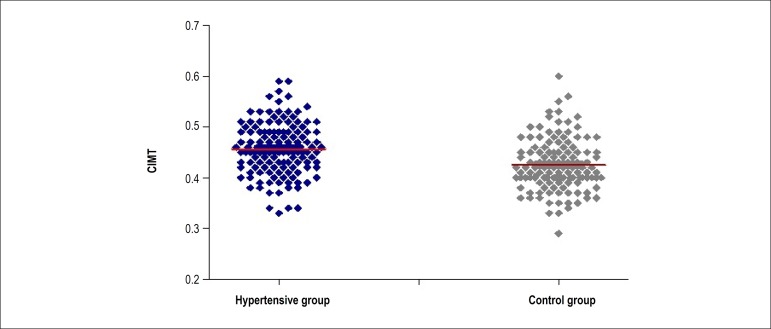
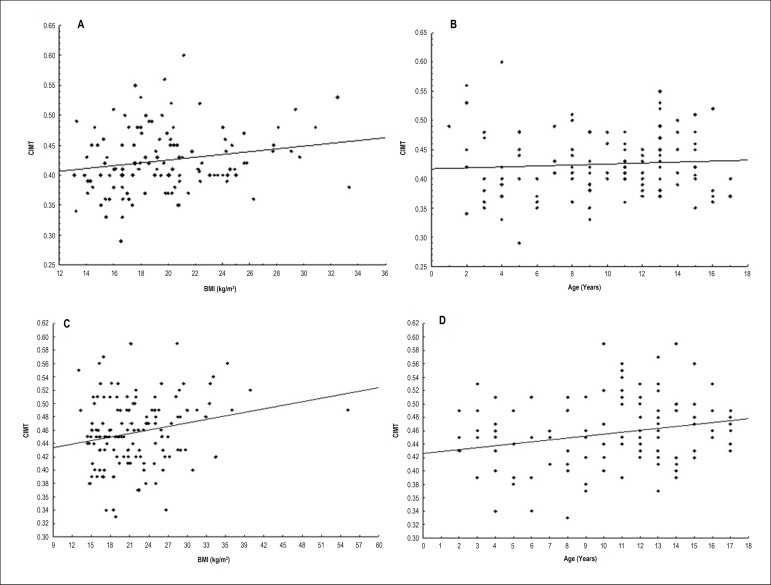
There were no significant difference regarding gender (p = 0.954) and age (p = 0.067) between groups. Hypertensive subjects had higher BMI when compared to control group (p = 0.004), although within the established range of 10%. Subjects in the hypertensive group had higher CIMT values when compared to control group (0.46 ± 0.05 versus 0.42 ± 0.05 mm, respectively, p < 0.001; one-way ANOVA). Carotid IMT values were not significantly influenced by gender, age, and BMI when analyzed in both groups separately (Student's t-test for independent samples). According to the adjusted determination coefficient (R²) only 11.7% of CIMT variations were accounted for by group variations, including age, gender, and BMI.
Carotid intima-media thickness was higher in hypertensive children and adolescents when compared to the control group. The presence of hypertension increased CIMT regardless of age, gender, and BMI.
成人颈动脉内膜中层厚度(CIMT)增加与动脉粥样硬化的存在相关,并且可描述高血压儿童和青少年的血管异常情况。
与非高血压对照组相比,评估CIMT作为高血压儿童和青少年动脉粥样硬化及血管损伤的早期标志物,并评估性别、年龄和体重指数(BMI)对每组CIMT的影响。
观察性队列研究。共有133名高血压受试者(男性69名,平均年龄10.5±4岁)接受颈动脉超声检查以评估CIMT。选取121名非高血压受试者(男性64名,平均年龄9.8±4.1岁)作为性别、年龄(±1岁)和BMI(±10%)的对照组。
两组之间在性别(p=0.954)和年龄(p=0.067)方面无显著差异。尽管在设定的10%范围内,但高血压受试者的BMI高于对照组(p=0.004)。与对照组相比,高血压组受试者的CIMT值更高(分别为0.46±0.05与0.42±0.05mm,p<0.001;单因素方差分析)。两组分别分析时,颈动脉IMT值不受性别、年龄和BMI的显著影响(独立样本t检验)。根据调整后的决定系数(R²),组间差异(包括年龄、性别和BMI)仅占CIMT变化的11.7%。
与对照组相比,高血压儿童和青少年的颈动脉内膜中层厚度更高。无论年龄、性别和BMI如何,高血压的存在都会增加CIMT。